Food spoils more slowly in the refrigerator because lower temperatures slow down many chemical reactions and the activity of microorganisms.
Does that mean living organisms also age more slowly when they live in the cold?
Experimental animals such as the nematode Caenorhabditis elegans do, in fact, live longer at moderately lower temperatures. But the reason is not quite that simple.
Let’s take a closer look together.

AI-assisted image
AI disclosure information
A study published in Nature on October 21, 2026 found that muscle responding to cold sends metabolites to other tissues, and that this process affects protein maintenance and lifespan.
But if cold switches on the body’s protective functions, could we make use of those functions on their own?
To find out, the researchers increased the expression of a particular gene in muscle without placing the animals in a cold environment. The nematodes’ lifespan increased in this setting as well.
Cells detect cold and respond
Living cells are not objects sitting passively in storage like food in a refrigerator. When they detect a change in temperature, they alter gene expression and activate functions that help them adapt to their environment.
In 2023, the same research group reported that low temperatures increase a particular activity of the proteasome, the machinery that processes damaged or unnecessary proteins. In cultured human cells, lowering the temperature from 37°C to 36°C also reduced disease-related proteins. The 2023 study
In other words, cells change their own maintenance capabilities in response to cold. This time, the researchers broadened the question: could a response that starts in one tissue be passed on to other tissues?
The researchers raised nematodes to adulthood at 20°C, then observed separate groups at 15°C, 20°C, and 25°C. One particularly notable change at the lower temperature was increased production of BH2, or dihydrobiopterin, in muscle.
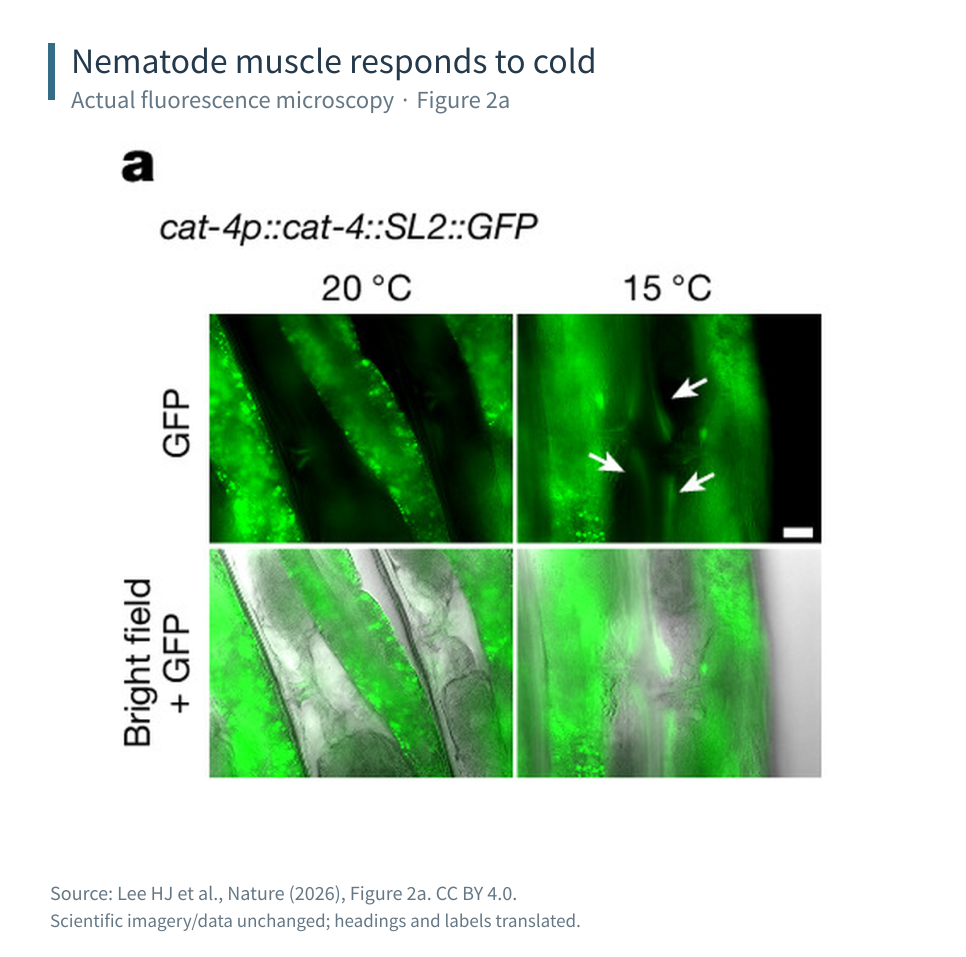
These are actual microscopy images of nematodes observed at 20°C and 15°C. The arrows indicate muscle regions where CAT-4 expression increased at the lower temperature. Green fluorescence marks CAT-4 expression; it is not an image of BH2 itself. Original scale bar: 20 µm.
Source: Lee HJ et al., Nature, 2026, Figure 2a. Edited by Reverse Entropy: panel excerpt, proportional enlargement, and added Korean title. Original image source. License: CC BY 4.0.
Translated text from the original illustration
- Nematode muscle responding to cold
- Actual fluorescence microscopy image · Figure 2a
- Panel a: cat-4p::cat-4::SL2::GFP
- Columns: 20°C and 15°C
- Upper row: GFP. Lower row: Bright field + GFP.
Headings and labels localized for this edition. Original scientific images, plotted data, numerical values, and statistical comparisons are unchanged.
Other tissues receive and use the material made by muscle
More important than the name BH2 is the role this substance plays as it moves through the body.
BH2 produced in muscle is delivered to other tissues, such as the intestine and neurons. In the receiving tissue, an enzyme called DHFR converts it to BH4. BH4 is a cofactor that helps certain enzymes do their work.
The reaction that converts the amino acid phenylalanine to tyrosine is very important for protein synthesis. By supporting this reaction, BH4 improved the ability to maintain proteins in the right condition and extended lifespan as well.
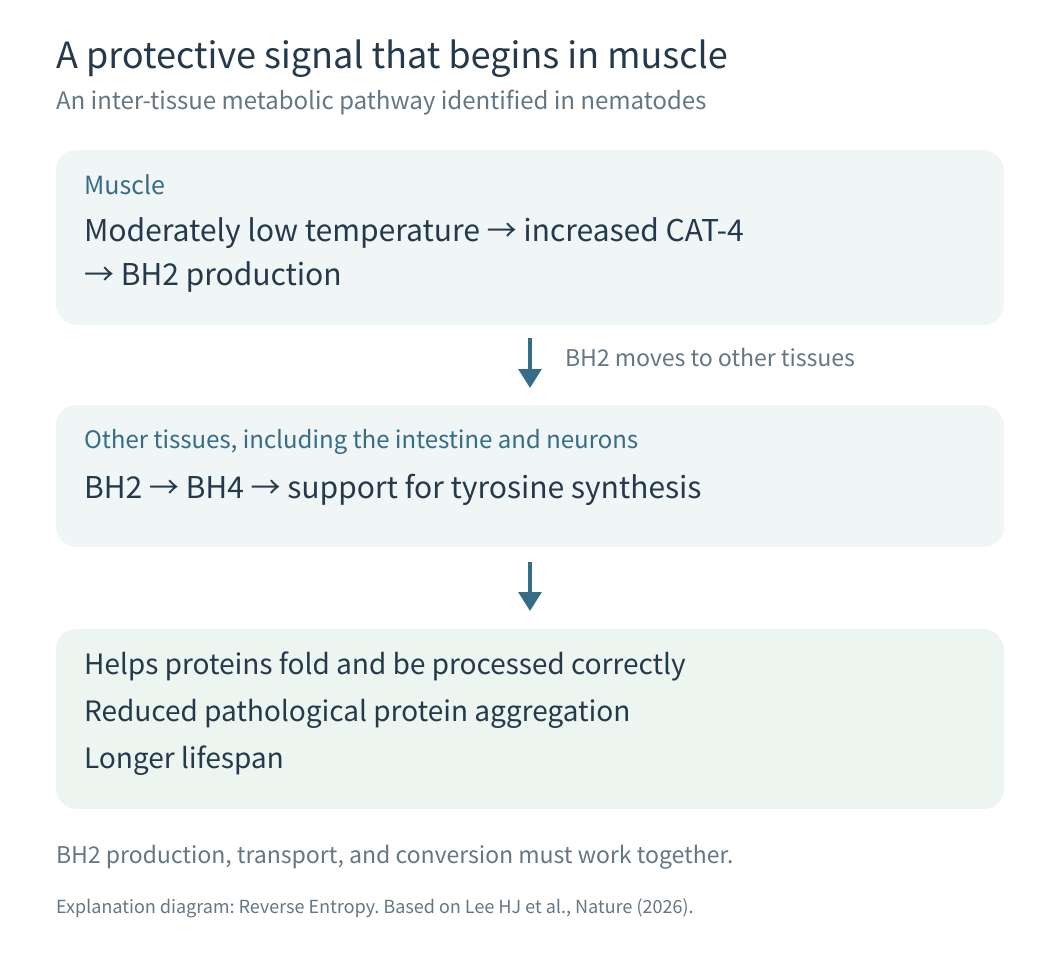
BH2 made in muscle travels to other tissues, where it is converted to BH4 and becomes linked to tyrosine synthesis and protein quality control. This explanatory diagram simplifies the nematode experiments; it is not a pathway proven to extend human lifespan.
Source: Explanatory diagram by Reverse Entropy, based on Lee HJ et al., Nature, 2026. Source for the illustration. Original explanatory diagram.
Translated text from the original illustration
- A protective signal that begins in muscle
- An inter-tissue metabolic pathway identified in nematodes
- Muscle: moderately low temperature → increased CAT-4 → BH2 production
- BH2 moves to other tissues
- Other tissues, including the intestine and neurons: BH2 → BH4 → support for tyrosine synthesis
- Helps proteins fold and be processed correctly
- Reduced pathological protein aggregation · Longer lifespan
- BH2 production, transport, and conversion must work together.
Explanatory diagram recreated with English labels.
The effect remained even without the cold
The researchers also investigated whether lifespan could be extended independently of temperature.
Suppressing CAT-4 in muscle reduced the lifespan extension normally seen at low temperatures.
Conversely, increasing CAT-4 expression in muscle extended lifespan not only at 15°C but also at 20°C and 25°C.
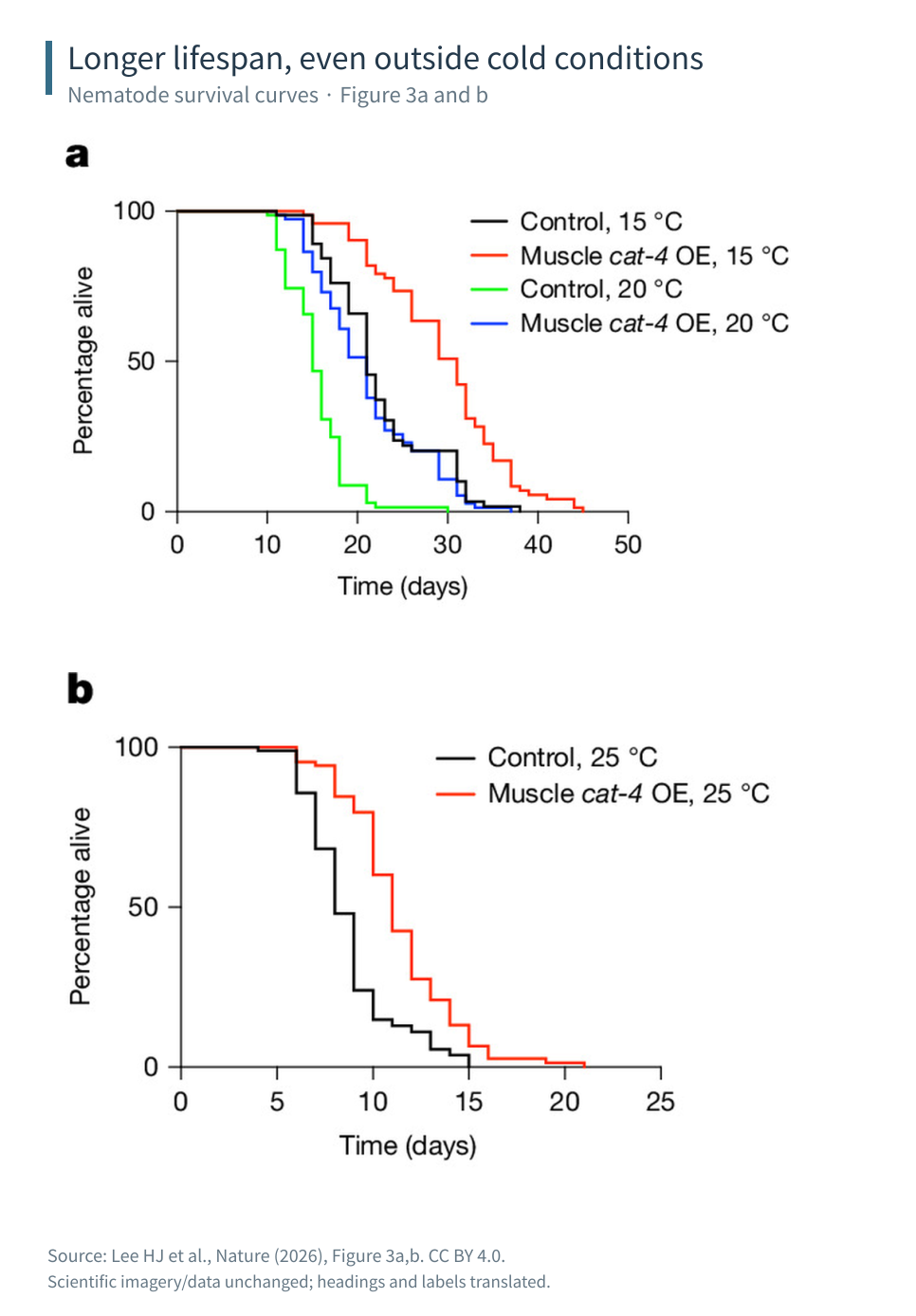
The survival curves of nematodes with increased muscle CAT-4 expression (OE) shifted to the right compared with controls at the same temperature. The upper panels show the 15°C and 20°C experiments, and the lower panel shows the 25°C experiment. The vertical axis is the proportion of worms still alive; the horizontal axis is elapsed days. There were 96 worms per condition. These are representative results from at least two independent experiments.
Source: Lee HJ et al., Nature, 2026, Figure 3a and b. Edited by Reverse Entropy: two panels excerpted, rearranged vertically, enlarged proportionally, and given an added Korean title. Original image source. License: CC BY 4.0.
Translated text from the original illustration
- Lifespan increased even outside a cold environment
- Nematode survival curves · Figure 3a and b
- Vertical axes: Percentage alive, marked at 0, 50, and 100%. Horizontal axes: Time (days).
- Panel a horizontal scale: 0–50 days in 10-day intervals. Black: control, 15°C. Red: muscle cat-4 OE, 15°C. Green: control, 20°C. Blue: muscle cat-4 OE, 20°C.
- Panel b horizontal scale: 0–25 days in 5-day intervals. Black: control, 25°C. Red: muscle cat-4 OE, 25°C.
Headings and labels localized for this edition. Original scientific images, plotted data, numerical values, and statistical comparisons are unchanged.
Next, the researchers examined which substance mattered most.
Increasing CAT-4 expression in muscle: lifespan extension at 15°C, 20°C, and 25°C.
Providing BH2 from an external source: a modest extension at 15°C, but no extension at 20°C.
Supplementing tyrosine: lifespan extension at 15°C and 20°C.
BH2 supplementation was relatively less effective.
The researchers suggested that poor absorption of externally supplied BH2 by the worms might be one explanation.
Even after identifying a beneficial pathway, the results differed depending on which substance was supplied to it.
Where the substance is made, where it is delivered, and whether it is used properly at its destination all matter. Figures 3 and 4 and Extended Data Figure 7
Changes in muscle also led to changes in the intestine
Proteins are building materials for muscle, but they also carry out many other functions as enzymes, receptors, and cellular structures. To work properly, they must fold into the right shape. If damaged or misfolded proteins accumulate and clump together, they can interfere with cell function.
In this experiment, increasing CAT-4 expression in muscle reduced pathological protein aggregation in other tissues as well. Protein aggregates and bacterial colonies also decreased in the intestines of older worms.
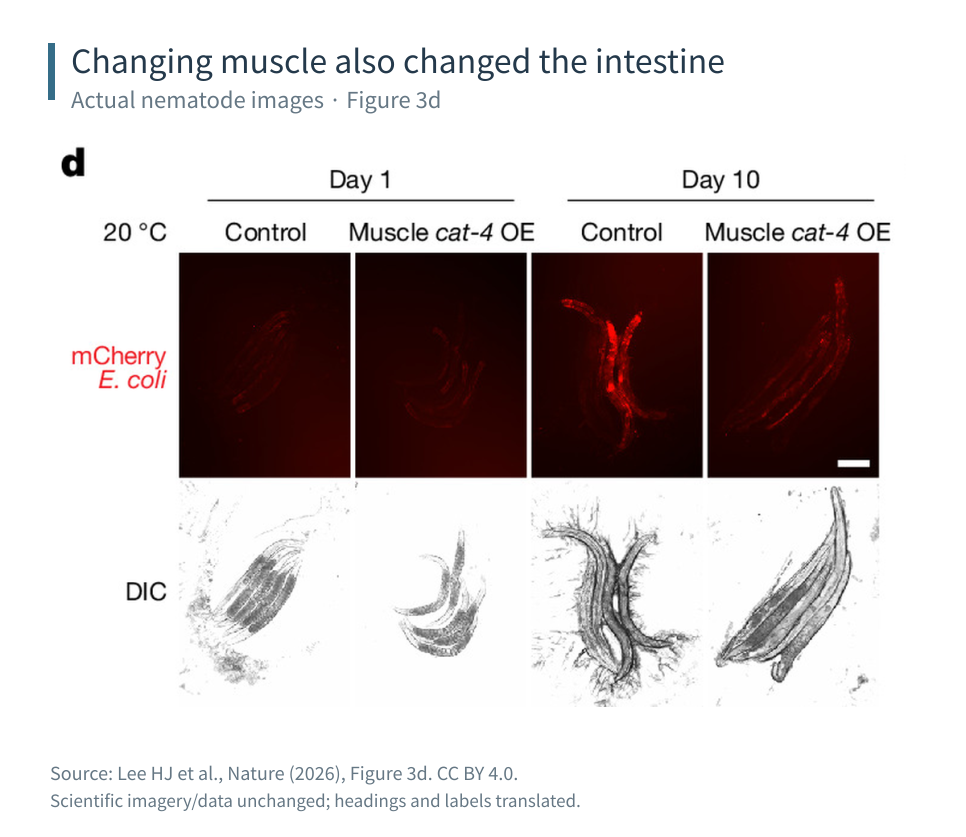
These images show the intestines of worms observed at 20°C. The red signal in the upper panels is fluorescently labeled E. coli; the lower panels show worms under the same conditions. On adult day 10 (Day 10), bacterial colonies were reduced in the group with increased muscle CAT-4 expression compared with controls. The red signal does not indicate protein aggregates. Original scale bar: 200 µm.
Source: Lee HJ et al., Nature, 2026, Figure 3d. Edited by Reverse Entropy: panel excerpt, proportional enlargement, and added Korean title. Original image source. License: CC BY 4.0.
Translated text from the original illustration
- Changing muscle also produced changes in the intestine
- Actual nematode images · Figure 3d
- Panel d, 20°C. Day 1 and Day 10: control and muscle cat-4 OE at each time point.
- Upper row: mCherry E. coli. Lower row: DIC (differential interference contrast).
Headings and labels localized for this edition. Original scientific images, plotted data, numerical values, and statistical comparisons are unchanged.
Follow-up experiments were also conducted in human cells. Treating cultured cells expressing abnormal proteins associated with Huntington’s disease or amyotrophic lateral sclerosis (ALS) with BH2 or tyrosine reduced protein aggregation. Cell death also decreased in motor neurons differentiated from stem cells carrying an ALS-related mutation.
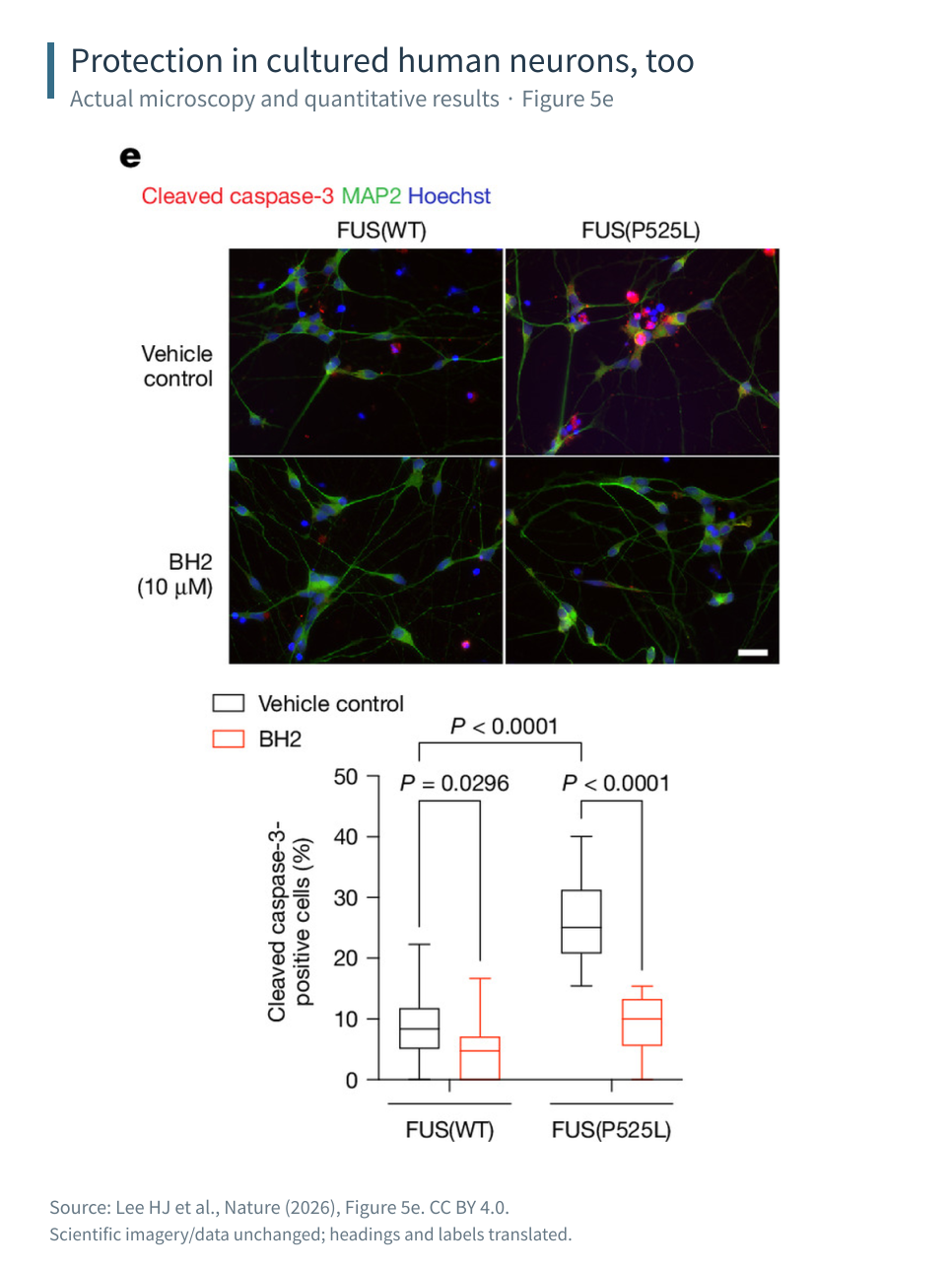
These are motor neurons differentiated from human induced pluripotent stem cells. In cells carrying an ALS-related FUS mutation, a cell-death marker decreased after BH2 treatment. Green marks neurons, blue marks cell nuclei, and red marks cell death. The red dots must not be interpreted as protein aggregates. Original scale bar: 20 µm. The graph below shows the proportion of cells positive for the cell-death marker.
Source: Lee HJ et al., Nature, 2026, Figure 5e. Edited by Reverse Entropy: panel excerpt, proportional enlargement, and added Korean title. Original image source. License: CC BY 4.0.
Translated text from the original illustration
- Protective effects in cultured human neurons, too
- Actual fluorescence microscopy images and quantitative results · Figure 5e
- Panel e: cleaved caspase-3 (red), MAP2 (green), Hoechst (blue). Columns: FUS(WT) and FUS(P525L). Rows: vehicle control and BH2 (10 µM).
- Graph: vehicle control (black) versus BH2 (red). Vertical axis: cleaved caspase-3-positive cells (%), 0–50% in 10-percentage-point intervals. Horizontal groups: FUS(WT) and FUS(P525L).
- Reported comparisons: P = 0.0296 within FUS(WT); P < 0.0001 within FUS(P525L); and P < 0.0001 for the bracket spanning the two vehicle-control groups.
Headings and labels localized for this edition. Original scientific images, plotted data, numerical values, and statistical comparisons are unchanged.
The fact that the findings went beyond longer lifespan in worms to protective effects in human cells makes the next stage of research promising. However, the evidence so far extends only to cultured cells. Effects on disease progression in patients or on human lifespan have not yet been tested.
Could exposure to cold benefit people, too?
Cold exposure has also been studied in humans. These studies examined metabolic changes, such as blood glucose regulation, rather than lifespan.
In a 2015 study, eight people with type 2 diabetes adapted to an environment of 14–15°C for 10 days, after which peripheral insulin sensitivity improved by about 43%. This means their bodies became better at handling blood glucose in response to insulin. The 2015 study
In 2021, however, nine people with diabetes were exposed to 16–17°C while avoiding pronounced shivering, and no improvement in insulin sensitivity was found.
By contrast, a 2024 study exposed 15 adults with overweight or obesity to cold that induced one hour of shivering per day for 10 days. Glucose tolerance and some metabolic measures improved afterward. The 2021 study · The 2024 study
All of these were small, short-term studies. Temperature, duration of exposure, muscle responses, and participants’ health differed, so shivering alone cannot explain the differences in results. Nor did these studies test lifespan extension in humans or the BH2 pathway described here.
We also need to consider an important difference between humans and nematodes. When people become cold, they produce more heat to maintain their body temperature, by shivering or activating other mechanisms of heat production. That is why entering cold water is difficult to describe as a way of ‘slowing metabolism to slow aging.’
Using the protective functions without enduring the cold
Then could we simply take BH2 or tyrosine?
I do not think these findings alone give us a reason to take them for anti-aging purposes. Results in worms cannot be converted into a human dose, and we also need to consider how well BH2 can be converted to BH4 in the tissue it reaches.
For example, in human blood vessels, BH4 is also used by the enzyme that produces nitric oxide, which relaxes blood vessels. If oxidative stress or impaired conversion disrupts the balance between BH4 and BH2, the enzyme may begin producing reactive oxygen species instead of nitric oxide. This is called eNOS uncoupling.
That does not mean BH2 itself is always harmful. In the cultured cells in this study, BH2 treatment did not increase the reactive oxygen species that were measured. But conversion capacity and conditions differ between cells, so both effectiveness and safety must be established before using it in people. Human-cell experiments and discussion in the paper
For health care today, I would prioritize regular resistance training and aerobic exercise. Human evidence has accumulated that these help prevent and manage a range of conditions, including cardiovascular disease and diabetes. WHO information on physical activity
There is no reason to suddenly start ice baths in the hope of living longer. Sudden cold-water exposure can trigger a cold-shock response that rapidly increases breathing, heart rate, and blood pressure. This can be particularly demanding if you have cardiovascular disease. American Heart Association explanation
What makes this discovery interesting is that it broadens the approaches we may be able to choose in the future. We might adjust muscle’s production capacity, deliver a substance to the tissues that need it, or make use of actions further downstream.
Once we understand what cold changes, we may not have to endure the cold itself to obtain those effects.
After all, don’t we all dislike being cold? Ha ha.
Five or six years ago, before the safe and effective appetite-suppressing injections available today had been developed, I tested a weight-loss treatment called cryotherapy, which involved stepping into a cold chamber. The effects were reasonably good, but people disliked the intense cold so much that I ultimately decided not to introduce it.
This is the kind of approach that interests me more in anti-aging medicine: identifying the functions a supposedly beneficial stimulus switches on, and obtaining the effects we need precisely, rather than simply making the stimulus stronger.
References
1. Lee HJ, Doğan C, Koyuncu S, et al. Cold activates a BH2 metabolic network promoting longevity and proteostasis. Nature. October 21, 2026. DOI: 10.1038/s41586-026-11152-9
2. Lee HJ, et al. Cold temperature extends longevity and prevents disease-related protein aggregation through PA28γ-induced proteasomes. Nature Aging. 2023;3:546–566. Original paper
3. Hanssen MJW, et al. Short-term cold acclimation improves insulin sensitivity in patients with type 2 diabetes mellitus. Nature Medicine. 2015;21:863–865. Original paper
4. Remie CME, et al. Metabolic responses to mild cold acclimation in type 2 diabetes patients. Nature Communications. 2021. Original paper
5. Sellers AJ, et al. Cold acclimation with shivering improves metabolic health in adults with overweight or obesity. Nature Metabolism. 2024;6:2246–2253. Original paper
6. WHO. Physical activity. Official information
7. American Heart Association. You’re not a polar bear: The plunge into cold water comes with risks. 2022. Official information
#AntiAging #Longevity #AgingResearch #ColdAndHealth #ColdWaterImmersion #BH2 #MuscleHealth #Proteostasis #Nature #MedicalScience #ReverseEntropy #청담흰