When we fall ill and get a diagnosis, it is easy to feel that a disease came out of nowhere. We felt fine until recently, after all.
But when researchers retrieved blood samples from people who later developed leukemia, they found mutant cells already competing for space. The signs were present in blood drawn up to 15 years before diagnosis.
This study traces the road to cancer. Genetic testing revealed not just which cells appeared, but how quickly they multiplied.
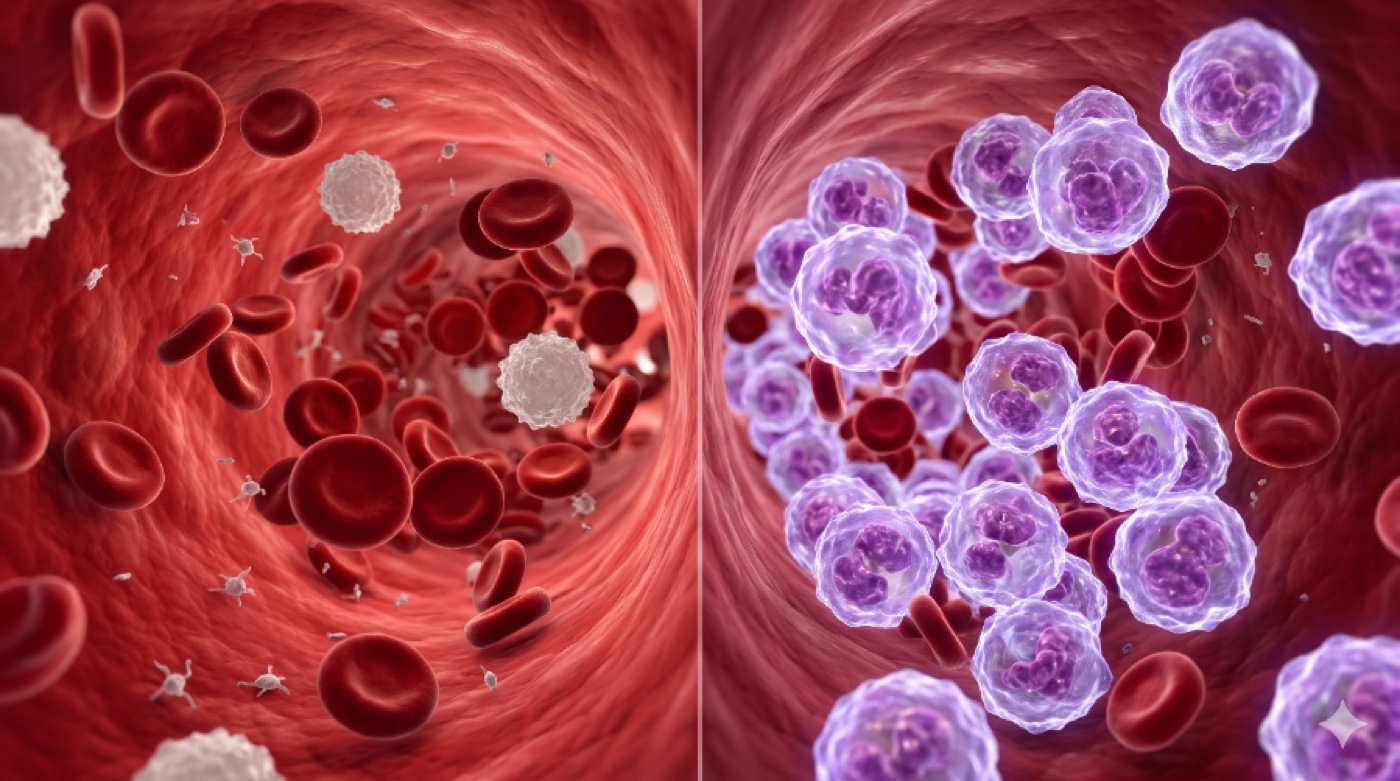
Taking blood samples out of the freezer, in order
The study appeared in Nature on November 11, 2026. The researchers analyzed stored blood from 47 women who developed acute myeloid leukemia (AML) and 46 comparison participants. These participants had given blood repeatedly over several years. [1]
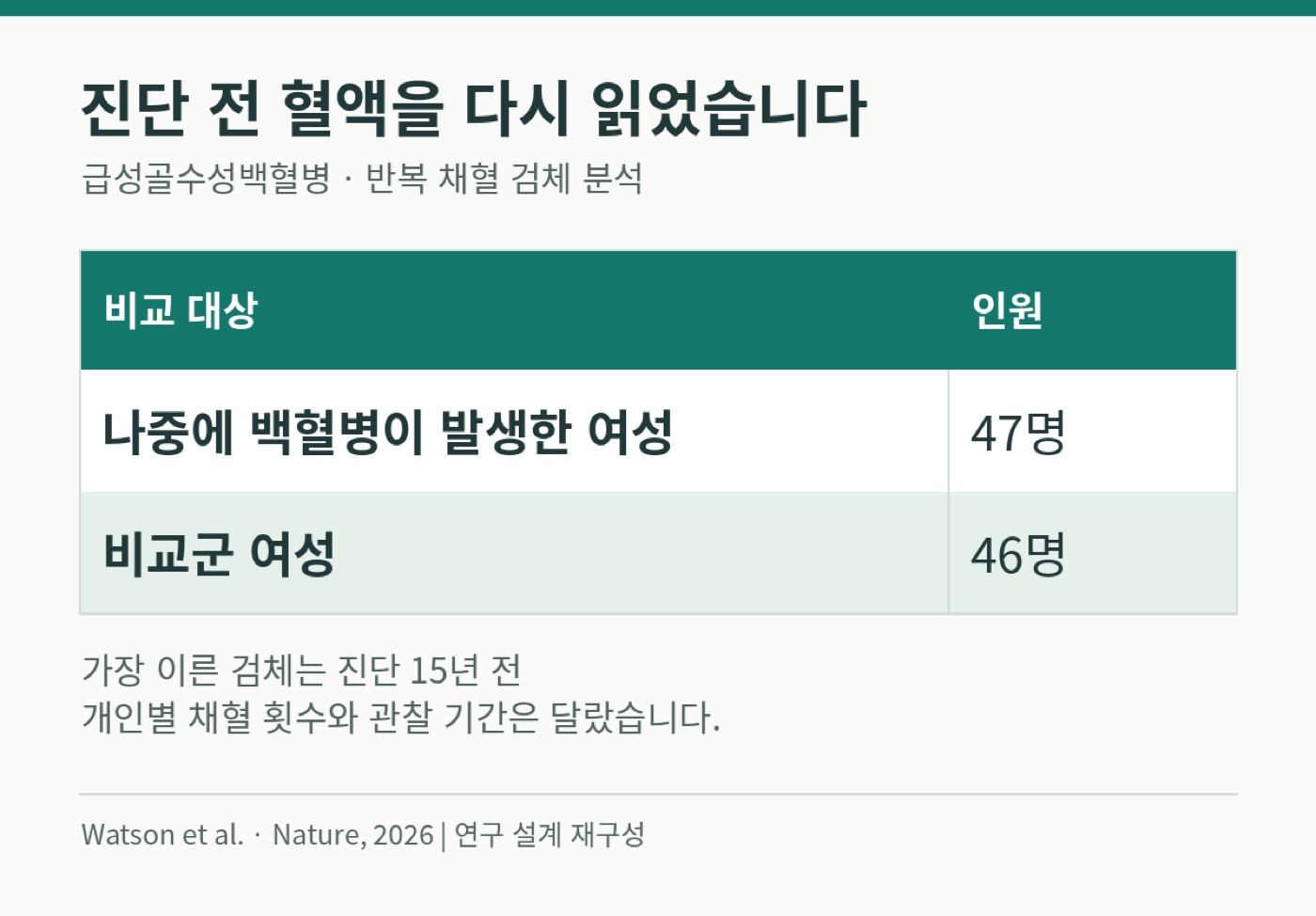
One test can tell you what the mutations are and how common they are in a sample. Put samples from several dates side by side and you can see whether cells carrying a mutation are holding steady, growing slowly, or suddenly expanding.
Cells compete inside our bodies
Imagine a mutation in a blood-forming cell. If the change gives that cell an advantage in growth or survival, its descendants inherit the mutation and gradually become more numerous. This expansion of a single lineage is known as clonal hematopoiesis.
Growth is not always explosive from the start. A lineage that has grown slowly for years can pick up another mutation and accelerate. A faster-growing lineage may then crowd out cells that got a head start.
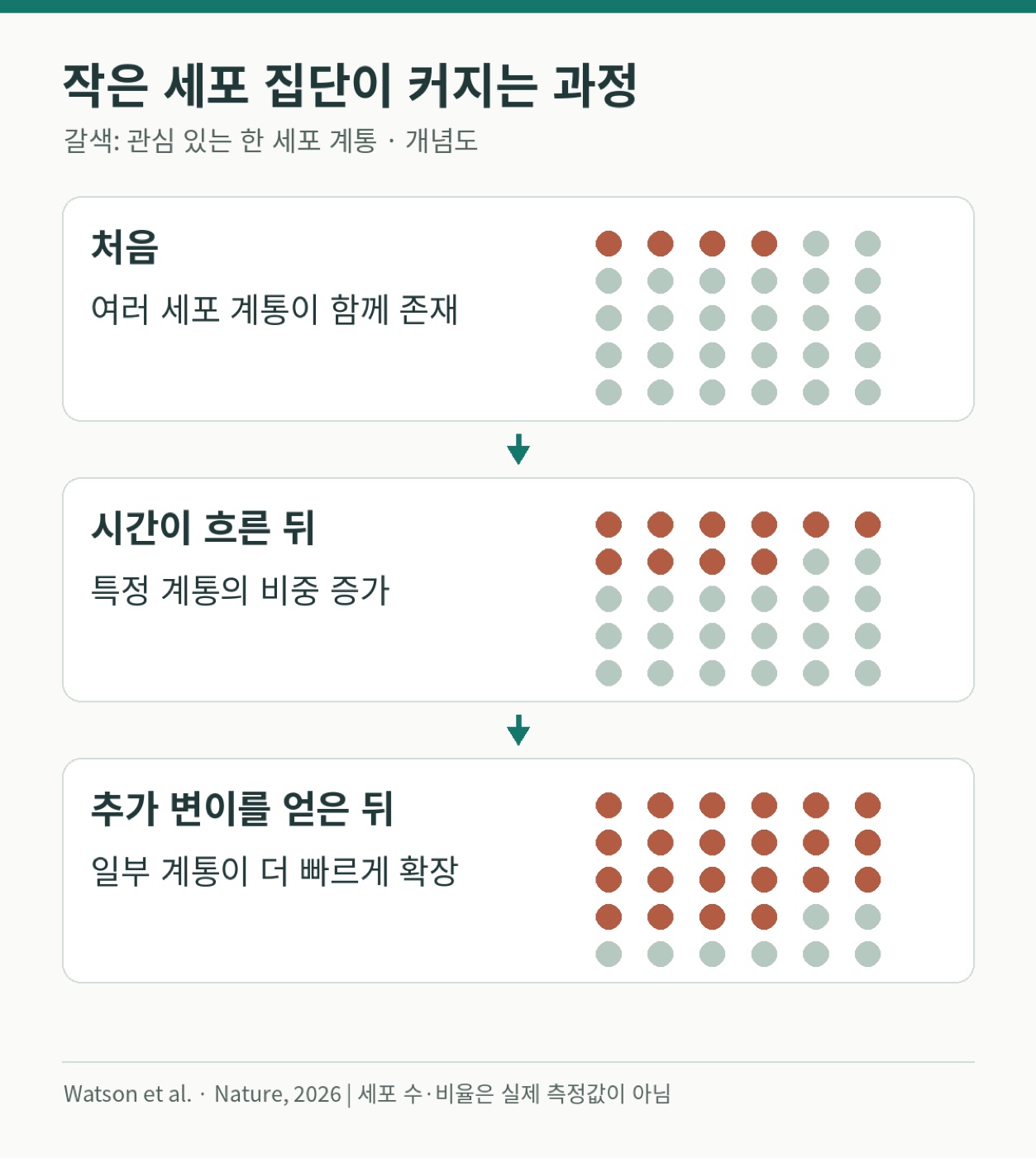
This is the process the researchers tracked. When the first mutation appeared, when additional mutations emerged, and how fast cells expanded differed from person to person. There was no single road to cancer. [1]
It may have started decades earlier
Using a mathematical model and the changes they observed in the blood, the researchers worked backward to estimate when the first mutation might have arisen. In some cases, the estimate put it decades before diagnosis.
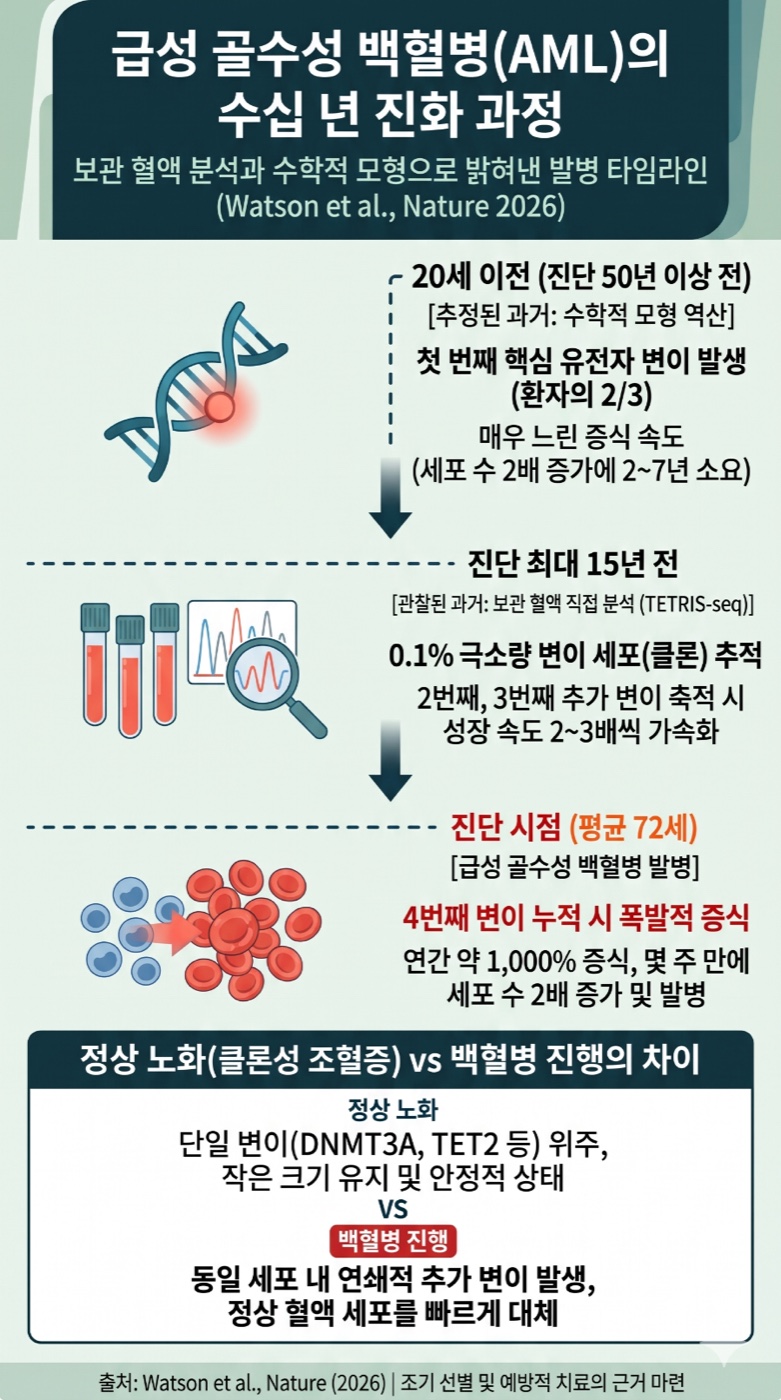
A small change that began long ago grew as it picked up other mutations. Diagnosis may be a scene near the end of that long story.
Finding a mutation is not enough
Researchers also found groups of mutant cells in participants who did not develop leukemia. A mutation alone cannot tell us who will develop cancer.
In current clinical practice, doctors assess which mutations are present, how many there are, how common they are, and whether blood counts are abnormal, alongside the rest of the diagnostic evaluation.
Adding the growth rate over time could help identify who needs closer follow-up, even among people carrying the same mutation.
This study alone does not give healthy people a reason to undergo regular genetic testing. We still need to find out whether screening and treating people in the general population would improve health or survival.
Tomorrow’s early diagnosis will look at “how fast”
We are getting better at spotting smaller changes in the body and seeing where those changes are headed. Techniques that ten years ago seemed out of reach because of technical limits or cost are beginning to make their way into use.
I think we are getting closer to an era when we can anticipate and prevent many diseases. If we live long enough to see it, perhaps staying young and healthy for centuries will no longer sound like a dream.
I started Reverse Entropy to share how close that future is and to keep learning myself. I’ll keep bringing you the latest research and thinking about what it could mean for your future.
References
- Watson CJ, et al. Evolutionary dynamics in the years preceding acute myeloid leukaemia. Nature. 2026. Original paper.
- Weeks LD, et al. Prediction of Risk for Myeloid Malignancy in Clonal Hematopoiesis. NEJM Evidence. 2023. Original paper.
#Leukemia #AcuteMyeloidLeukemia #ClonalHematopoiesis #EarlyCancerDetection #GeneticMutations #HealthyAging #ReverseEntropy #HINClinic