We increase our training volume to build muscle.
But if we exercise twice as much, will our muscles grow twice as quickly?
Providing more stimulation and having the body absorb that stimulus and grow are different things.
Training too hard can actually interfere with muscle growth.
In a study published in October 2026, artificially activating muscle stem cells initially accelerated recovery. But when injury was repeated, their regenerative capacity declined instead.
In another experiment, shortening the interval between muscle-training sessions too much prevented muscles from growing well.
What mattered was applying a stimulus and then carrying the recovery process through properly.
Let’s look at the studies in more detail.
Muscles have a reserve repair team
Muscles contain stem cells called satellite cells. Usually, they wait quietly; when needed, they become activated and participate in muscle regeneration.
It helps to think of them as a repair team.
Some help repair damaged muscle, while others remain as stem cells to prepare for the next injury. Both the ability to repair now and the ability to repair again later are needed.
What happens, then, if we wake this repair team up more quickly?
Recovery was faster at first. The problem came afterward
Scientists removed the function of a regulatory protein called TCF3 in mouse muscle stem cells.
You do not need to memorize the name. It is a protein involved in keeping stem cells in a resting state.
Without TCF3, the stem cells activated more readily. Early recovery after a single injury was faster too.
But when stem-cell activation was repeated without time to remain at rest, the outcome changed.
The ability to maintain the stem-cell pool declined, and muscle regeneration worsened.
This was not, of course, an experiment in making animals exercise excessively. It was a mouse study involving genetic manipulation and muscle injury. It would be wrong to interpret it as meaning that “training hard depletes your stem cells.”
Original study: Guo et al., Cell Death & Disease, 2026
What happened when recovery time between sessions was shortened?
Another study directly compared training intervals.
In 2019, researchers divided 21 male rats into three groups. Each group underwent 18 training sessions in which electrical stimulation produced strong contractions of the leg muscles, but with different intervals between sessions.
At 72-hour intervals, the muscles grew.
At 24-hour intervals, the muscles also grew.
But
at 8-hour intervals, the muscles did not grow.
Inflammatory responses and signals related to protein breakdown were also stronger.
More frequent stimulation did not produce a better result.
Reading these two studies brought the same question to my mind.
Before providing more stimulation, shouldn’t we check whether the body is ready to handle it?
Original study: Takegaki et al., Physiological Reports, 2019
In humans, stem cells have also increased after exercise
The experiments above may make us worry.
Could exercising a lot use up our stem cells?
Not necessarily.
In a study of 15 young men who performed resistance training for 90 days, the number of stem cells, or satellite cells, per muscle fiber increased by approximately 19% at day 30 and 31% at day 90 compared with before training.
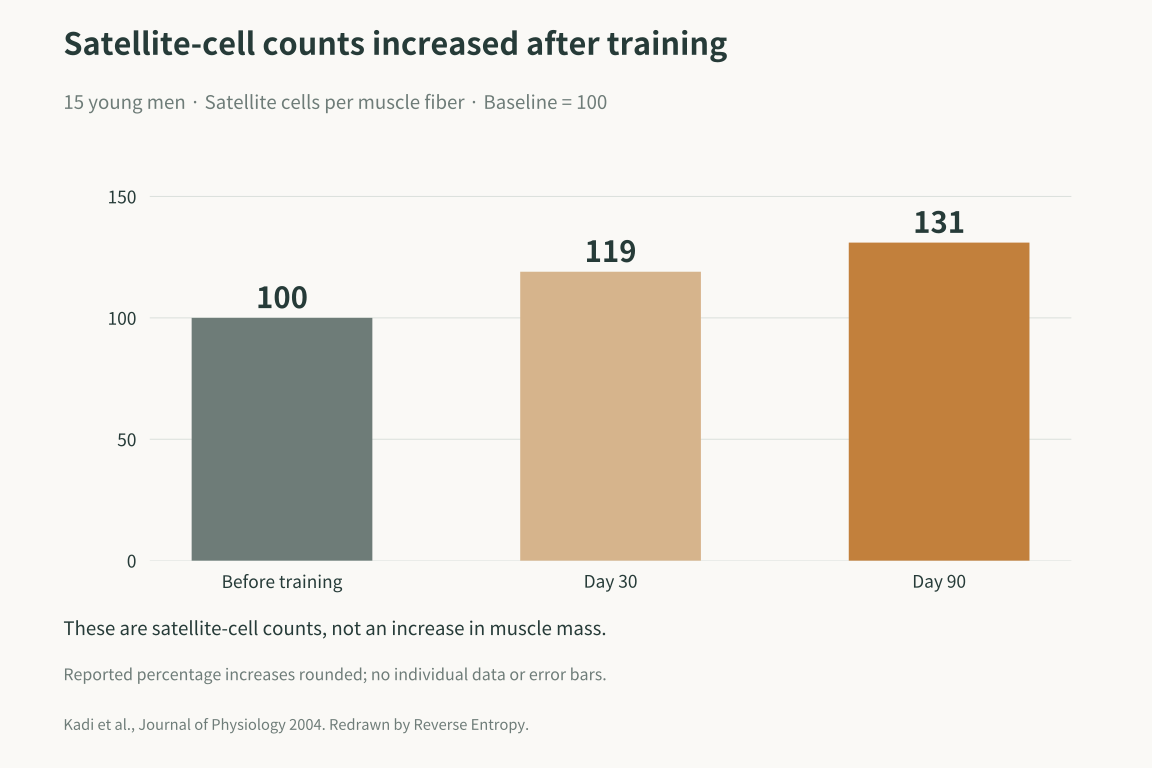
Source: Kadi F et al., Journal of Physiology, 2004. Graph redrawn by Reverse Entropy from the reported values.
This does not mean that muscle mass increased by 31%. It means that the number of satellite cells involved in muscle regeneration increased.
It shows that exercise does not invariably use up stem cells.
Original study: Kadi et al., Journal of Physiology, 2004
Do stronger skin treatments also work better?
From here, I would like to connect the discussion to my own field, skin care in clinical practice.
Muscle satellite cells and the fibroblasts that produce collagen in skin are different. We cannot use muscle research to claim that frequent skin procedures deplete stem cells.
Even so, the question of what kind of tissue forms after stimulation is important in skin too.
In a study in which 25 women received microneedle radiofrequency treatment, biopsies showed increases in dermal thickness and collagen content. It was a small study with limited long-term follow-up, but it did observe tissue changes after treatment.
Original study: Seo et al., Lasers in Surgery and Medicine, 2012
Does simply having more collagen mean having healthier skin?
Collagen forms a mesh-like structure that supports the skin. A net is not stronger just because it contains more threads. How those threads connect and are arranged matters too.
Skin research has observed a vicious cycle: when collagen becomes fragmented, its support for surrounding fibroblasts weakens, and enzymes that break down collagen increase further.
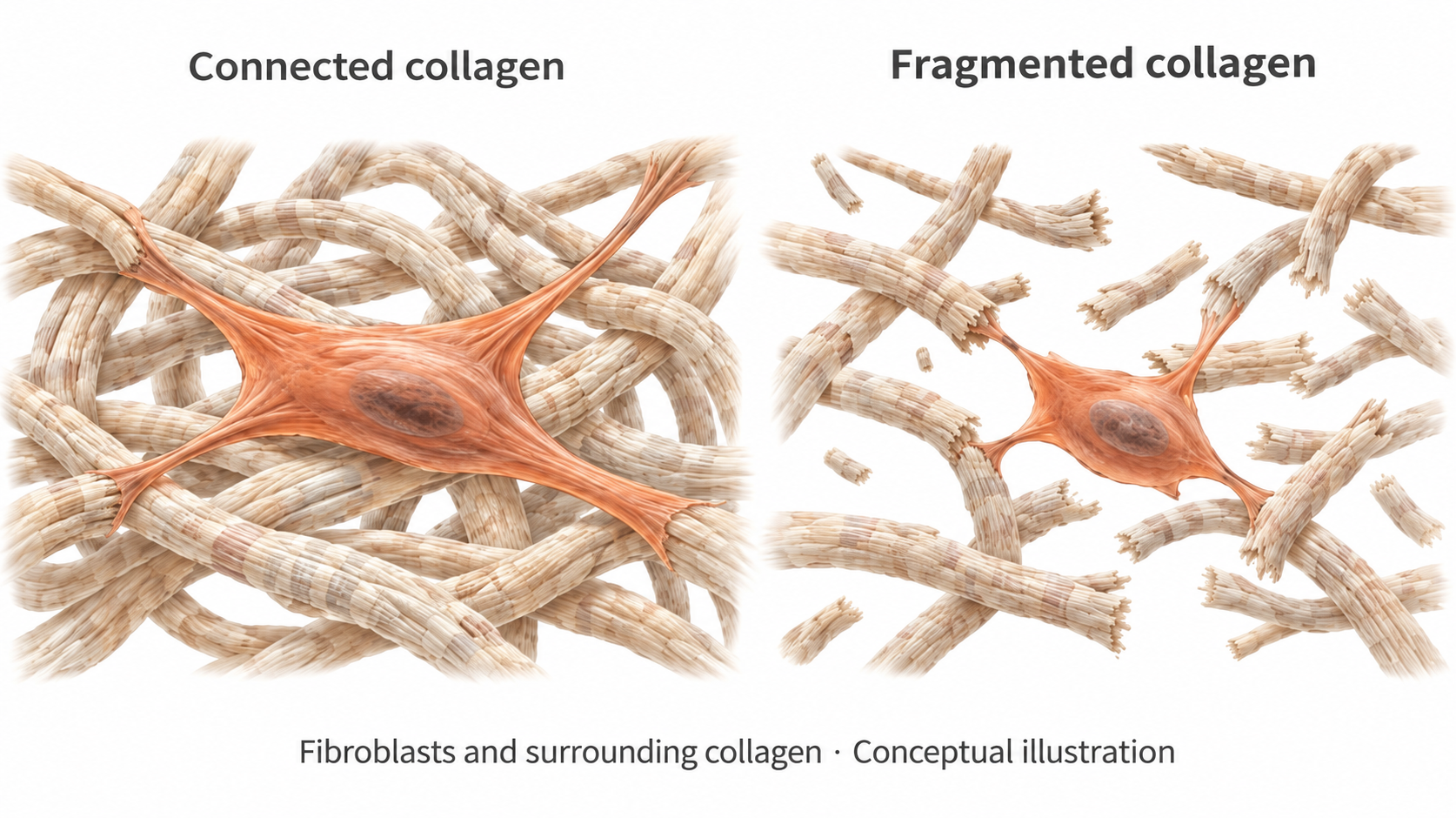
Source: Original illustration by Reverse Entropy based on Fisher GJ et al., American Journal of Pathology, 2009. AI-generated conceptual diagram, with text edited separately.
The cells that make collagen and the environment around them influence one another.
That is why I believe we should examine the structure and function of recovered skin, rather than only how much collagen has increased.
Original study: Fisher et al., American Journal of Pathology, 2009
Increasing the intensity increased both the benefit and the burden
A clinical trial directly compared treatment intensity in skin.
In 30 adults with acne scars, one half of the face received high-energy fractional radiofrequency and the other half received moderate-energy treatment.
One month after treatment ended, scar improvement was greater on the high-energy side.
At three and six months, however, there was no statistically significant difference in effectiveness between the two intensities. The high-energy side also had more pain and longer-lasting redness.
These are questions we must always consider when deciding on a procedure.
What intensity of treatment can this person tolerate?
Could performing too many treatments at once actually reduce the benefit?
Original study: Phothong et al., Lasers in Medical Science, 2016
That is why I regard stimulation and recovery as one treatment
I do not believe that every treatment should simply be gentle. Sometimes an adequate stimulus is necessary to produce an effect.
But I believe the recovery that begins after that stimulus must be included in treatment as well.
Providing sufficient stimulation, and taking responsibility for recovery afterward.
How much improvement, rather than how much stimulation
The goal should not be the number of workouts completed or how high we set the treatment energy.
What matters more to me is what comes afterward.
For exercise, did it lead to muscle growth and improved function?
For a skin procedure, did the skin actually become healthier after recovery?
A large immediate response does not necessarily mean a better long-term outcome.
We need to keep checking whether both the stimulus we provide and the recovery process are appropriate.
References
1. Guo Y, et al. TCF3-mediated lysosomal function contributes to muscle stem cell quiescence. Cell Death & Disease. October 8, 2026. Original paper
2. Takegaki J, et al. Influence of shortened recovery between resistance exercise sessions on muscle-hypertrophic effect in rat skeletal muscle. Physiological Reports. 2019;7:e14155. Free full text
3. Kadi F, et al. The effects of heavy resistance training and detraining on satellite cells in human skeletal muscles. Journal of Physiology. 2004;558:1005–1012. Free full text
4. Flann KL, et al. Muscle damage and muscle remodeling: no pain, no gain? Journal of Experimental Biology. 2011;214:674–679. Abstract
5. Seo KY, et al. Skin rejuvenation by microneedle fractional radiofrequency treatment in Asian skin; clinical and histological analysis. Lasers in Surgery and Medicine. 2012;44:631–636. Abstract
6. Fisher GJ, et al. Collagen fragmentation promotes oxidative stress and elevates matrix metalloproteinase-1 in fibroblasts in aged human skin. American Journal of Pathology. 2009;174:101–114. Free full text
7. Phothong W, et al. High versus moderate energy use of bipolar fractional radiofrequency in the treatment of acne scars: a split-face double-blinded randomized control trial pilot study. Lasers in Medical Science. 2016;31:229–234. Abstract
#MuscleGrowth #ResistanceTraining #ExerciseRecovery #WhyMusclesDoNotGrow #MuscleStemCells #SatelliteCells #SkinRegeneration #CollagenRegeneration #Radiofrequency #DALL #DALLInjection #AntiAging #ReverseEntropy