It is easy to assume that a medicine taken by mouth will work better than one applied to the scalp because it acts from inside the body.
Let me start with my conclusion. Oral minoxidil can be a useful option for people who struggle to apply a topical treatment consistently, or who develop scalp irritation.
But being a tablet does not, by itself, make it more effective. If topical minoxidil is already working for you, there is no need to switch simply because an oral option exists.
The final choice should take account of how your scalp responds, how easily you can use the treatment every day, and the side effects that may affect the rest of your body.
1. Researchers directly compared the tablet and the topical treatment
A study published in JAMA Dermatology in 2024 randomly assigned 90 men with male pattern hair loss to two groups: oral minoxidil 5 mg once daily, or topical minoxidil 5% twice daily.
Sixty-eight participants completed 24 weeks. For the main outcomes—hair density at the front and crown of the scalp—oral treatment did not demonstrate superiority over topical treatment. [1]
That means a topical medicine can still be a perfectly reasonable foundation of treatment.
2. A more recent study reached a similar conclusion
A trial published in September 2026 randomly assigned 100 men and women with pattern hair loss to oral or topical minoxidil.
The oral dose was 2.5 mg a day for men and 1.25 mg for women. The topical treatment was 5% for men and 2% for women, applied twice a day.
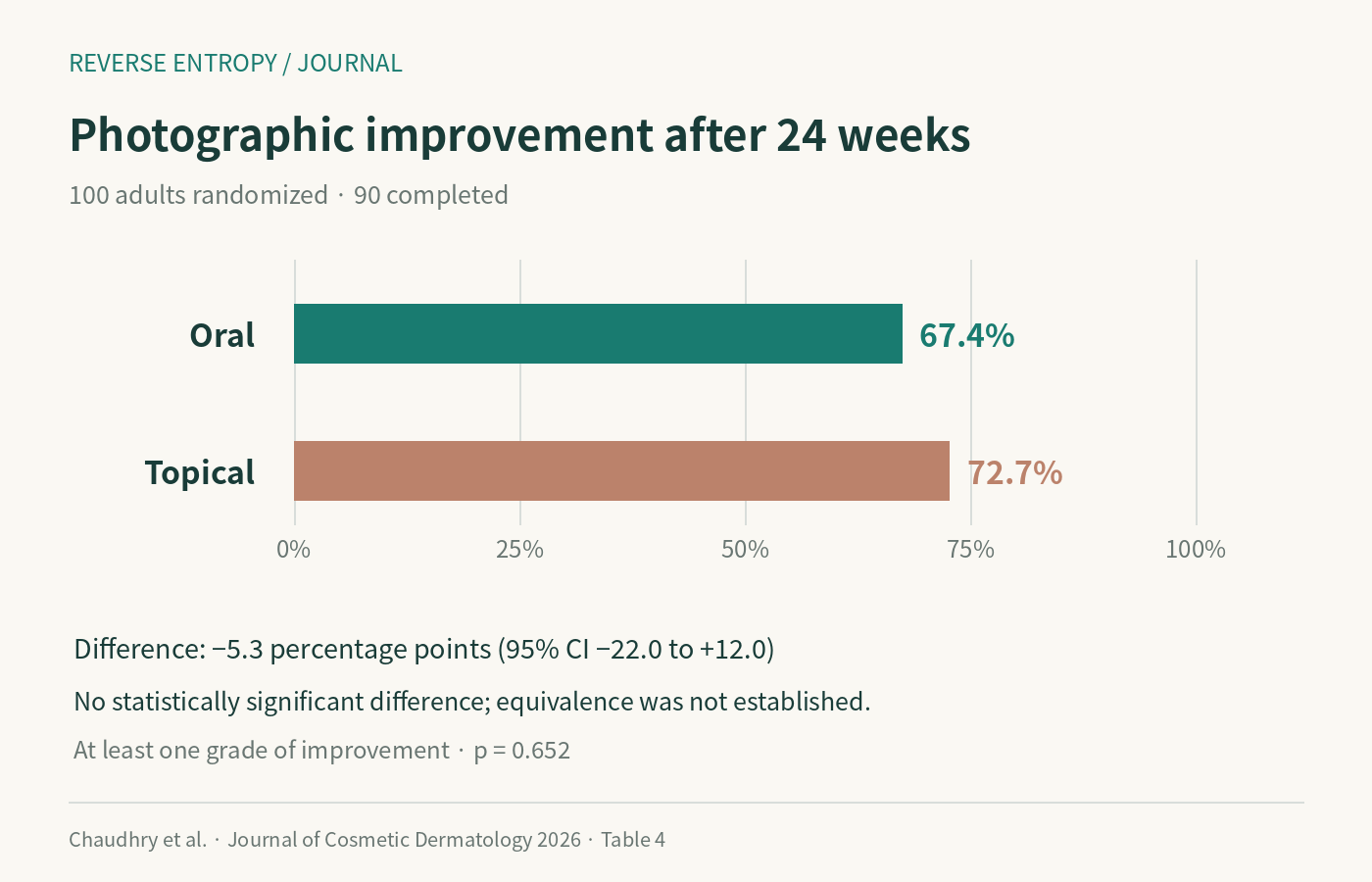
In photographic assessments of the 90 people who completed 24 weeks, improvement was seen in 67.4% with oral minoxidil and 72.7% with topical minoxidil.
The difference was not statistically significant. This trial did not establish that the treatments were equivalent, but it did not show oral treatment to be more effective either. [2]
3. A treatment also needs to fit into everyday life
Applying medication to the scalp is not easy for everyone.
The sticky feeling or residue may be unpleasant, and it may disrupt a hairstyle. Some people stop because their scalp becomes itchy or red. If the application process is so inconvenient that you keep skipping it, the treatment becomes difficult to sustain.
In that situation, the convenience of a tablet can be a meaningful practical advantage.
An international consensus involving 43 experts from 12 countries also identified difficulties with topical use, scalp inflammation, and a plateau in response as circumstances in which oral treatment may be considered. [3]
For me, the important question is: “Which treatment can this person keep using consistently in their own life?”
4. The side effects deserve a comparison too
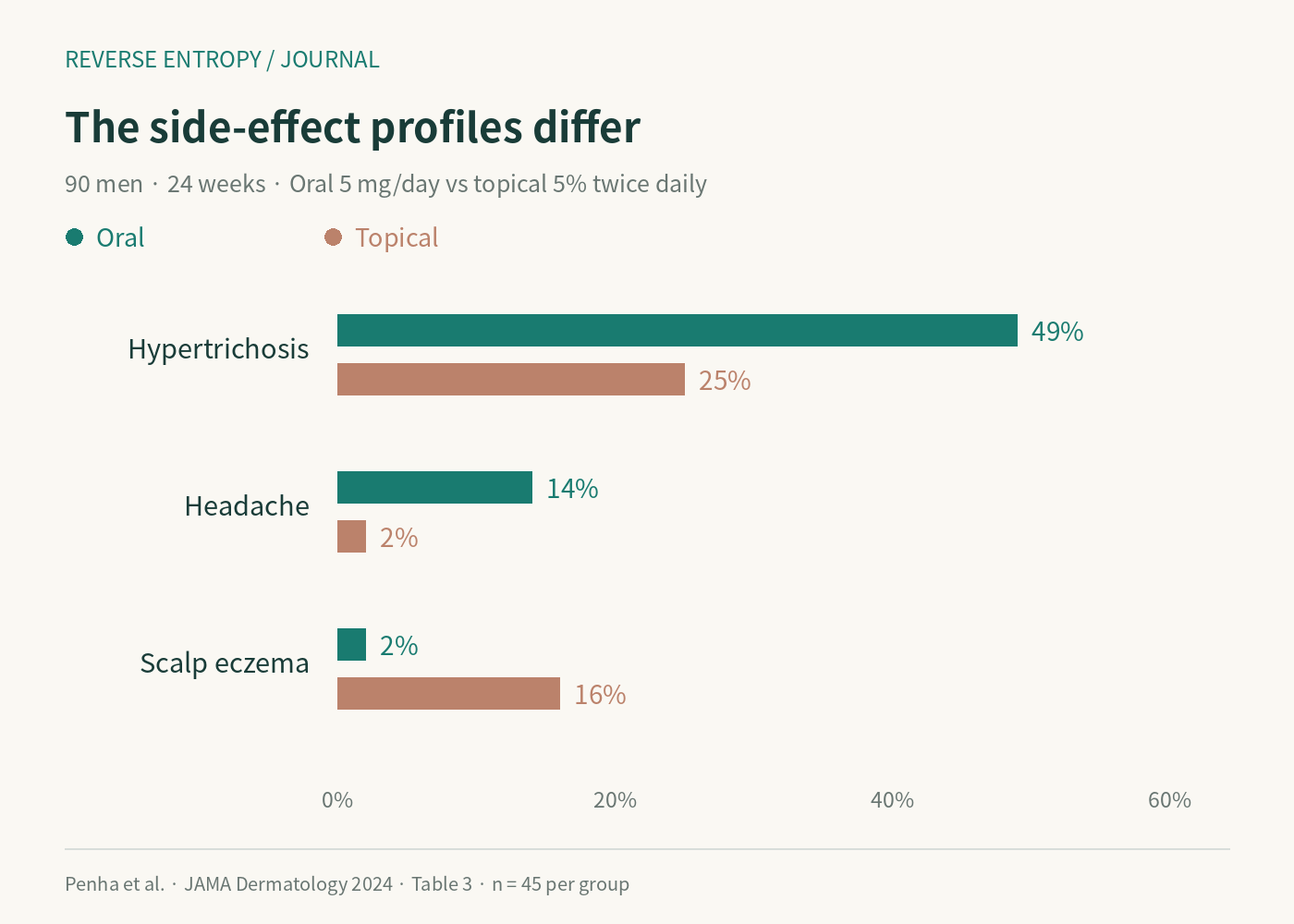
The earlier 2024 trial in men compared oral minoxidil 5 mg a day with topical minoxidil 5%. The reported rates of increased facial or body hair were 49% versus 25%; headaches, 14% versus 2%; and scalp eczema, 2% versus 16%.
In this comparison, unwanted hair growth and headaches were more of an issue with the tablet, while scalp eczema was more of an issue with the topical treatment. [1]
A multicenter review of the medical records of 1,404 people using low-dose oral minoxidil also reported unwanted hair growth, light-headedness, fluid retention, and a faster heartbeat. [4]
When choosing an oral treatment, we need to look beyond the scalp and also consider blood pressure, pulse, swelling, and other whole-body responses.
5. Match the treatment to the scalp and the person
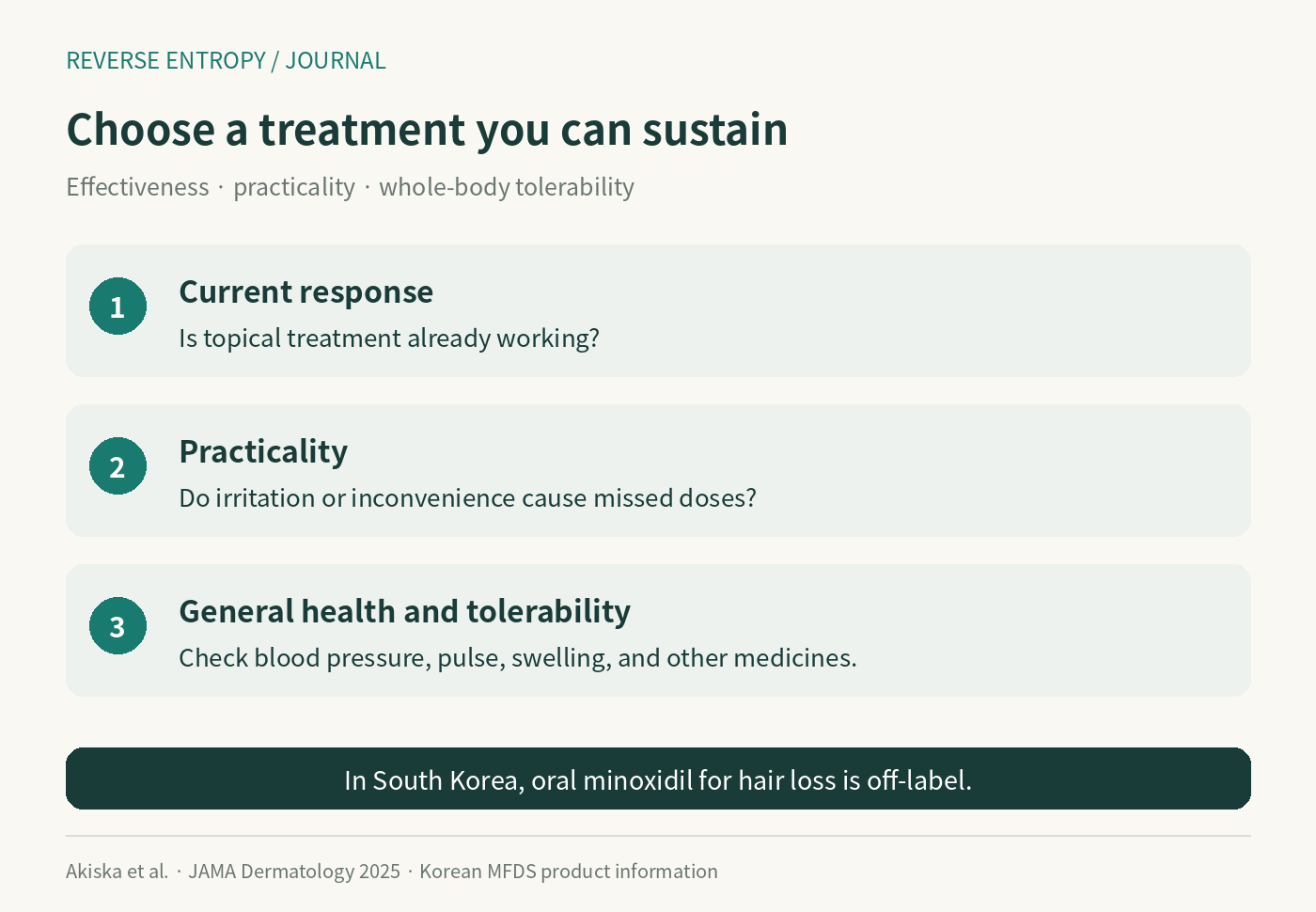
In South Korea, oral minoxidil is approved for hypertension; its use for hair loss is off-label. [5]
Choosing a dose requires a review of usual blood pressure, arrhythmias, heart or kidney disease, and other medicines. It should be avoided during pregnancy and breastfeeding. If there was an allergic reaction to a topical product, the responsible ingredient needs to be identified first.
If palpitations or swelling develop after starting treatment, the dose and whether to continue should be reviewed with the prescribing physician. Shortness of breath or chest pain calls for prompt medical assessment. [3]
Choose a treatment you can sustain
If topical minoxidil is working and is comfortable to use, you can continue with that treatment.
If applying it is difficult and you repeatedly stop, oral minoxidil can be considered alongside an assessment of your general health.
When choosing a hair-loss medicine, consider effectiveness together with how comfortably and safely your scalp and body can tolerate it over time.
References
1. Penha MA, et al. Oral Minoxidil vs Topical Minoxidil for Male Androgenetic Alopecia. JAMA Dermatology. First published April 10, 2024. DOI: 10.1001/jamadermatol.2024.0284.
2. Chaudhry MAE, et al. Low-Dose Oral Versus Topical Minoxidil in Androgenetic Alopecia. Journal of Cosmetic Dermatology. First published September 21, 2026. DOI: 10.1111/jocd.71198.
3. Akiska YM, et al. Low-Dose Oral Minoxidil Initiation for Patients With Hair Loss: An International Modified Delphi Consensus Statement. JAMA Dermatology. 2025;161:87–95. Published online November 20, 2024. DOI: 10.1001/jamadermatol.2024.4593.
4. Vañó-Galván S, et al. Safety of low-dose oral minoxidil for hair loss: A multicenter study of 1404 patients. JAAD. 2021. DOI: 10.1016/j.jaad.2021.02.054.
5. Korean Ministry of Food and Drug Safety. Official prescribing information for Damosidil tablets (minoxidil). Consulted in November 2026.