Is fitting protein into a busy morning becoming another source of stress?
More people are making a point of eating protein for their health and muscles. Along with that comes advice that is often repeated as a rule: ‘You can only absorb 30 g at a time, so you need to divide your protein evenly across three meals,’ or ‘You have to drink a protein shake within 30 minutes of finishing your workout.’
Preparing eggs and chicken breast every morning can be hard enough without having to follow a strict timetable as well. People who practice intermittent fasting and eat just one meal at lunch or dinner may also worry that they are losing muscle.
Let me start with the conclusion: missing protein at breakfast does not mean you have failed to look after your muscles that day. You can make up for it at lunch or dinner. Nor does eating more than 30 g in one meal mean that everything above that amount goes unabsorbed or is wasted.
The first things I look at are whether you have eaten enough over the course of the day and whether you are using your muscles regularly. After that, you can adjust meal timing to fit your life.
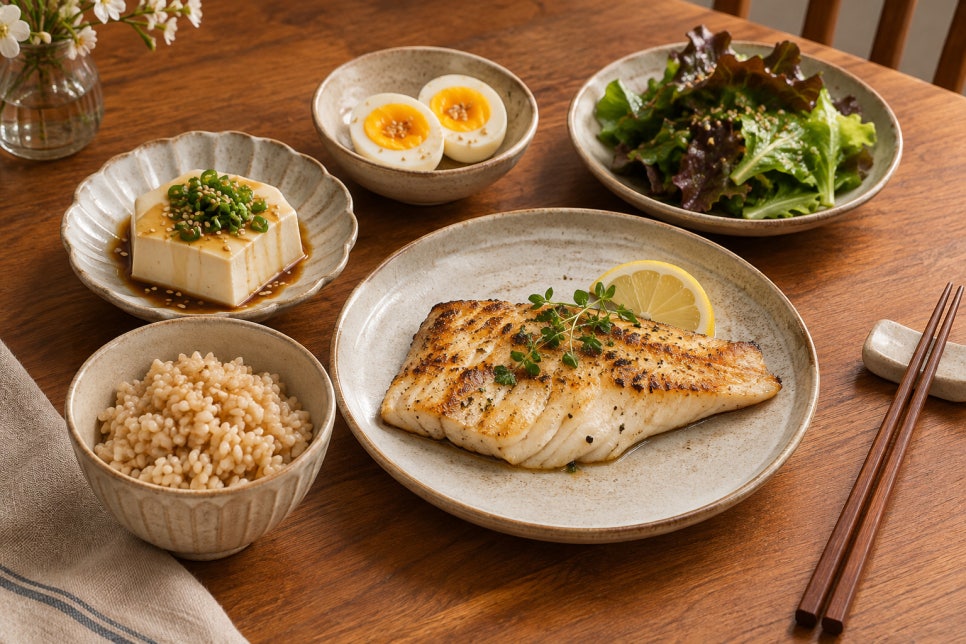
Dinner can provide plenty of protein, too. This is an illustrative meal image, not a meal plan calculated to provide specific nutrient amounts.
Source: AI-generated meal example. Not a nutritional analysis of an actual meal. AI-generated image.
Where did the advice to eat 30 g after exercise come from?
Many articles online tell you to eat protein within 30 minutes of exercising and to divide it into several servings of 30 g each.
They explain that this is because protein is absorbed slowly.
But we need to distinguish between two things.
Absorption is the process in which protein in food is broken down into small building blocks, such as amino acids, which then pass through the intestinal wall.
Muscle protein synthesis is the process of using those building blocks to make new muscle protein.
Getting the building blocks into the body and using them to build muscle are not the same thing. Once broken down, protein is used not only for muscle but also to build other tissues, including the intestines and liver, as well as enzymes and proteins in the blood. Some is also used as an energy source.
In several earlier experiments, eating around 20–30 g of protein after exercise substantially increased the muscle protein synthesis response over the few hours that were observed. As these findings became widely known, they turned into the claim that ‘only 30 g can be absorbed at a time.’
But that does not mean that any additional protein cannot be absorbed through the intestines. So you can eat more than 30 g.
Review of absorption and protein use within a single meal
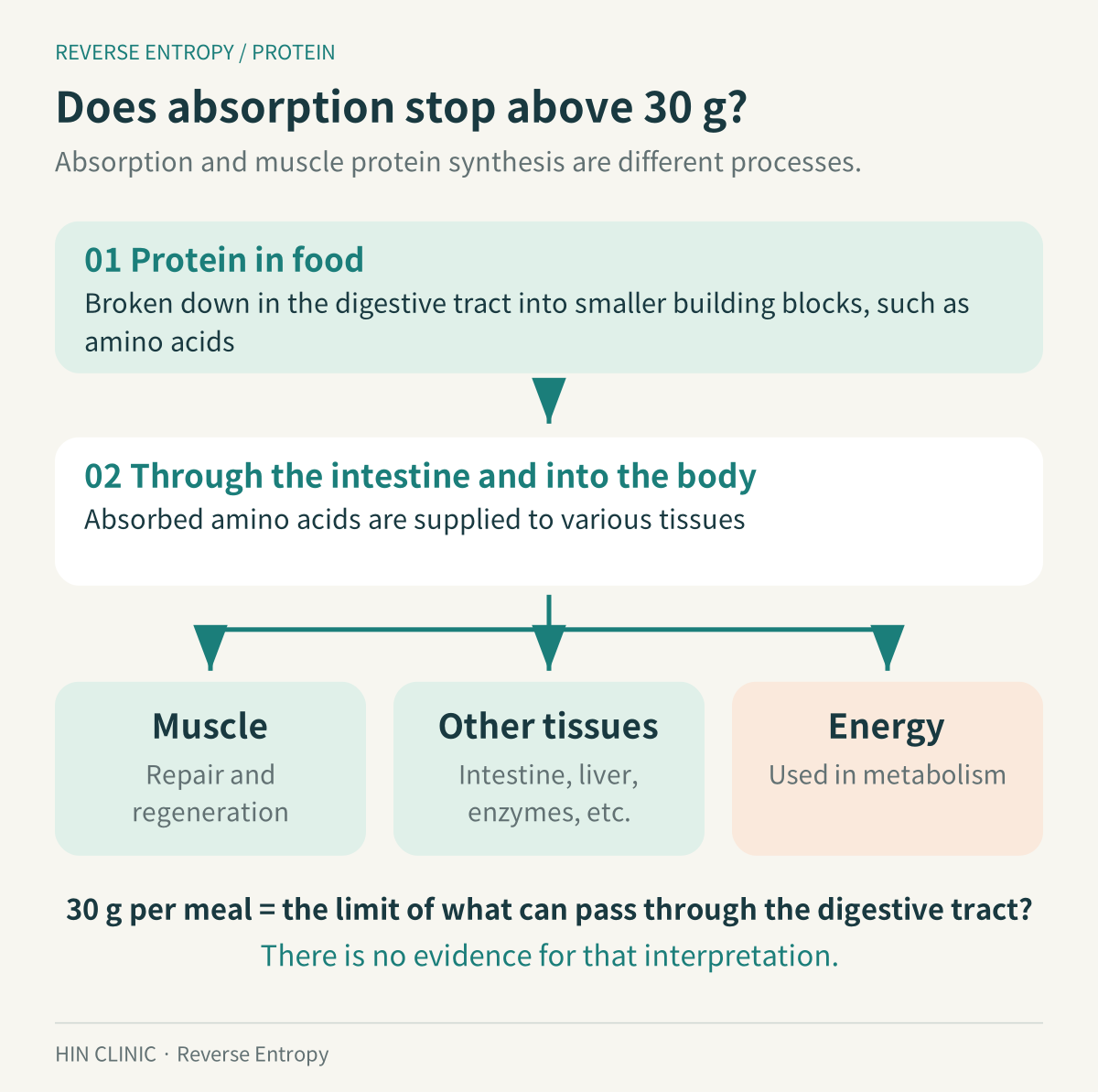
Absorbed amino acids are used not only in muscle but also in other tissues and metabolic processes. The arrows simplify the pathways of use; they do not represent proportions.
Source: Original conceptual diagram based on Schoenfeld and Aragon, 2018. Source for the illustration. Created by Reverse Entropy. No figures from the original paper have been reproduced.
Translated text from the original illustration
- REVERSE ENTROPY / PROTEIN
- Does absorption stop above 30 g?
- Absorption and muscle protein synthesis are different processes.
- 01 Protein in food
- Broken down in the digestive tract into smaller building blocks, such as amino acids
- 02 Through the intestine and into the body
- Absorbed amino acids are supplied to various tissues
- Muscle
- Repair and regeneration
- Other tissues
- Intestine, liver, enzymes, etc.
- Energy
- Used in metabolism
- 30 g per meal = the limit of what can pass through the digestive tract?
- There is no evidence for that interpretation.
- 청담흰 · Reverse Entropy
Researchers gave participants 100 g at once and followed them for 12 hours
A Maastricht University study published in Cell Reports Medicine in 2023 used a longer observation period.
The researchers divided 36 healthy young men into three groups. After a full-body resistance workout, the groups consumed 0 g, 25 g, or 100 g of milk-derived protein. Blood and muscle samples were collected to track amino acid movement and protein synthesis over 12 hours.
Compared with the 25 g group, the 100 g group had a larger muscle protein synthesis response over the full 12-hour period, and the response lasted longer. The additional protein was not simply all wasted. Trommelen et al., 2023
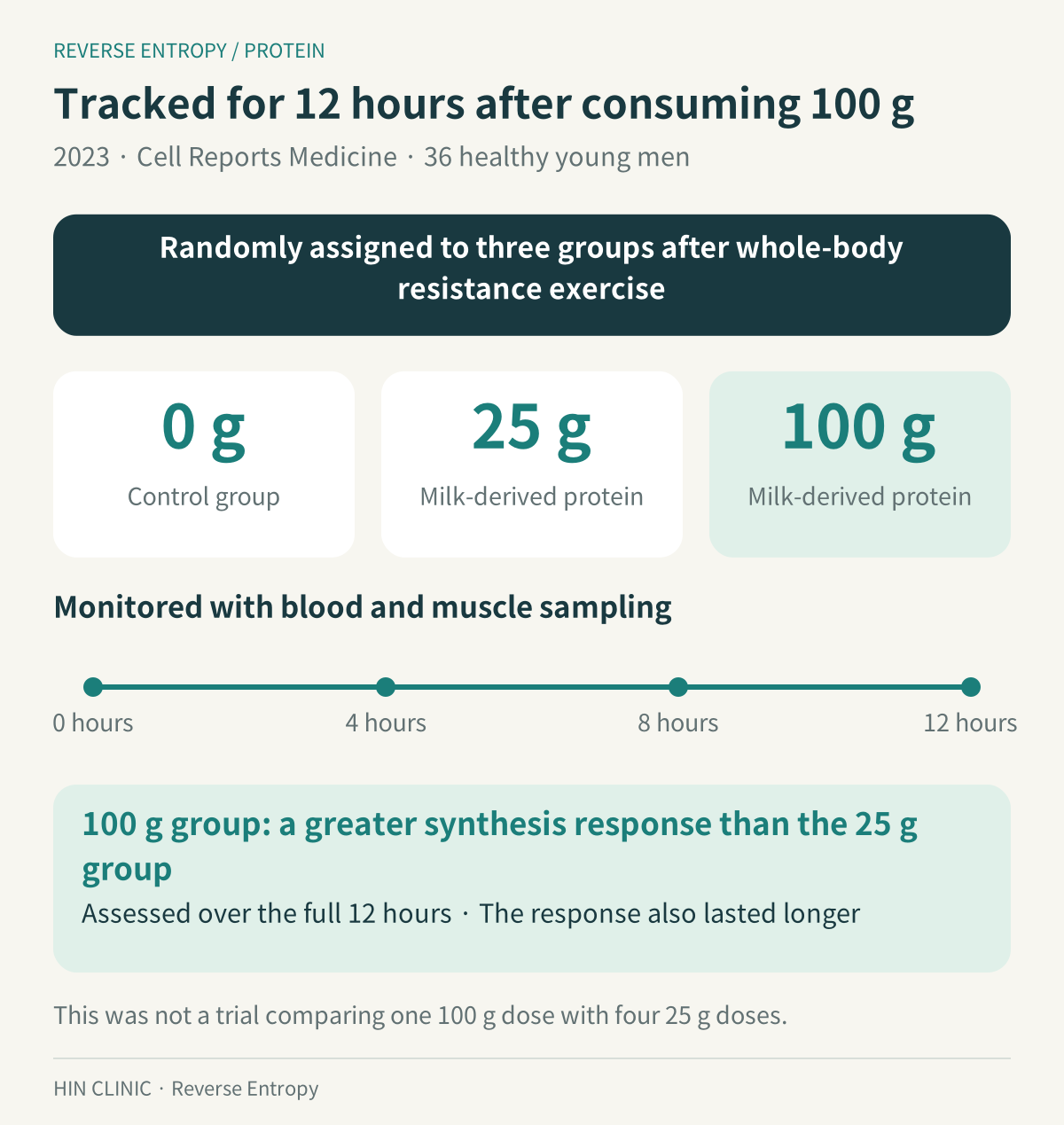
This experiment compared metabolic responses over 12 hours after exercise in young men. The illustration summarizes the study design and the direction of the results; it does not reproduce the magnitude of synthesis rates as a graph.
Source: Original illustration based on Trommelen et al., Cell Reports Medicine, 2023. Source for the illustration. Created by Reverse Entropy. No figures from the original paper have been reproduced.
Translated text from the original illustration
- REVERSE ENTROPY / PROTEIN
- Tracked for 12 hours after consuming 100 g
- 2023 · Cell Reports Medicine · 36 healthy young men
- Randomly assigned to three groups after whole-body resistance exercise
- 0 g
- Control group
- 25 g
- Milk-derived protein
- 100 g
- Milk-derived protein
- Monitored with blood and muscle sampling
- 0 hours
- 4 hours
- 8 hours
- 12 hours
- 100 g group: a greater synthesis response than the 25 g group
- Assessed over the full 12 hours · The response also lasted longer
- This was not a trial comparing one 100 g dose with four 25 g doses.
- 청담흰 · Reverse Entropy
This was not a long-term trial comparing the same 100 g eaten in one sitting with four separate servings of 25 g. What the study did show, however, is that our bodies can make use of a large amount of protein consumed at once for longer than we might expect.
So if you eat more protein than usual in one meal, there is no need to think, ‘I went over 30 g, so the rest is useless.’
A meal is processed over several hours
Finishing a meal does not mean that digestion and absorption have finished, too.
A meal containing meat, fish, eggs, or tofu is gradually broken down as it passes through the digestive tract. The form and composition of the food affect both how quickly it moves from the stomach to the intestines and how quickly amino acids appear in the blood.
Rather than being put away in a dedicated store like fat, protein is used through digestion, absorption, and the ongoing turnover of proteins in different tissues. These processes continue after the meal is over. Protein digestion rates and utilization
There are priorities to meet before getting the timing right
Having a shake straight after exercise can be a convenient habit. But missing the 30-minute window does not make the benefits of your workout disappear.
In an analysis by Schoenfeld, Aragon, and Krieger that pooled studies of protein intake around exercise, no significant differences in strength or muscle hypertrophy were identified according to protein timing. Total protein intake was the strongest factor explaining the effects on muscle hypertrophy. Meta-analysis of protein timing, 2013
An analysis published in 2025 also found no clear difference in gains in fat-free mass across five randomized trials directly comparing protein intake before and after exercise. The studies were small, so subtle differences cannot be ruled out. Still, the evidence for sticking to a minute-by-minute timetable is weak. Meta-analysis comparing intake before and after exercise, 2025
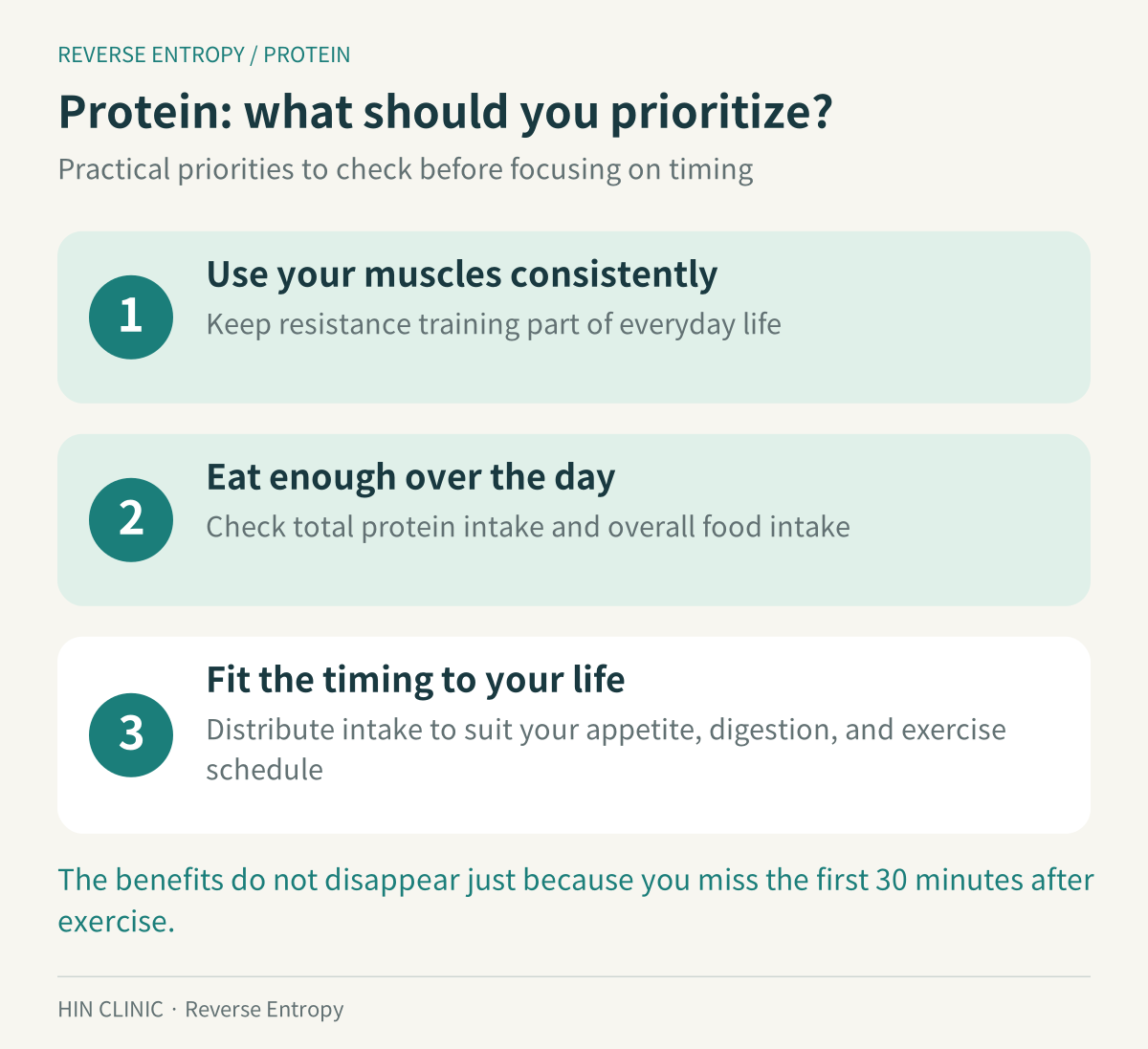
Prioritize total intake and resistance training, then adjust timing in a way you can maintain. These are practical guidelines for applying the research to everyday life.
Source: The author’s practical summary based on Schoenfeld et al., 2013, and Jäger et al., 2017. Source for the illustration. Created by Reverse Entropy. No figures from the original paper have been reproduced.
Translated text from the original illustration
- REVERSE ENTROPY / PROTEIN
- Protein: what should you prioritize?
- Practical priorities to check before focusing on timing
- 1
- Use your muscles consistently
- Keep resistance training part of everyday life
- 2
- Eat enough over the day
- Check total protein intake and overall food intake
- 3
- Fit the timing to your life
- Distribute intake to suit your appetite, digestion, and exercise schedule
- The benefits do not disappear just because you miss the first 30 minutes after exercise.
- 청담흰 · Reverse Entropy
That is why I think it is more important to establish regular resistance training and an adequate daily intake first, then find an eating pattern that is easy to sustain, rather than focusing on timing.
If including protein in each of three meals works for you, do that. If two meals suit you better, make those two meals more substantial.
If you have eaten a proper meal before or after exercise, there is no reason to rush to add a shake. It could help, of course, if you have not had enough protein that day.
International Society of Sports Nutrition position stand on protein and exercise
If you practice intermittent fasting, eat enough within your eating window
Researchers are also studying whether intermittent fasting can be combined with looking after your muscles.
In a 12-week randomized trial in 2026 involving 23 adults who performed resistance training, similar gains in strength were observed in the 16:8 group, which fasted for 16 hours and ate within an 8-hour window, and the group following a regular eating schedule.
We need to bear in mind that this was a small study and that body composition was measured using bioelectrical impedance. Even so, the findings suggest that shortening the eating window does not, by itself, make muscle gain impossible. 12-week randomized trial of a 16:8 eating schedule, 2026
In everyday life, the first thing to check is whether you actually eat the amount of food you need within your eating window, rather than the length of the fast. If fewer opportunities to eat leave you short of both protein and food overall, you need to make adjustments.
For example, if your daily protein target is 100 g, you could have 45 g at lunch and 55 g at dinner. You do not have to divide it equally between the two meals or limit each meal to 30 g or less. If the amount feels overwhelming, you can spread it out by adding snacks such as yogurt or eggs within your eating window.
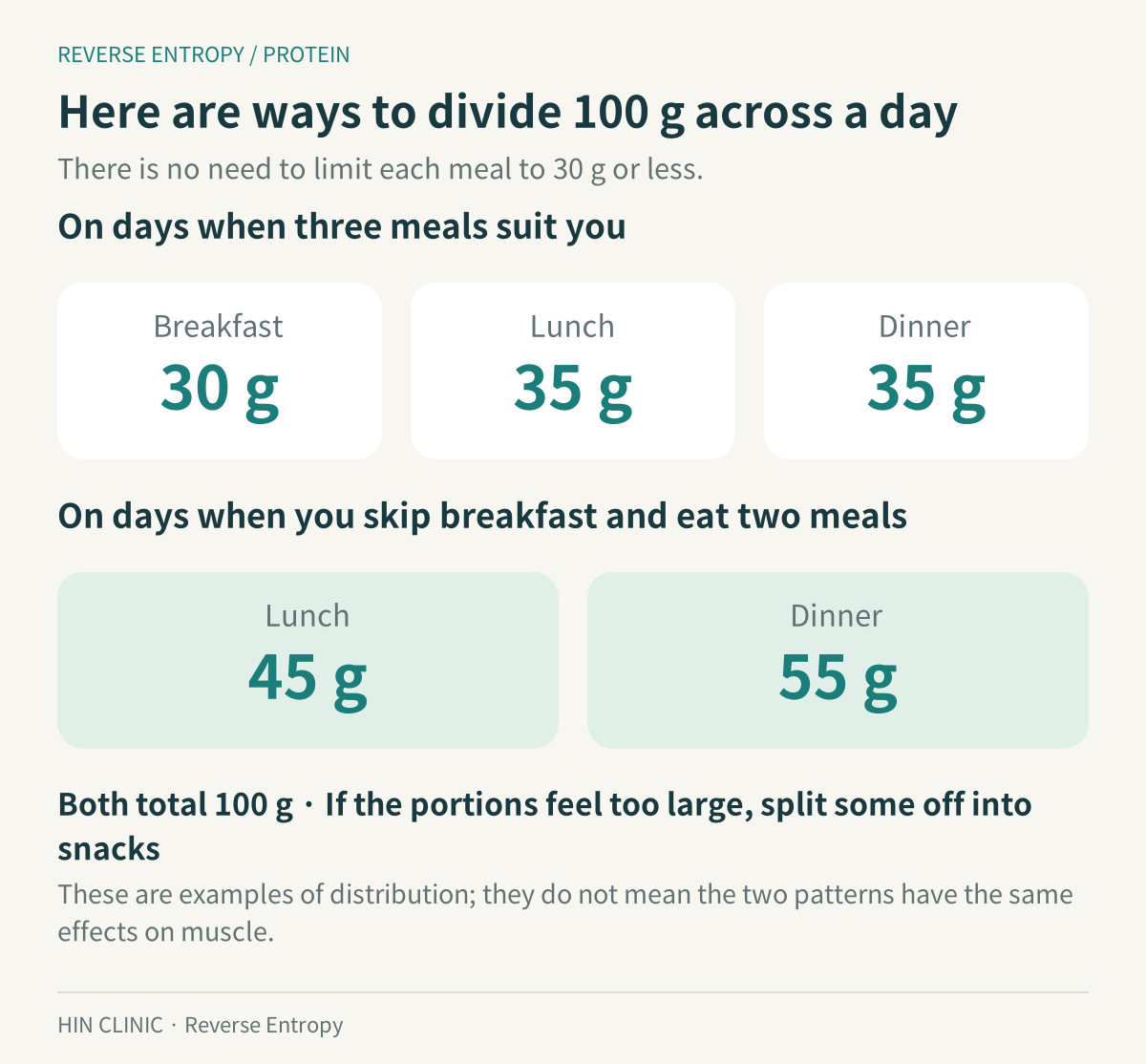
These are calculated examples of how to reach 100 g a day. A target of 100 g does not apply to everyone, and these examples are not evidence that the two distribution patterns have identical long-term effects.
Source: Meal-distribution examples calculated and created by the author. Not clinical trial results. Created by Reverse Entropy. No figures from the original papers have been reproduced.
Translated text from the original illustration
- REVERSE ENTROPY / PROTEIN
- Here are ways to divide 100 g across a day
- There is no need to limit each meal to 30 g or less.
- On days when three meals suit you
- Breakfast
- 30 g
- Lunch
- 35 g
- Dinner
- 35 g
- On days when you skip breakfast and eat two meals
- Lunch
- 45 g
- Dinner
- 55 g
- Both total 100 g · If the portions feel too large, split some off into snacks
- These are examples of distribution; they do not mean the two patterns have the same effects on muscle.
- 청담흰 · Reverse Entropy
How much should you eat each day?
For a healthy adult concerned about maintaining muscle, I would start with a practical range of 1.2–1.6 g per kilogram of body weight per day. For someone actively engaged in resistance training, I would consider around 1.6–2.0 g. These are not minimum amounts that everyone must consume. They can be adjusted according to exercise levels, age, and whether you are trying to lose weight.
A meta-analysis of 49 resistance-training studies involving 1,863 participants found that once total protein intake reached around 1.6 g/kg per day, consuming more did not, on average, produce a clearly greater benefit in gains in fat-free mass. Eating more and more does not lead to unlimited muscle growth. Morton et al., 2018
The International Society of Sports Nutrition suggests 1.4–2.0 g/kg/day for most adults who exercise. You can use this as a reference and adapt it to your own goals and eating habits. Protein intake recommendations
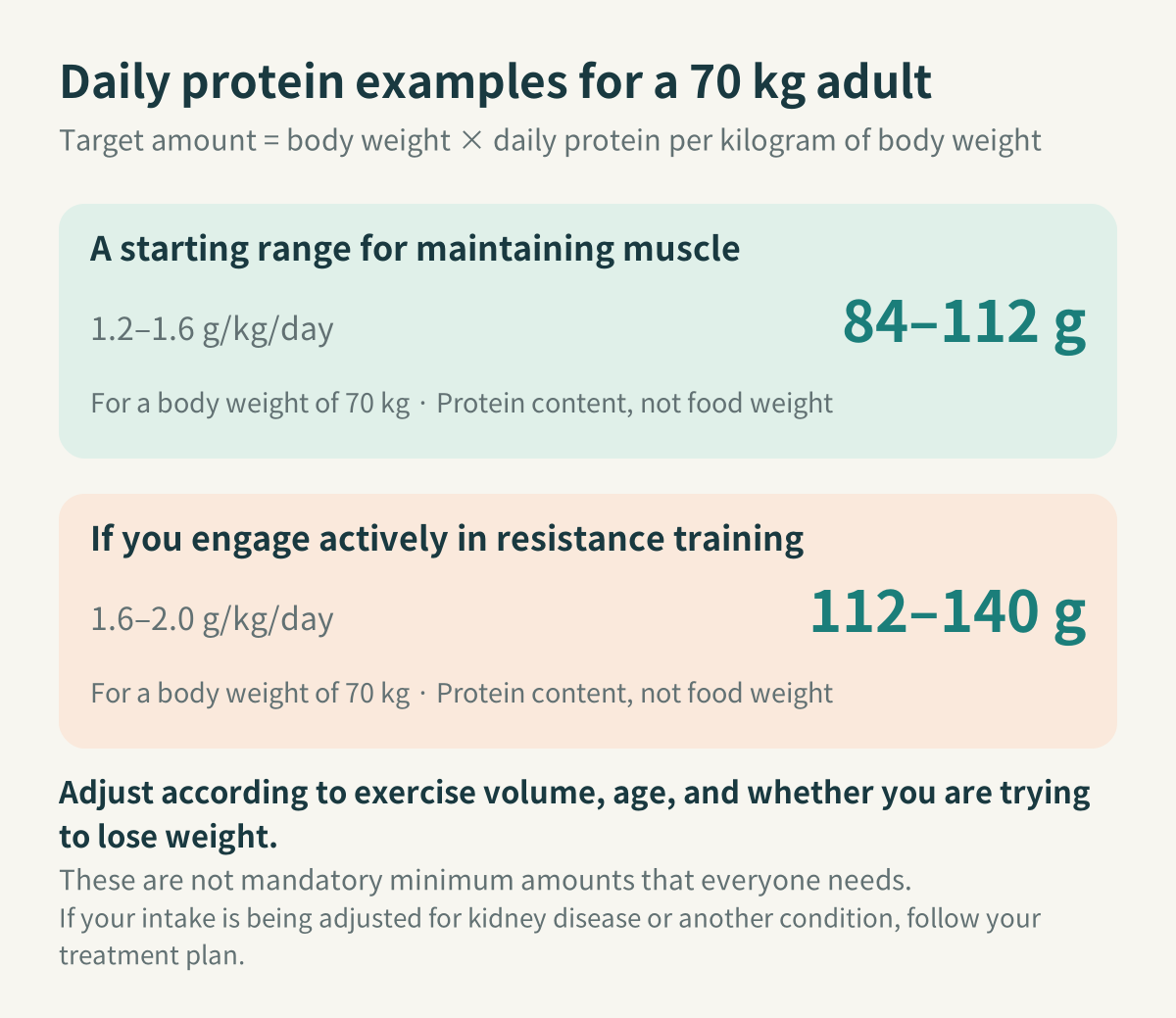
These values are calculated by multiplying 70 kg by the practical ranges given in the article. The grams refer to the amount of protein contained in the food, not the weight of the meat or food itself.
Source: Original calculations and illustration. The target ranges in the article draw on recommendations for people who exercise and Morton et al., 2018. Source for the illustration. Created by Reverse Entropy. No figures from the original paper have been reproduced.
Translated text from the original illustration
- Daily protein examples for a 70 kg adult
- Target amount = body weight × daily protein per kilogram of body weight
- A starting range for maintaining muscle
- 1.2–1.6 g/kg/day
- 84–112 g
- For a body weight of 70 kg · Protein content, not food weight
- If you engage actively in resistance training
- 1.6–2.0 g/kg/day
- 112–140 g
- For a body weight of 70 kg · Protein content, not food weight
- Adjust according to exercise volume, age, and whether you are trying to lose weight.
- These are not mandatory minimum amounts that everyone needs.
- If your intake is being adjusted for kidney disease or another condition, follow your treatment plan.
Here, grams mean the amount of protein in a food, not the weight of the food. A 100 g serving of meat is not the same as 100 g of protein. Your daily total includes protein from eggs, tofu, dairy products, and grains, as well as meat and fish.
Supplements are a convenient way to help reach that total. If you have eaten enough through meals, there is no obligation to add them.
As you get older, make each meal count
Older adults in particular may develop anabolic resistance, meaning that the muscle protein synthesis response becomes less pronounced even when they eat the same amount of protein. Rather than simply eating small amounts frequently, it is important to make sure each meal provides a meaningful amount of protein. PROT-AGE expert recommendations
If eating a lot of meat at once feels difficult, you can meet your needs with a variety of easier-to-eat foods, such as fish, eggs, tofu, and dairy products.
However, if you are adjusting your protein intake because of kidney disease or another condition, do not apply these ranges as they stand. Follow your own treatment plan.
If you missed breakfast, have a good dinner
Health habits need to fit into everyday life to be sustainable. Consistently getting the amount you need over the day is more realistic than exhausting yourself trying to get every meal exactly right.
If you did not have protein at breakfast, make up for it at lunch and dinner. If you practice intermittent fasting, eat enough within your eating window. If you want to maintain your muscles, include resistance training as well.
There is no need to let the number 30 g or the 30 minutes after exercise make you anxious about an otherwise good eating and exercise routine. Tonight, enjoy a satisfying meal and give your body enough of the building blocks it can use.
References
1. Trommelen J, et al. Cell Reports Medicine. 2023;4:101324. Tracking protein metabolism for 12 hours after a single 25 g or 100 g serving
2. Schoenfeld BJ, Aragon AA. J Int Soc Sports Nutr. 2018;15:10. Protein use within a meal and distribution across the day
3. Schoenfeld BJ, Aragon AA, Krieger JW. J Int Soc Sports Nutr. 2013;10:53. Meta-analysis of protein timing around exercise
4. Nutrients. 2025;17:2070. Meta-analysis of randomized trials directly comparing intake before and after exercise
5. Blake DT, et al. J Int Soc Sports Nutr. 2025;22:2492184. 16:8 eating and resistance training with adequate calories and protein
6. Gavanda S, et al. Journal of Nutrition. 2026;156:101722. Randomized trial of 16:8 eating and 12 weeks of resistance training
7. Morton RW, et al. Br J Sports Med. 2018;52:376–384. Meta-analysis of resistance training and protein supplementation
8. Jäger R, et al. J Int Soc Sports Nutr. 2017;14:20. International Society of Sports Nutrition position stand on protein and exercise
9. Bauer J, et al. J Am Med Dir Assoc. 2013;14:542–559. PROT-AGE protein recommendations for older adults