Two ways to remove senescent cells
Countless cells in our bodies are damaged every day.
Most repair themselves or, if the damage is too severe, are eliminated. But some enter a rather unusual state.
They neither die nor work like normal cells.
These are often called zombie cells. Their precise name is senescent cells.
The problem is that some senescent cells can release substances that cause inflammation around them.
They are rather like an employee who stops working but stays in the office, disrupting the atmosphere.
Two recent studies posed some intriguing questions.
“What if we used drugs to remove zombie cells directly?”
Or, “What if we restored the cleanup functions our bodies already possess?”
One showed therapeutic potential in human liver disease; the other proposed a new mechanism through experiments in mice and cells.
1. Why do senescent cells accumulate in the body?
Senescent cells also arise in young people.
A cell entering senescence is not necessarily a bad thing in itself. It prevents damaged cells from proliferating excessively and can temporarily contribute to wound healing.
What matters is that these cells appear when needed and are appropriately cleared once their role is over.
This balance can break down as we age.
More senescent cells may form, and the ability to clear existing ones may also decline.
The balance between the rate of production and the rate of clearance is disrupted.
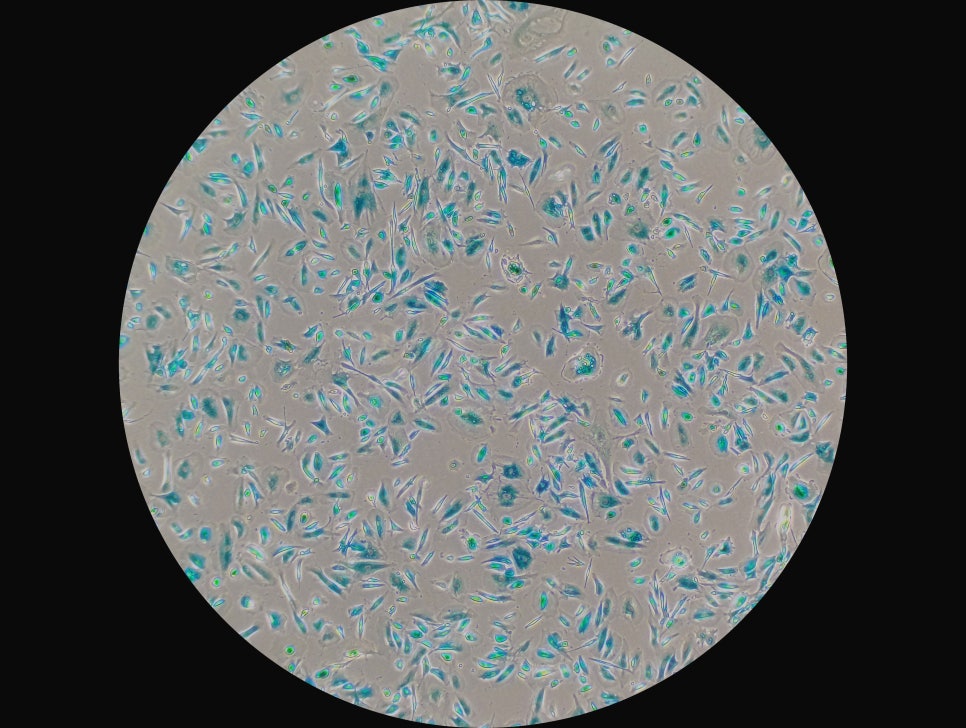
A micrograph of actual senescent cells stained blue. This is an explanatory image made publicly available by the NIH, not a specimen from the senolytic or CMA experiments discussed in this article.
Source: NIH Intramural Research Program. Preserving Cellular Health During Aging. Profile of Nathan Basisty’s laboratory. Updated July 24, 2024.
2. The first approach: remove zombie cells directly with drugs
Drugs intended to selectively eliminate senescent cells are called senolytics.
A study published on October 1, 2026, tested this approach in patients with liver disease.
It involved 31 patients with metabolic dysfunction-associated steatohepatitis (MASH) and liver fibrosis.
The researchers used dasatinib and quercetin together.
Dasatinib is a drug also used to treat certain leukemias, while quercetin is a compound found in plants.
The trial was double-blind, randomized, and placebo-controlled.
Changes were seen not just in blood tests, but in liver biopsies.
The primary endpoint was an improvement in liver fibrosis by at least one stage without worsening of steatohepatitis.
And an effect was observed.
The proportion meeting this endpoint was 47% in the treatment group and 7% in the placebo group.
Resolution of steatohepatitis was also reported in 53% of the treatment group and 7% of the placebo group.
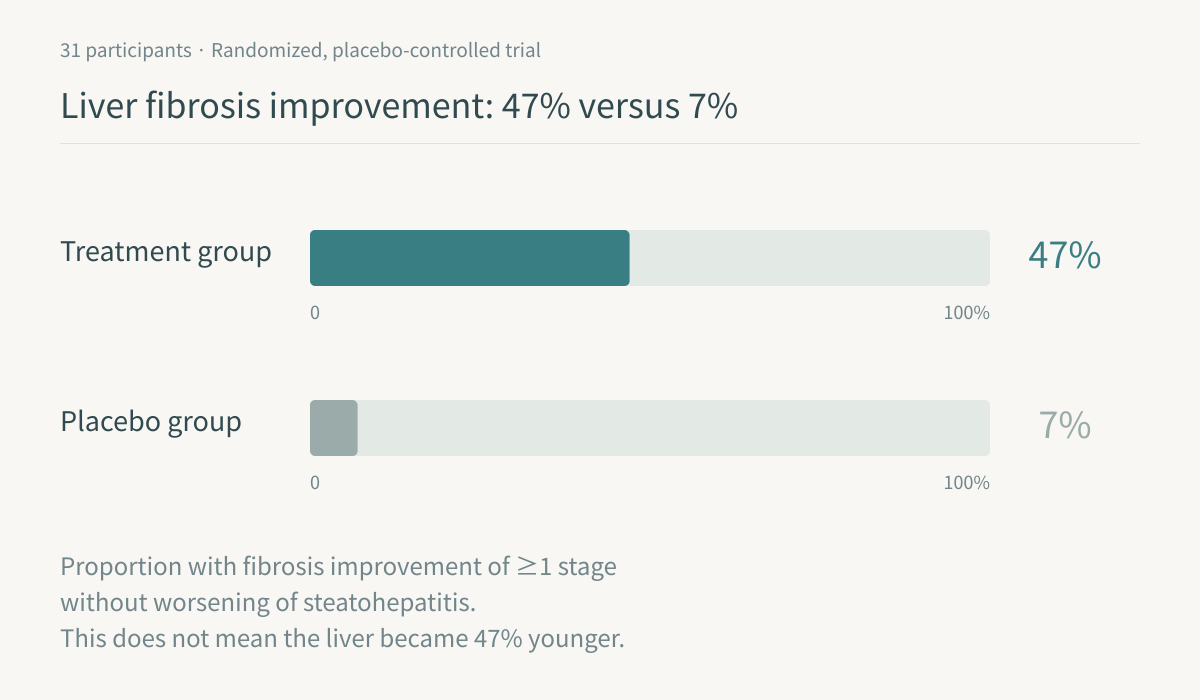
The proportion of patients whose liver fibrosis improved by at least one stage without worsening of MASH. The reported values of 47% and 7% have been redrawn on the same 0–100% scale.
Source: Created by Reverse Entropy, based on Koning et al. or Sereda et al., 2026.
Original Reverse Entropy diagram localized from the published facts. This is not a reproduced research figure.
Aging research often uses indirect measures, such as biological age or markers of inflammation.
This study is noteworthy because changes were confirmed in tissue affected by actual human disease.
3. Does this mean we finally have a treatment for aging?
It is still too early to say that.
There were only 31 participants, and adverse events were reported in 82% of the treatment group and 43% of the placebo group. The study stated that all reported adverse events were self-limiting.
Dasatinib is an anticancer drug that requires specialist supervision. Nor should these findings be interpreted as evidence for taking quercetin supplements alone.
The study also evaluated tissue improvement in patients with liver disease. It does not mean that healthy people became younger or lived longer.
We also need to establish how selectively senescent cells were eliminated and what mechanisms produced the effects.
Even so, the findings are very encouraging.
They show the possibility that a strategy targeting senescent cells could lead to improvements in actual human disease.
I hope larger clinical trials will repeatedly confirm its efficacy and safety.
4. But do we have to kill zombie cells with drugs?
This brings us to the second study, published on October 5, 2026.
Our bodies have an immune system that disposes of unwanted cells. Macrophages are among the principal cells involved in this process.
Put simply, they are the body’s cleanup crew.
But even a cleanup crew may struggle to work properly if its own internal maintenance system develops problems.
The researchers focused on CMA, or chaperone-mediated autophagy.
CMA is a maintenance system that selectively breaks down specific proteins inside cells.
Macrophages in our bodies also act as cleaners that remove senescent cells.
With age, however, these cleaners become less able to deal with senescent cells properly.
One reason is the weakening of CMA, the intracellular protein-cleanup process.
When CMA weakens, levels of SIRPα, a protein that conveys a “don’t eat me” signal to macrophages, increase.
As a result, macrophages become less able to clear senescent cells.
5. When the cleanup crew malfunctions, more zombie cells accumulate
In the study, senescent cells with reduced CMA function also showed changes in their properties and secreted signals.
These signals affected neighboring cells and also interfered with CMA function in macrophages and their ability to engulf senescent cells.
In other words, the problem involved not only the cleanup crew itself, but also its interaction with senescent cells.
Inhibiting CMA in macrophages increased the accumulation of senescent cells in mice.
Conversely, pharmacologically activating CMA reduced the senescent-cell burden in aged mice and also reduced disease severity in an animal model of pulmonary fibrosis.
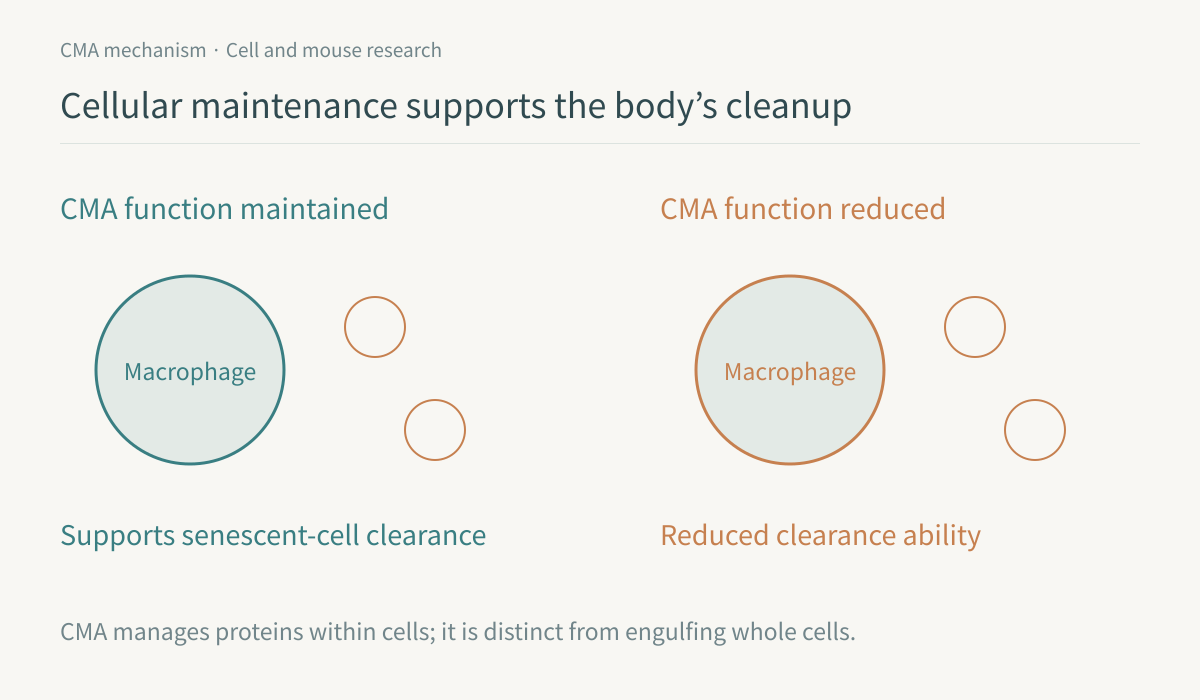
CMA is a pathway for breaking down specific proteins inside cells. It is distinct from the process by which macrophages engulf senescent cells.
Source: Created by Reverse Entropy, based on Koning et al. or Sereda et al., 2026.
Original Reverse Entropy diagram localized from the published facts. This is not a reproduced research figure.
It is clear why this finding is interesting.
Rather than killing senescent cells directly, it suggests an approach that restores the body’s own clearance functions.
6. Taken together, the two studies suggest a new picture
The first study takes this approach:
“Use drugs to remove senescent cells that have already accumulated.”
The second takes a different approach:
“Get the body’s own system for clearing senescent cells working again.”
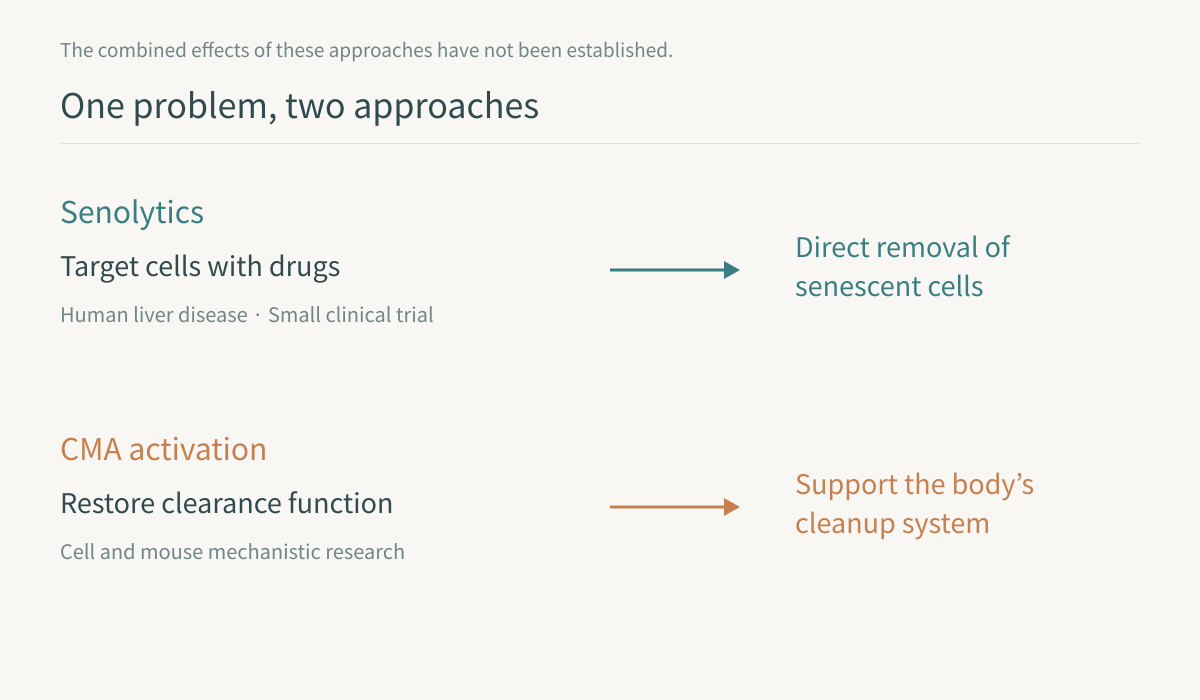
Senolytics and CMA activation are at different stages of research. Their combined effects and any effects on extending human lifespan have not been established.
Source: Created by Reverse Entropy, based on Koning et al. or Sereda et al., 2026.
Original Reverse Entropy diagram localized from the published facts. This is not a reproduced research figure.
The two approaches do not have to compete with each other.
In the future, we might consider selectively reducing senescent cells that have already accumulated, then restoring clearance functions to slow their reaccumulation.
7. This raises a bigger question for me
Our bodies sustain damage continually throughout life.
DNA is damaged, proteins are made incorrectly, and cells lose their functions.
Yet when we are young, we deal with these problems relatively well.
We break down damaged proteins, remove cells that cannot recover, and supply new cells where they are needed.
Perhaps what matters is not just preventing damage from happening at all.
How well can we deal with damage, repair it, and replace what is lost when it occurs?
I think this capacity is extremely important in aging research.
These two studies approach that question in different ways.
One removes accumulated problems; the other repairs the system that deals with them.
8. Where might future anti-aging treatments lead?
The anti-aging field has shown considerable interest in approaches that reduce damage, such as antioxidants, dietary restriction, and metabolic regulation.
But damage is difficult to avoid entirely.
Future research will need to examine reducing damage, removing existing problems, and restoring tissue together.
The senolytic trial showed the potential of a clearance strategy for treating human disease; the CMA study showed the potential of restoring the body’s clearance functions.
Of course, senescent cells can also play roles in wound healing and tumor suppression.
Indiscriminately eliminating all senescent cells should not be the goal.
What matters is understanding which cells should be removed, when, and to what extent.
I hope to see more clinical findings in this field that improve actual patients’ function and disease.
So what can we do right now?
What I find most interesting about this research is the possibility of acting without directly killing senescent cells,
by enabling our own immune cells to clear them on their own.
Senolytic therapies that remove senescent cells are an important area of anti-aging medicine research.
However, no such treatment yet has adequately established long-term efficacy and safety.
I hope these studies advance quickly and lead to treatments for patients.
I do have one concern, though.
What frightens me most about anti-aging treatment is the possibility that an approach we believe is beneficial today,
and use for years or decades, could later prove harmful instead.
There is a real example involving beta-carotene, which had been expected to prevent cancer:
large clinical trials found that it actually increased lung cancer incidence in some smokers.
I will discuss that story in detail another time.
So what should we do until new senolytic treatments have been validated?
I strongly recommend regular exercise and appropriate body-fat management.
Interestingly, some studies suggest that exercise, too, may help clear senescent cells.
Several studies examining human muscle tissue have found instances of fewer senescent cells after exercise.
Yang et al., Aging (2018): fewer p16-positive cells and macrophage infiltration were observed in muscle after resistance exercise.
Jean et al., Aging (2023): markers associated with cellular senescence in muscle decreased after high-intensity interval exercise.
This suggests that exercise may do more than build muscle: it may also help clean up senescent cells that accumulate in our bodies.
Moreover, regular exercise and appropriate body-fat management
have benefits for cardiovascular health, metabolic function, and chronic inflammation,
as established by many years of research.
Of course, there is no need to be thin at any cost. What matters is maintaining muscle while reducing unnecessary visceral fat.
While we wait for future senolytic treatments, why not make use of our bodies’ existing ability to clear senescent cells?
References
Koning M, et al. Senolytics dasatinib and quercetin in metabolic dysfunction-associated steatohepatitis: a proof-of-principle randomized, controlled trial. Nature Metabolism. October 1, 2026.
Human clinical trial of senolytics
Sereda R, et al. Decline of chaperone-mediated autophagy in aging impairs macrophage clearance of senescent cells. Nature Aging. October 5, 2026.
Study of CMA and senescent-cell clearance
Photograph of actual senescent cells: NIH research profile
#SenescentCells #ZombieCells #AntiAging #Senolytics #Immunosenescence #Macrophages #Autophagy #CMA #RegenerativeMedicine #AgingResearch #Healthspan #ReverseEntropy