Can cutting back on sweet foods help slow skin aging? Yes—glycation really does contribute to the aging of skin. But reducing the changes caused by glycation is different from improving skin that has already changed.
Understanding that distinction helps us decide where diet, skin care, and procedures each belong.
What happens when sugar reacts with collagen?
Collagen, which supports the skin, is a protein. Sugars can react with proteins without the help of enzymes. Through a series of steps, these reactions produce a range of substances called advanced glycation end products, or AGEs.
Some of them form unwanted links between collagen fibers. Imagine spots of glue joining together parts of a mesh that should remain flexible. As these changes accumulate, they can affect the physical properties of the tissue and the way proteins are renewed.
Glycation products can also activate a cellular receptor called RAGE, contributing to oxidative stress and inflammatory responses. Glycation can therefore affect both the skin’s structure and the behavior of surrounding cells. Mechanisms and research.
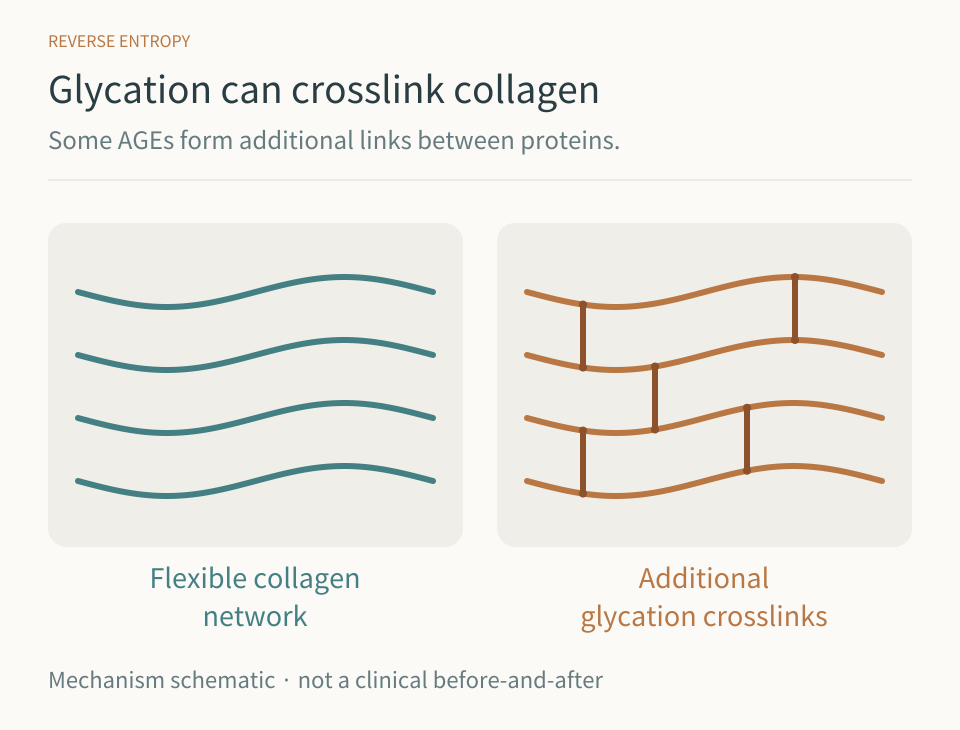
When we hear that skin becomes “glycated,” it is easy to picture it turning yellow like caramel. But AGEs are not one single substance, and not all are yellow or fluorescent. A yellowish complexion alone cannot tell us that glycated collagen has accumulated in the dermis.
What a survey of 800 women actually tells us
A study published in the Journal of Cosmetic Dermatology in 2026 surveyed 800 women aged 20–50 in China online and conducted in-depth focus-group interviews with 24 participants.
The changes participants most wanted from anti-glycation skin care were less dullness and less yellowing. These were selected by 60% and 58%, respectively. Shi et al., 2026.
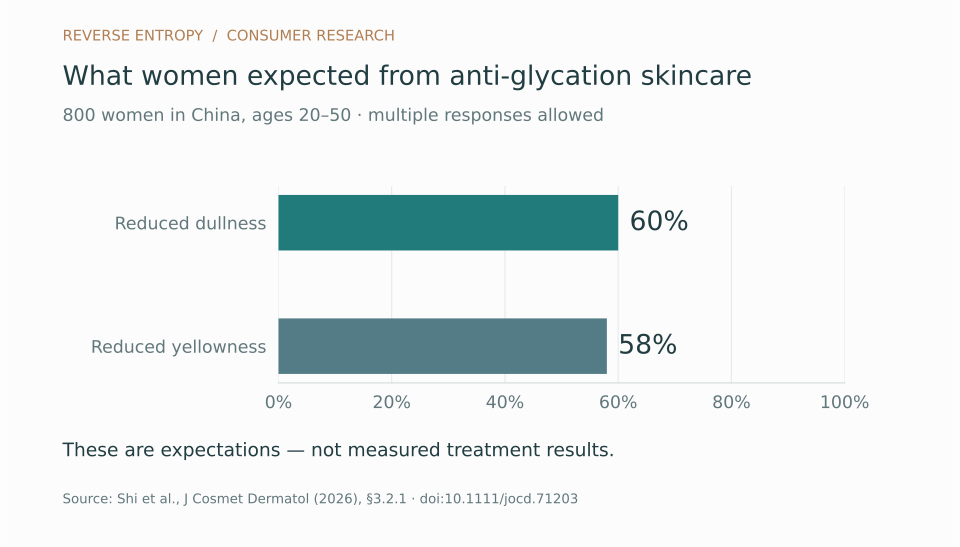
Source: Shi S, Chua K, Lua BL. Journal of Cosmetic Dermatology, 2026, Section 3.2.1. Article. Chart: Reverse Entropy.
The meaning of those numbers matters. They do not mean that 60% of participants’ skin improved. They mean that 60% hoped for that improvement. The study did not measure glycation in skin tissue or compare the effects of cosmetics and procedures.
What it shows is that consumers strongly associate “anti-glycation” with changes in skin tone. So, are there glycation products that actually contribute to yellowing in skin?
A yellow glycation product found in human skin
In 2024, researchers isolated a yellow glycation-related substance called AGEY from human skin. In an analysis of 14 epidermal tissue samples from light skin types, samples with more AGEY also tended to be more yellow. This was not a treatment trial in living people, but it provides a specific clue linking skin yellowing with glycation. Fang et al., 2024.
Interestingly, the tissue studied was the epidermis. If we explain all glycation as a problem of collagen deep in the dermis, we can miss part of what is happening in the skin.
The same researchers induced glycation in reconstructed human epidermis and treated the model with a combination of four cosmetic ingredients, including niacinamide. AGEY formation and yellowing decreased. Results from a cultured model are not the same as the clinical effects of a finished skin-care product, but they provide a reason to study topical approaches.
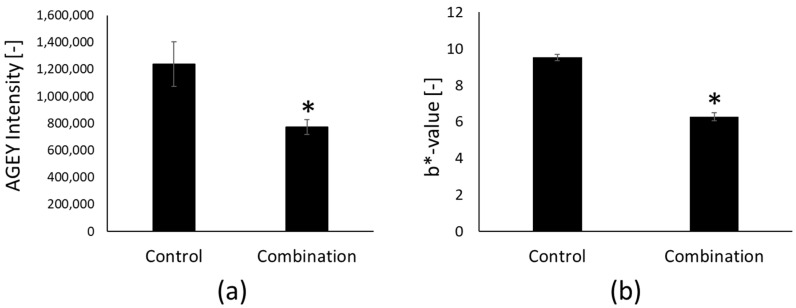
Source: Fang B et al. International Journal of Molecular Sciences. 2024;25:5596. Article · CC BY 4.0. Original figure unchanged.
Why cutting back on sweets matters
Glucose is normally present in our bodies. Blood glucose levels, duration of exposure, and the rate at which tissues are renewed all influence glycation. Long-lived collagen has more time to accumulate these changes.
Human research supports this relationship. A DCCT ancillary study analyzed skin collagen from 216 people with type 1 diabetes. After about five years, those receiving intensive glucose management had lower levels of several glycation and glycoxidation markers and greater collagen solubility than those receiving conventional therapy. Monnier et al., 1999.
This is evidence that blood glucose management is connected to long-term changes in skin tissue.
In practice, I would start with sustainable eating habits and exercise: reduce sugary drinks and frequent overeating, move regularly, and manage diabetes or prediabetes according to the individual’s condition. Blood glucose management basics.
I would pay particular attention to drinks sweetened with high-fructose corn syrup. I recently wrote about this in a separate Korean post, which readers interested in the topic may also find useful.
A short period using a continuous glucose monitor can also be considered as a way to review how eating habits relate to glucose patterns. In my own case, I take a low dose of metformin, 250 mg daily, for an anti-aging purpose rather than to treat diabetes.
Can radiofrequency and PN treatments such as Rejuran also help?
Managing blood glucose does not immediately remove existing loss of elasticity or rough skin texture. This is why I consider systemic metabolism and the condition of the skin itself together.
Radiofrequency uses heat to induce structural changes and remodeling responses in collagen, and is used to improve skin firmness and texture. Clinical studies of PN injections have also assessed hydration, roughness, pores, and other skin outcomes. Review of energy-based treatments · Trial comparing PN and hyaluronic acid.
What I expect here is an improvement in skin condition. My clinical approach is to use radiofrequency to encourage the turnover and remodeling of collagen affected by glycation, while considering PN or PDRN to support inflammation control and the tissue environment. I believe this combination can help skin renew collagen whose structure has deteriorated.
Metabolic care
Blood glucose and sustainable daily habits.
Manage the environment the skin lives in over time.
Everyday skin care
Sun protection, moisturization, and irritation control.
Build a foundation that limits damage and dryness.
Individual treatment
Pigmentation, vessels, texture, and firmness.
Choose a treatment for a defined finding and goal.
I think about supporting skin recovery while managing the metabolic environment: reducing the conditions that promote collagen damage through glucose management, then identifying whether the main skin concern is pigmentation, visible vessels, dryness, or elasticity.
Cutting back on sweets is an important first step in that plan. Add sun protection, moisturization, and care appropriate to the person’s metabolic health. For remaining skin concerns, choose a treatment with a clear purpose. That is how I approach comprehensive skin care.
References
- Shi S, Chua K, Lua BL. Consumer Perceptions of Glycation-Induced Facial Skin Aging and the Role of Skincare Products. Journal of Cosmetic Dermatology. 2026;25:e71203. Article.
- Fang B, et al. Identification of Yellow Advanced Glycation End Products in Human Skin. International Journal of Molecular Sciences. 2024;25:5596. Article.
- Monnier VM, et al. Skin Collagen Glycation, Glycoxidation, and Crosslinking Are Lower in Subjects With Long-Term Intensive Versus Conventional Therapy of Type 1 Diabetes. Diabetes. 1999;48:870–880. Article.
- Zheng W, et al. Research Advances on the Damage Mechanism of Skin Glycation and Related Inhibitors. Nutrients. 2022;14:4588. Article.
- Lee YJ, et al. Comparison of the effects of polynucleotide and hyaluronic acid fillers on periocular rejuvenation. Journal of Dermatological Treatment. 2022;33:254–260. Abstract.
- High-Intensity Focused Ultrasound and Radiofrequency in Non-Invasive Skin Rejuvenation. Applied Biosciences. 2026;5:72. Article.
- NIDDK. Managing Diabetes. Official guidance.