“How many hours do you sleep a night?”
It is usually the first question we ask about sleep. We start by checking whether someone gets seven hours, eight hours, or perhaps too little.
But that question alone is not enough.
“Do you go to bed and wake up at similar times every day?”
“Is your room dark and quiet enough while you sleep?”
Those questions are missing.
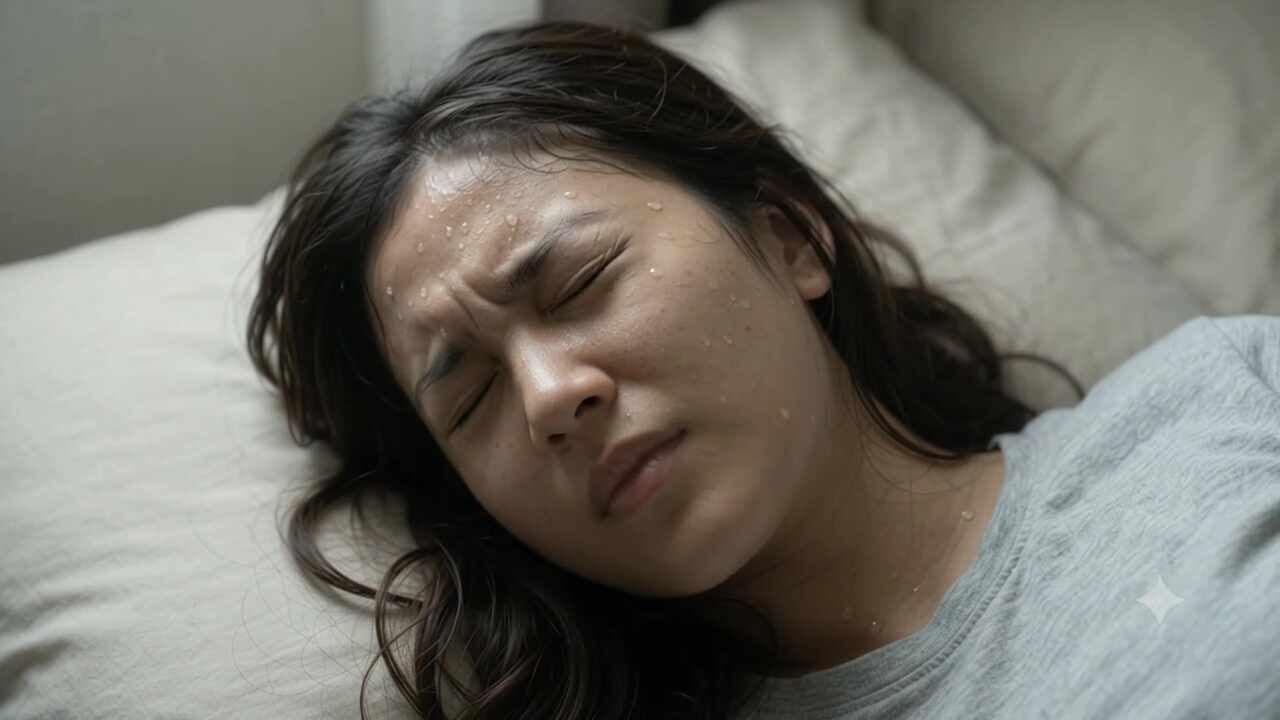
For people who find it difficult to extend their sleep for various reasons, I think it is worth checking sleep regularity and the sleeping environment first, rather than simply trying to force in more time.
Here is why.
1. A study of 60,000 people found a 30% lower mortality risk in the most regular sleepers
The study was published online in the journal Sleep in 2023.
Researchers analyzed wrist-activity data from 60,977 UK Biobank participants.
A research device worn on the wrist, much like a smartwatch, recorded their sleep patterns over one week.
During an average follow-up of about 6.3 years, 1,859 participants died.
Rather than looking only at sleep duration, the researchers focused on the Sleep Regularity Index, or SRI.
In simple terms, this measures how consistently someone is asleep or awake at the same time today and tomorrow. It reflects not just bedtimes and waking times, but also patterns of waking during sleep.
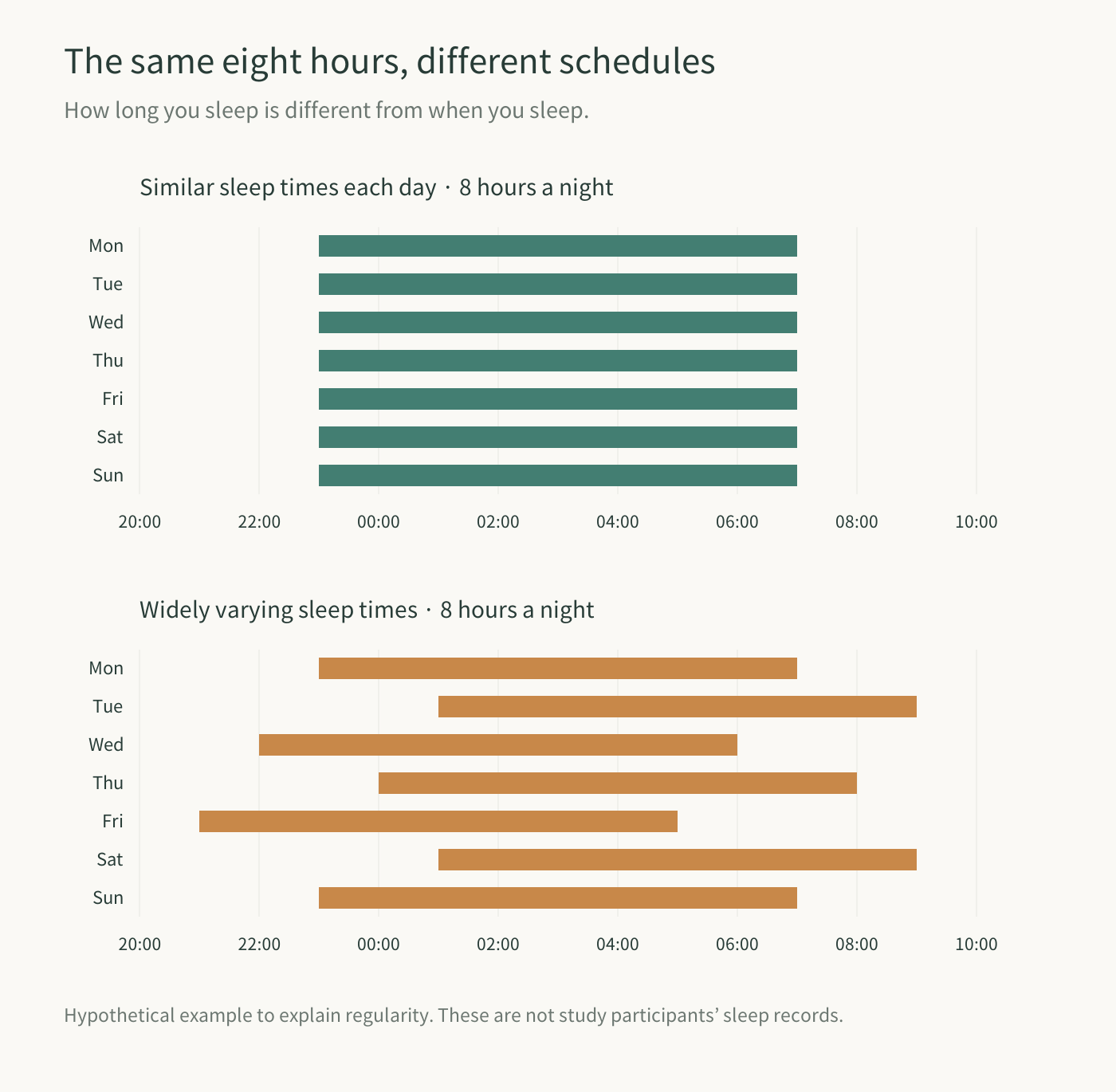
Source: An original Reverse Entropy illustration of sleep regularity, based on Windred et al., Sleep, doi:10.1093/sleep/zsad253. Source paper. Created by Reverse Entropy; not a reproduction of a figure from the paper.
The results were interesting.
The top 20% for sleep regularity had an approximately 30% lower risk of death from any cause than the bottom 20%, whose sleep was least regular (HR 0.70).
I think this finding suggests that we need to change how we look at sleep.
We should consider not just how much we sleep, but how consistently we follow a sleep rhythm.
2. Can sleeping long enough make up for an irregular schedule?
A separate study using the same UK Biobank examined this question more directly.
Published in the Journal of Epidemiology & Community Health, it followed 72,269 people without a previous major adverse cardiovascular event for about eight years.
Compared with regular sleepers, irregular sleepers had a 26% higher risk of major cardiovascular events, including heart attack, heart failure, and stroke. The hazard ratio was 1.26, with a 95% confidence interval of 1.16–1.37.
There was another important finding.
Even when participants met the recommended sleep duration, the excess cardiovascular risk remained in the highly irregular sleep group. Chaput et al., original paper
“My sleep times are all over the place, but I get eight hours in total, so I’m fine.”
This is one reason that assumption is hard to make.
Both studies were observational. We cannot therefore calculate that changing our daily rhythm will reduce our risk by precisely those amounts. But the findings did not support the idea that getting enough hours completely offsets the burden of irregular sleep.
I would like us to stop treating sleep as something to fit into whatever time is left at the end of the day.
Sleep needs a schedule, as well as time.
3. Sleeping with the light on increased insulin resistance the next morning
The next study actually changed the sleeping environment.
In 2022, researchers at Northwestern University in the United States studied 20 healthy adults and published the results in PNAS.
Ten people slept in a dark environment of less than 3 lux on both nights. The other ten slept in darkness on the first night, then with 100-lux room lighting on the second.
Changes appeared after just one night.
Those who slept with the light on had a higher heart rate during sleep and greater insulin resistance the next morning. Mason et al., PNAS
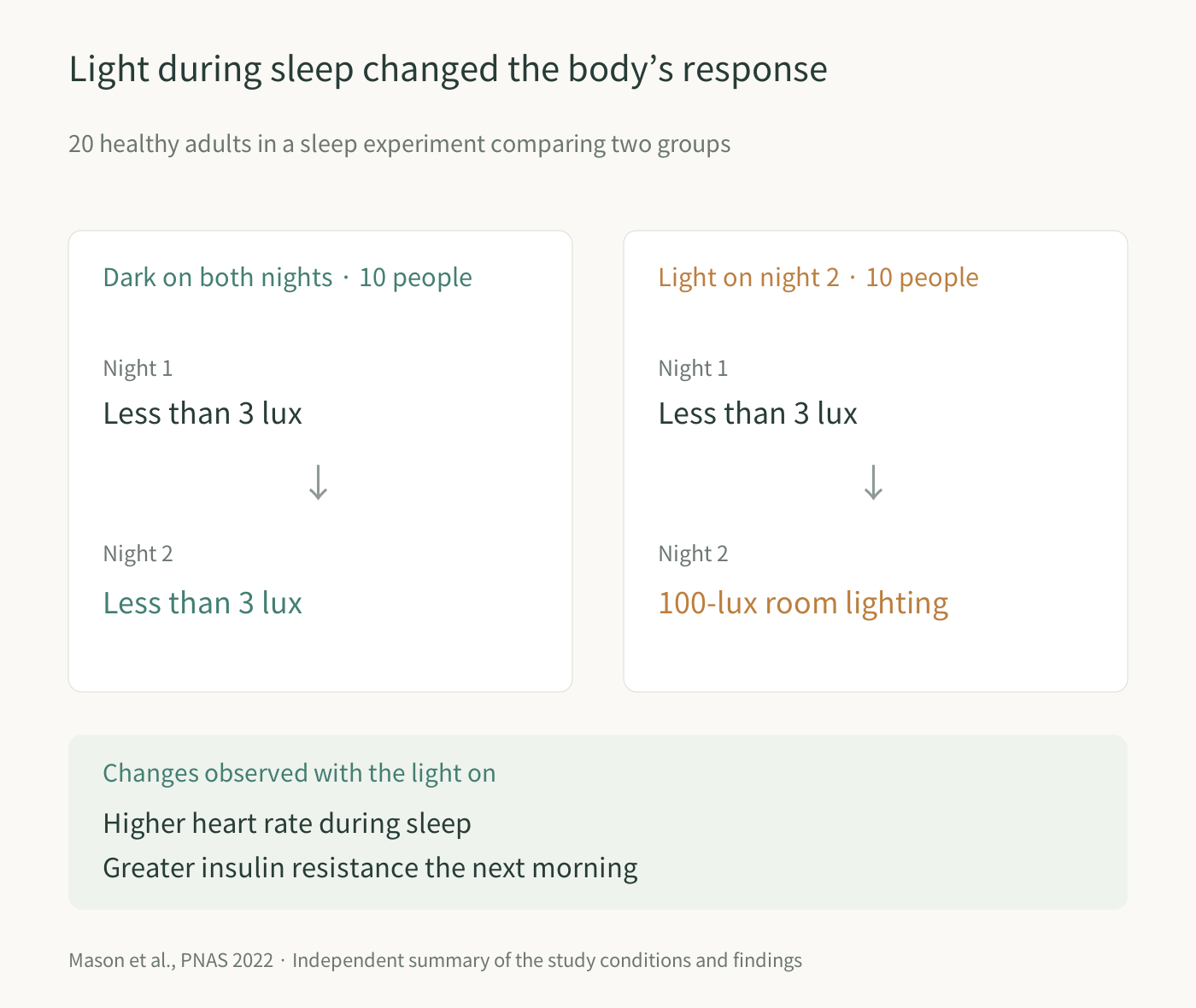
Source: Reverse Entropy’s independent summary of the experimental conditions and results in the text and Table 1 of Mason et al., PNAS. 2022;119:e2113290119. Source paper. Created by Reverse Entropy; not a reproduction of a figure from the paper.
Greater insulin resistance means that the body responded less sensitively to insulin when handling the same glucose load. What this experiment demonstrated was a change in the next day’s metabolic response.
More interestingly, there was no clear difference in participants’ subjective sleep quality.
Someone could think, “I slept reasonably well,” while their body showed a different response.
4. Nighttime light also mattered when researchers followed actual diabetes diagnoses
A much larger study appeared in The Lancet Regional Health – Europe in 2024.
Researchers had 84,790 people wear light sensors for one week to measure their daytime and nighttime light exposure. They then followed the incidence of type 2 diabetes for an average of about 7.9 years.
The 10% with the most nighttime light exposure had a 53% higher risk of developing diabetes than the 50% with the darkest nights.
After adjustment for multiple factors, the hazard ratio was 1.53, with a 95% confidence interval of 1.32–1.77. The association between nighttime light and diabetes remained in analyses that also accounted for sleep duration and other factors. Windred et al., original paper
The sensors recorded light during nighttime activity as well as during sleep.
It is therefore more appropriate to read this as a finding about how brightly lit a person’s nighttime environment was, rather than the effect of a bedroom light alone.
Together with the earlier experiment, this points in an important direction.
Light at night is not simply something that makes falling asleep uncomfortable. It may be an environmental factor connected to metabolic health.
I think we should look at how we spend our nights, just as we look at food and exercise when managing our health.
If you sleep with the television on or keep your home brightly lit late into the night, please change those habits. The same goes for looking at your phone right up until bedtime.
5. Noise is similar: being able to fall asleep does not mean it has no effect
“I can sleep even when it’s noisy.”
Some people say this. But being able to fall asleep and noise having no effect on the body are two different things.
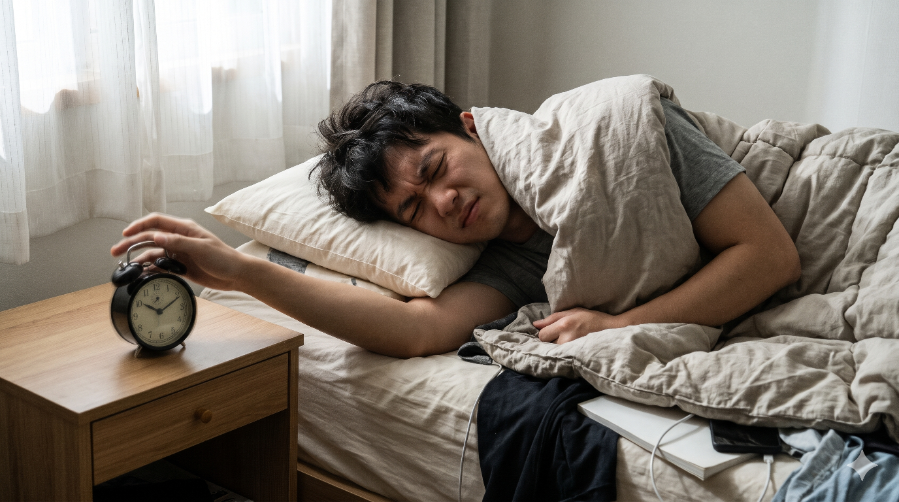
In a study published in the European Heart Journal in 2013, 75 healthy adults were exposed to aircraft noise while sleeping at home.
In random order, participants experienced a night without aircraft noise, a night with 30 aircraft-noise events, and a night with 60.
Noise-exposed nights were associated with poorer sleep quality and higher adrenaline the following morning. Impaired endothelial function was also observed in the 60-event condition. Schmidt et al., original paper
The endothelium is the layer of cells lining the inside of blood vessels. It plays an important role in allowing them to dilate properly.
The study documented the effects of noise beyond simply “feeling annoyed because it is loud”: it found changes in stress responses and blood-vessel function.
6. Bedroom temperature is part of sleep, too
A study published in Science of the Total Environment in 2023 placed environmental sensors in the homes of 50 older adults and measured their sleep with wearables. The analysis covered 10,903 nights in total.
In this group, sleep was generally most efficient and stable when the bedroom temperature was 20–25°C. As the temperature rose from 25°C to 30°C, sleep efficiency fell by about 5–10%. Baniassadi et al., original paper
Sleep efficiency is the proportion of time in bed that is actually spent asleep.
If you lie in bed for eight hours but sleep for only six, your sleep efficiency is 75%. This is why simply counting time in bed does not tell us enough about sleep.
There were also substantial individual differences. Rather than applying a 20–25°C target to everyone, I think the important thing is to find conditions in which neither heat nor cold disrupts sleep.
Adjust the thickness of your bedding and your sleepwear along with the room temperature, so that you can stay comfortable throughout the night.
7. “I sleep fine even after coffee” is not a completely reliable guide
Even with a dark, quiet bedroom, consuming a large amount of a stimulant close to bedtime can still have a negative effect.
A randomized crossover trial published online in Sleep in 2024 gave 23 adult men a single dose of either 100 mg or 400 mg of caffeine 12, eight, or four hours before bedtime.
At 100 mg, no significant difference from placebo was detected. At 400 mg, however, sleep onset and sleep structure changed depending on when the caffeine was taken.
In particular, even 400 mg taken eight hours before bed was associated with more fragmented sleep. Yet participants did not report clearly worse sleep quality at that timing. Gardiner et al., original paper
Caffeine’s effects depended on the dose and timing, and what people felt did not always match what was measured.
So I would not judge caffeine’s effects solely from the feeling that “I can fall asleep fine after coffee.”
Falling asleep without difficulty and recovering adequately throughout the night are different things.
8. That is why I would first check the conditions that support sleep
Once you have set aside enough time for sleep, the next goal is not to lie in bed longer. It is to make that time count.
These are the things I would check first when managing sleep.
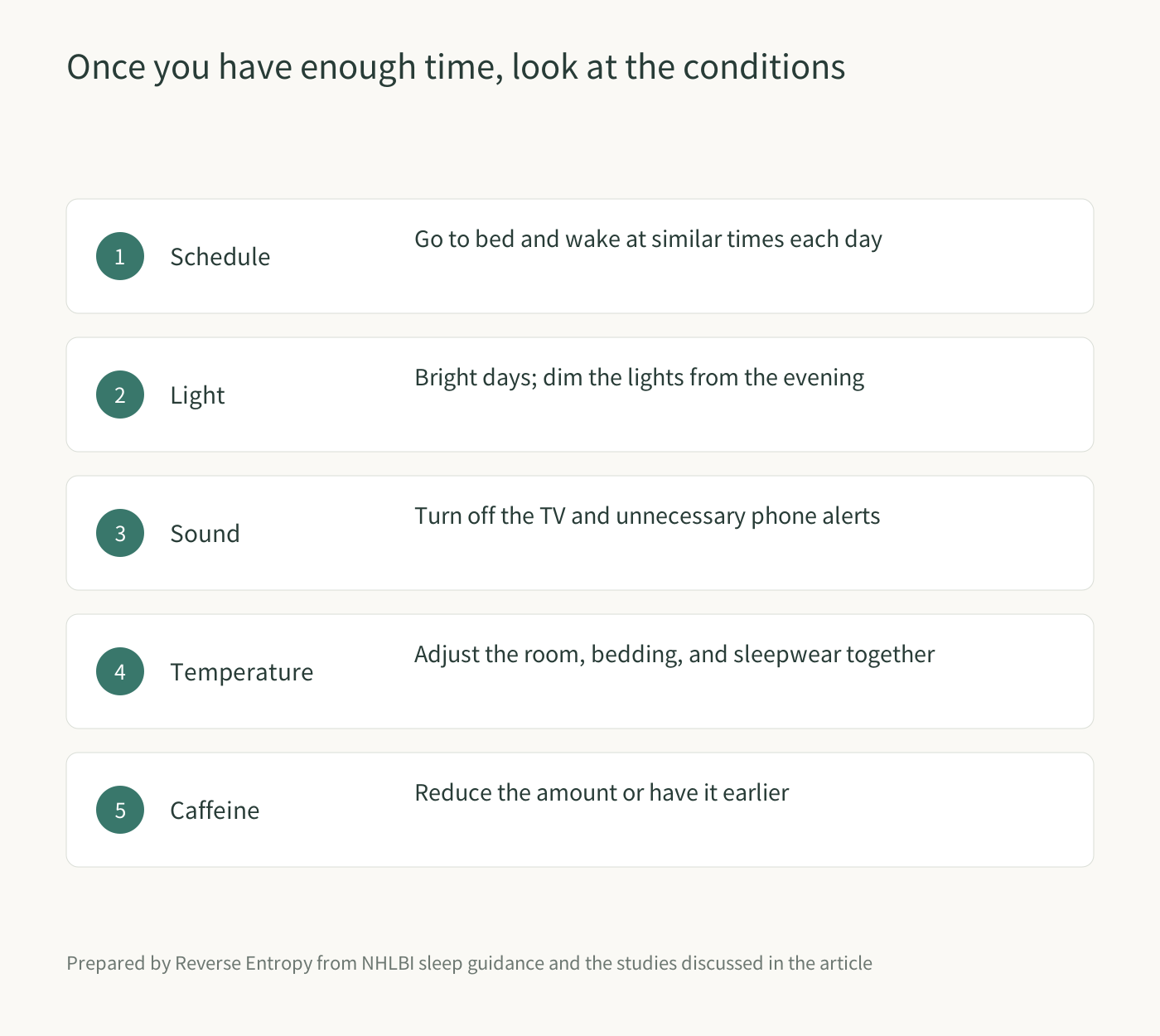
Source: Created by Reverse Entropy from NHLBI’s Healthy Sleep Habits and the studies discussed in this article. Source guidance. An original illustration, not a reproduction of a research figure.
What to check, and what to change
Bedtimes and waking times: Set a schedule that allows enough sleep. Try to keep the difference between weekdays and weekends to about an hour or less.
Daytime and nighttime light: Get natural light in the morning and during the day, and dim the lights from the evening. Turn off the television and unnecessary lights when sleeping. Avoid looking at your phone as much as possible.
Noise: Turn off unnecessary phone alerts and start by reducing avoidable disturbances, such as the television and outside noise.
Temperature and bedding: Adjust the room temperature, bedding, and sleepwear together so that you are neither too hot nor too cold.
Caffeine: Avoid high doses in the afternoon and evening. If your sleep is poor, try reducing the amount or having it earlier.
One more useful tip: if you need to go to the bathroom at night, use a dim light that lets you move around safely.
If you are very sleepy during the day despite getting enough sleep, or have loud snoring or pauses in breathing during sleep, other causes, including sleep apnea, should be evaluated.
In closing: managing sleep means managing the schedule and environment too
I disagree with treating sleep health only as a numerical task of “getting eight hours a day.”
You should not feel reassured just because you have filled the hours if your bedtimes and waking times vary widely, your room is bright, noise keeps recurring, or you toss and turn because it is hot.
My conclusion is this.
Once you have secured the sleep time you need, improve regularity and the environment before simply trying to add more hours.
I would like us to value waking at similar times each day, dimming evening lights, and making the bedroom quiet just as much as the intention to sleep more.
Before considering a new anti-aging drug or supplement, it is more important to check the nights you repeat day after day.
Add one more question to “How many hours did I sleep last night?”
“During those hours, did my body have the conditions it needed to rest properly?”
References
1. Watson NF, et al. Recommended Amount of Sleep for a Healthy Adult: A Joint Consensus Statement of the American Academy of Sleep Medicine and Sleep Research Society. Sleep. 2015;38:843–844. Source
2. Windred DP, et al. Sleep regularity is a stronger predictor of mortality risk than sleep duration: A prospective cohort study. Sleep. 2024;47:zsad253. Published online in 2023. Source
3. Chaput JP, et al. Sleep regularity and major adverse cardiovascular events: a device-based prospective study in 72 269 UK adults. Journal of Epidemiology & Community Health. 2025;79:257–264. Source
4. Mason IC, et al. Light exposure during sleep impairs cardiometabolic function. PNAS. 2022;119:e2113290119. Source
5. Windred DP, et al. Personal light exposure patterns and incidence of type 2 diabetes: analysis of 13 million hours of light sensor data and 670,000 person-years of prospective observation. The Lancet Regional Health – Europe. 2024;42:100943. Source
6. Schmidt FP, et al. Effect of nighttime aircraft noise exposure on endothelial function and stress hormone release in healthy adults. European Heart Journal. 2013;34:3508–3514. Source
7. Baniassadi A, et al. Nighttime ambient temperature and sleep in community-dwelling older adults. Science of the Total Environment. 2023;899:165623. Source
8. Gardiner CL, et al. Dose and timing effects of caffeine on subsequent sleep: a randomized clinical crossover trial. Sleep. 2025;48:zsae230. Published online in 2024. Source
9. NHLBI. Sleep Deprivation and Deficiency: Healthy Sleep Habits. Source
10. Brown TM, et al. Recommendations for daytime, evening, and nighttime indoor light exposure to best support physiology, sleep, and wakefulness in healthy adults. PLOS Biology. 2022;20:e3001571. Source
#Sleep #SleepRegularity #SleepEnvironment #SleepDuration #RestfulSleep #CircadianRhythm #BedroomLighting #LightPollution #Caffeine #GlucoseManagement #CardiovascularHealth #AntiAging #Healthspan #ReverseEntropy #HINClinic