The 2005 film The Island has an intriguing premise.
Wealthy people create genetically identical clones of themselves and receive their organs whenever they need a transplant.
If their heart fails, they get a new heart.
If their kidney fails, they get a new kidney.
It is a kind of living warehouse of spare parts.
But from the perspective of aging, a different question arises.
The original Korean article illustrated this passage with a scene from The Island. This independently created conceptual illustration replaces that still; it is not a film scene or experimental image. New conceptual illustration by Reverse Entropy, prepared with AI assistance. Not a still from The Island or an experimental image.
If we kept replacing old organs with young ones, could we stay young indefinitely?
With a car, when you replace an old part with a new one, at least that part is new.
In the human body, however, the story seems a little different.
In a heart-transplant study released in September 2026,
a young heart grew older when placed in an old body.
Conversely, an old heart became younger when placed in a young body.
The heart itself was not the only thing determining its condition.
Does the heart remember its own age?
The study by Jesse Poganik, Tomohisa Matsunaga, Vadim Gladyshev, and colleagues has the following title:
Transplanted hearts assimilate the recipient’s biological age
In everyday language, this means that transplanted hearts are influenced by the recipient’s age and become similar to it.
The title itself tells us the result.
Here is how the experiments were carried out.
They exchanged young and old hearts
The researchers used young mice aged 3 months, middle-aged mice around 1 year old, and old mice aged 18–20 months.
Unlike a human heart transplant, the original heart was not removed.
The original heart remained in place, and a second heart was connected to blood vessels in the neck.
This allowed the researchers to compare the native and transplanted hearts within the same animal.
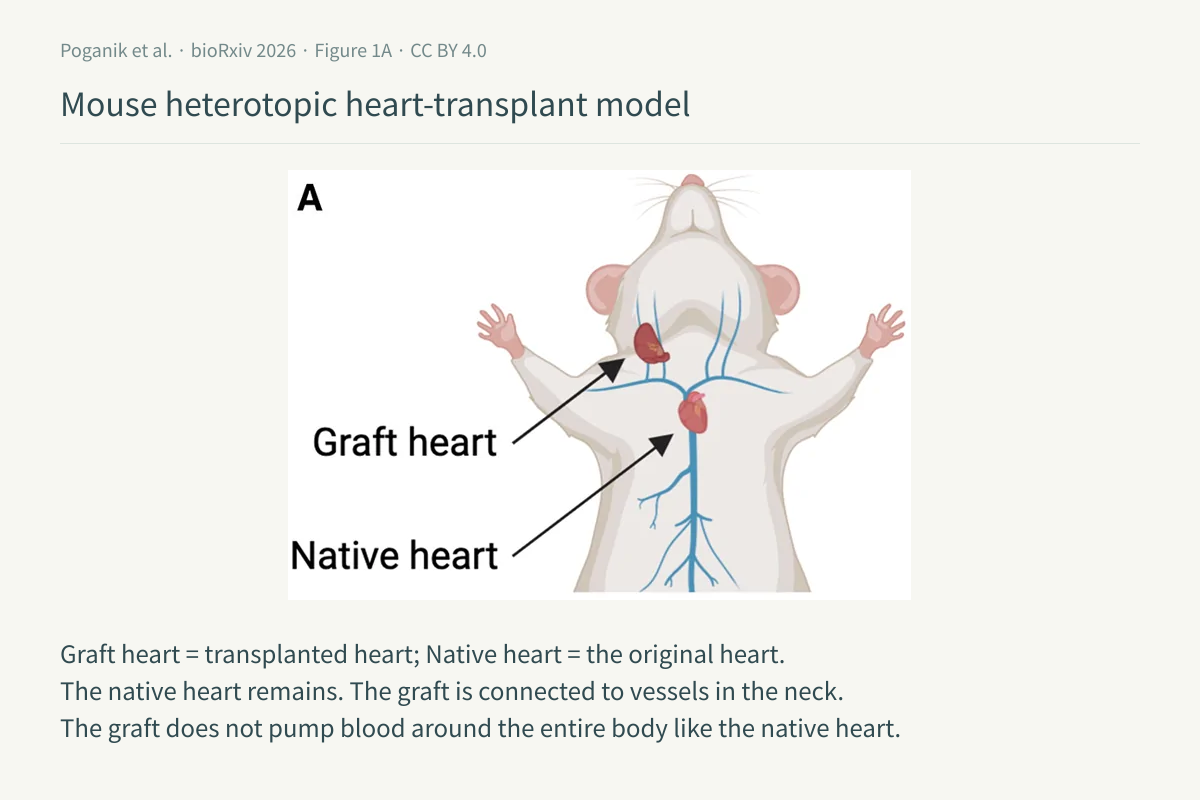
A mouse experiment in which a second heart was connected to neck vessels while the native heart remained in place. The grafted heart was not configured to pump blood throughout the body in the same way as the native heart.
Source: Poganik JR et al. bioRxiv. 2026. Figure 1A. CC BY 4.0. Panel A excerpted from the original.
Original panel preserved without changes; a localized explanatory key was added. Poganik et al., CC BY 4.0.
The researchers measured DNA methylation in heart tissue 4–6 months later.
DNA methylation consists of small chemical marks attached to DNA. Their patterns change with age, allowing researchers to construct aging clocks that estimate a tissue’s “biological age.”
This study did not rely on just one clock; several measures were applied together.
The heart’s age shifted with the body’s environment
Young heart → old body
DNA methylation markers of aging in the transplanted heart shifted in an older direction.
Old heart → young body
Conversely, aging markers in the transplanted heart shifted in a younger direction.
Universal Clocks 2 and 3 and the mouse pan-tissue clock showed results in the same direction.
Gene-expression analyses broadly supported these findings as well.
Put simply, the heart’s age changed depending on where it was placed.
An organ’s age may not be stored solely within the organ itself.
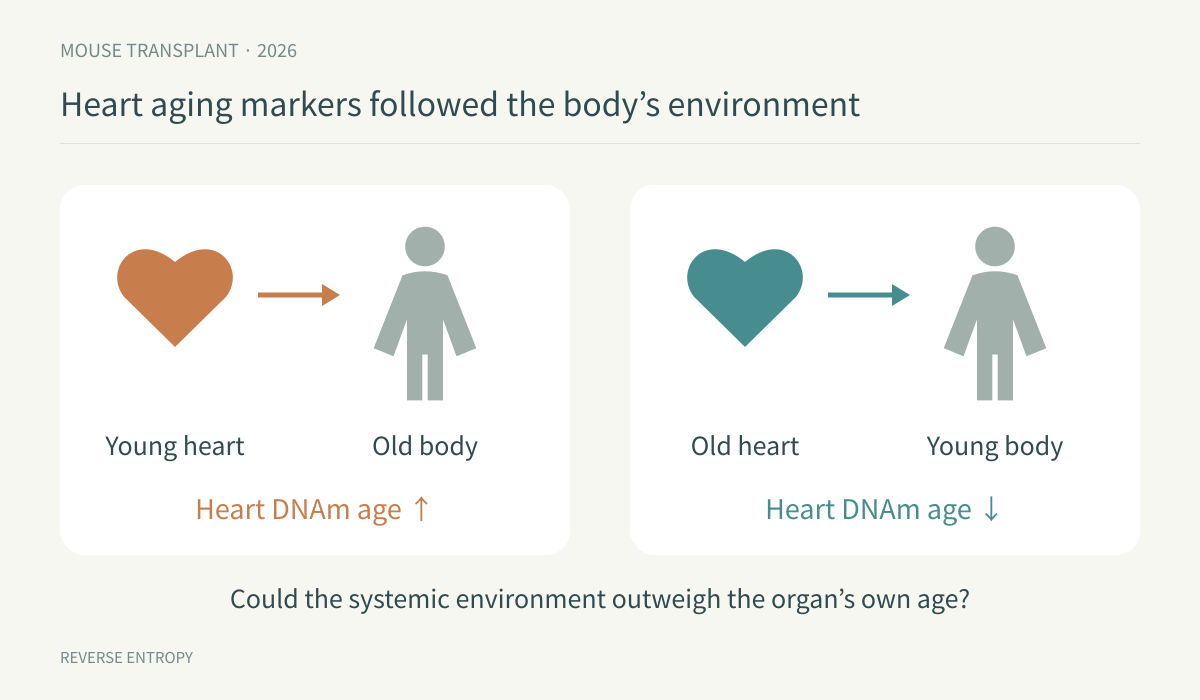
Molecular aging markers changed when young hearts were placed in old bodies and old hearts in young bodies. This experiment showed no clear whole-body rejuvenation effect.
Source: Original conceptual diagram by Reverse Entropy, based on Poganik JR et al. bioRxiv. 2026.
Original Reverse Entropy conceptual diagram, localized. Not a study data plot.
Did the old body become younger, then?
At this point, I think the next question is more important.
After a young heart was placed in an old body, might that body also have become a little younger?
The researchers examined aging markers not only in the transplanted heart, but also in the native heart, liver, and blood.
These did not show a consistent, clear whole-body rejuvenation effect.
There were some small changes, but the results did not establish that one young heart meaningfully lowered the biological age of the entire old body.
In this experiment, the effect of the body’s environment on the transplanted organ was more pronounced than the effect of one young organ on the whole body.
Similar findings appeared in transplanted human hearts
An experiment attaching a second heart to a mouse cannot, on its own, explain what happens in people.
The researchers therefore analyzed myocardial biopsy specimens from actual heart-transplant patients stored at Brigham and Women’s Hospital.
The analysis involved 11 people with large age differences between donor and recipient.
Five were young recipients of hearts from older donors; six were older recipients of hearts from younger donors.
The human findings were similar to those of the mouse experiments described above.
However, the sample was small, and results sometimes differed depending on the aging clock used.
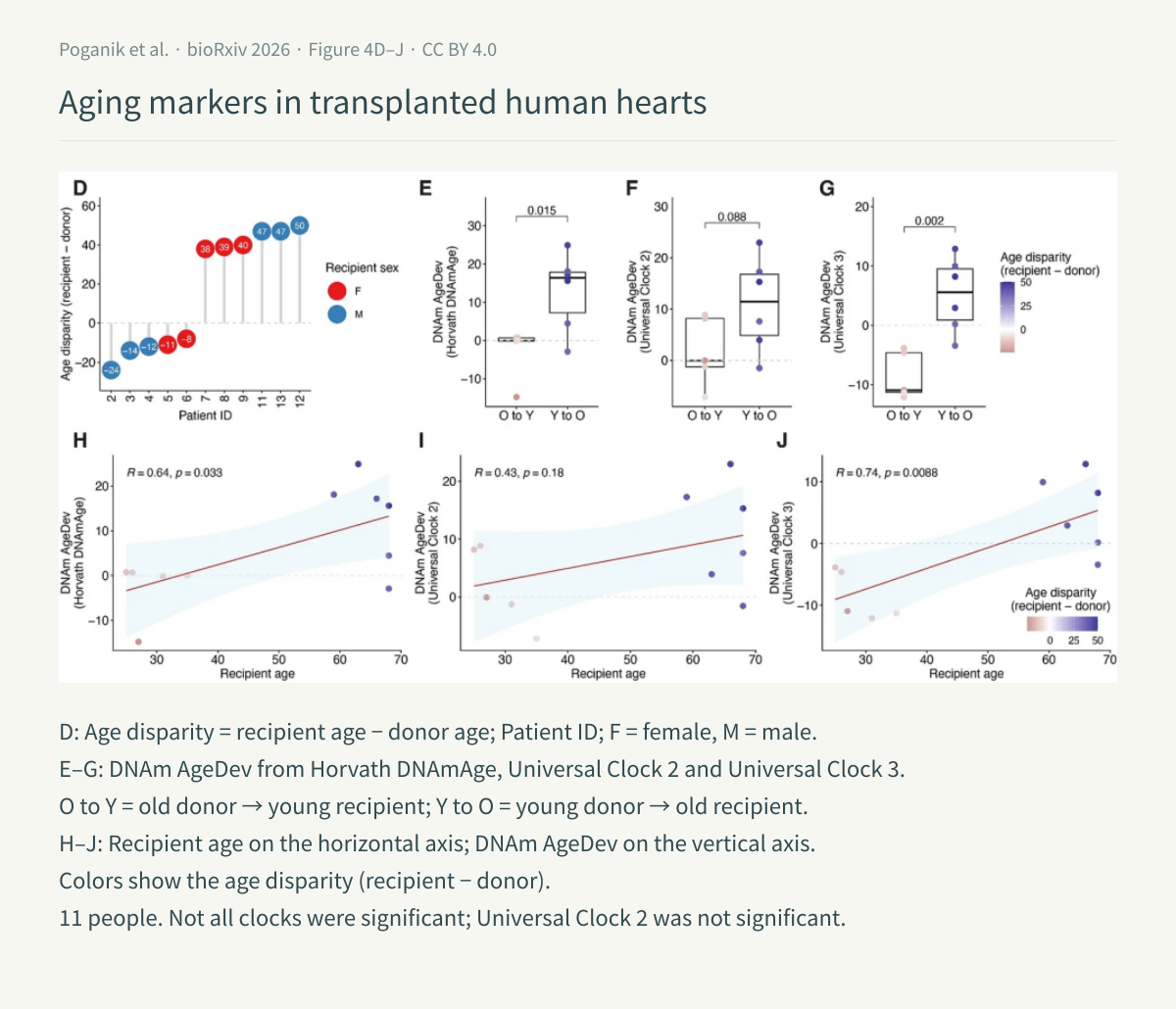
Changes related to recipient age were also observed in transplanted human hearts. The molecular analysis involved 11 people, and not all clocks yielded statistically significant results. Neither the between-group difference nor the correlation was significant for Universal Clock 2.
Source: Poganik JR et al. bioRxiv. 2026. Figure 4D–J. CC BY 4.0. The relevant panels are excerpted without alteration of the data.
Data, points, axes, statistics and confidence bands are unchanged. A localized label key has been added below the original panels.
To strengthen these findings, the researchers also examined electrocardiograms, echocardiograms, and exercise-test results from hundreds of transplant patients. Depending on the analysis, the number of patients ranged from approximately 150 to 317.
Heart rate, posterior wall thickness, and some measures of exercise capacity were associated with recipient age even after adjustment for donor age.
But a 2024 study pointed in the other direction
A study published in the American Journal of Transplantation in 2024 was titled:
“Transplanting old organs promotes senescence in young recipients.”
The study included transplanting hearts from 18-month-old mice into young, 3-month-old mice.
Thirty days later, the young recipients showed increased cellular senescence in their lymph nodes, fat, liver, and muscle, along with reduced physical performance. In separate cognition experiments, hearts from 3- or 18-month-old donors were transplanted into middle-aged, 12-month-old recipients. Spatial learning and memory were tested 1 and 4 months after transplantation, and recipients of older hearts showed cognitive impairment.
Blood levels of factors associated with the senescence-associated secretory phenotype (SASP), released by senescent cells, and of mitochondrial DNA increased.
These results suggest that an aged organ can affect other tissues.
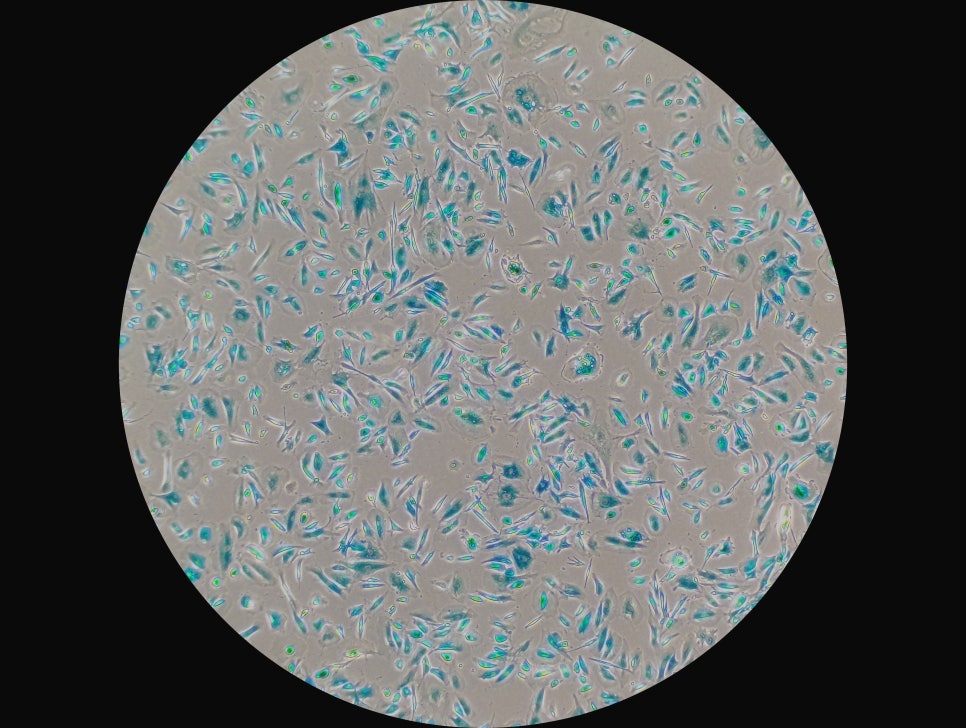
A micrograph of actual senescent cells stained blue. This explanatory image was made publicly available by the NIH and is not a specimen used in the heart-transplant experiments discussed here.
Source: NIH Intramural Research Program. Preserving Cellular Health During Aging. Profile of Nathan Basisty’s laboratory. Updated July 24, 2024.
The researchers also performed an experiment in which old donor mice received a single treatment of dasatinib and quercetin, aimed at clearing senescent cells, before transplantation.
This reduced the release of mitochondrial DNA and mitigated the decline in recipients’ physical function.
Do the two studies contradict each other?
In the 2024 study, an old organ promoted cellular senescence in younger recipients, with functional impairments also observed.
In the 2026 study, a young body made an old organ younger.
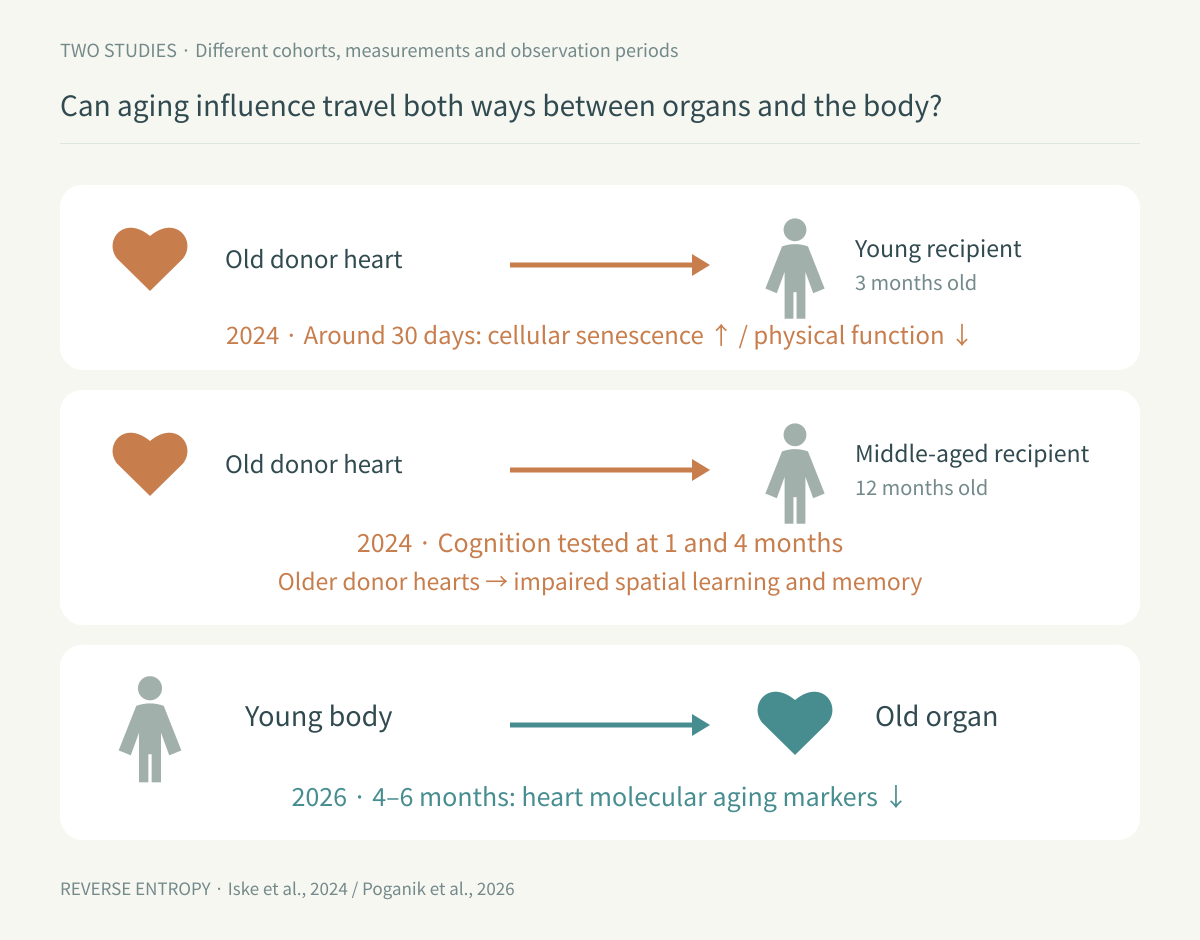
Organ-to-body and body-to-organ influences can coexist. The 2024 study included cellular-senescence and physical-function findings in young recipients around 30 days after transplantation, and separate cognitive tests in middle-aged, 12-month-old recipients at 1 and 4 months. The 2026 study examined molecular aging markers at 4–6 months. These were not the same experiment reproduced in opposite directions.
Source: Original comparison diagram by Reverse Entropy, based on Poganik JR et al., bioRxiv 2026, and Iske J et al., American Journal of Transplantation 2024.
Original Reverse Entropy comparison diagram, localized and corrected to distinguish the 2024 young-recipient tissue/physical findings from the middle-aged-recipient cognitive tests. Not a study data plot.
Not necessarily.
An aged organ can release inflammatory signals that affect other tissues.
At the same time, that organ is continually influenced by the body’s wider environment, including blood, immune cells, hormones, and metabolites.
Organ → whole body; whole body → organ.
The influence can run in both directions.
The studies also measured different things. The 2024 work included cellular senescence and physical function in young recipients around 30 days after transplantation; cognition was examined separately in 12-month-old, middle-aged recipients at 1 and 4 months. The 2026 study examined molecular aging markers after 4–6 months.
They therefore cannot be regarded as identical experiments reaching opposite conclusions. More research is needed to determine which signals act, when they act, and how strongly.
Aging also takes place in the relationships between organs
We often say that the skin ages, the heart ages, or the brain ages.
As though each organ were wearing out independently.
Yet all our organs are connected to the same blood and immune systems, sharing hormones and metabolites and exchanging signals.
If we view organs only as individual worn-out parts, we may miss something important.
A sound approach to anti-aging requires more than finding one special rejuvenating substance.
We need to understand which signals increase in an aging body and which diminish,
and how those changes are transmitted to other tissues.
I think the next question is crucial:
What makes other tissues age?
Identifying an aging phenomenon and identifying what causes it are different tasks.
This is also why I pay attention to systems that can affect the whole body,
such as the immune, vascular, and endocrine systems.
Could endless young-organ replacements make us immortal?
This one study cannot answer that question.
But its findings weigh against the simple idea that replacing an organ with a young one will make the whole body young.
The young heart placed in an old body instead followed the body’s aging state.
Of course, organ transplantation is an important, life-saving treatment. Providing a new heart to someone who would otherwise die of heart failure can extend their life.
That effect must be distinguished from reversing aging throughout the body.
I find the result in the opposite direction more interesting
If we read this study only as “there is no point in putting in a young organ,” we miss something important.
In the research described earlier, even old organs showed shifts in some aging markers toward a younger state when their environment changed.
The measured molecular aging state was not completely fixed.
That leads to a clear next conclusion:
We need to change the environment that keeps making organs age
If we can identify and regulate the conditions in which organs become younger,
we may open up a strategy quite different from endlessly preparing young organs as in The Island.
Going a step beyond replacing a worn-out organ: changing the environment that continually makes it age.
To me, that is a more interesting direction for anti-aging research.
Perhaps more important than finding a young heart is building a body in which that heart can remain young.
References
Poganik JR, Matsunaga T, Tyshkovskiy A, et al. Transplanted hearts assimilate the recipient’s biological age. bioRxiv. Posted September 17, 2026. Preprint, not yet peer-reviewed. Original paper
Iske J, Roesel MJ, Martin F, et al. Transplanting old organs promotes senescence in young recipients. American Journal of Transplantation. 2024;24(3):391–405. Original paper
#Aging #AntiAging #Rejuvenation #BiologicalAge #HeartTransplant #OrganTransplant #SenescentCells #Senolytics #SASP #EpigeneticClock #DNAMethylation #LifeExtension #ReverseEntropy