Could removing the “zombie cells” that accumulate in our bodies slow aging?
The drugs that carry this promise are called senolytics, or senescent-cell-clearing drugs. Yet senescent cells do not all respond to the same drug in the same way.
Some cells die. Others hold on.
A study published on October 16, 2026 traced this difference to survival signals inside the cell. It showed why simply using a stronger drug may not solve the problem.
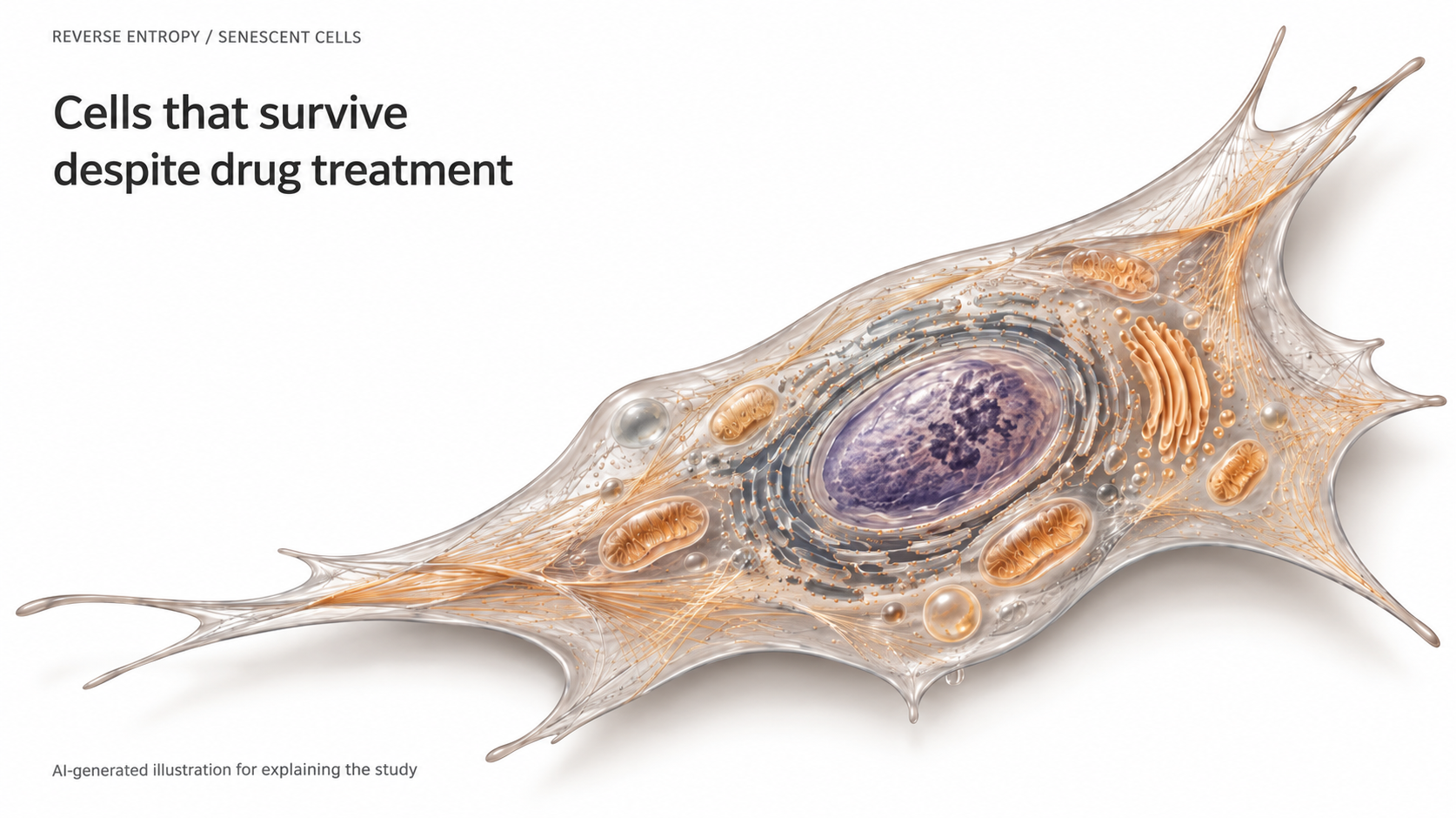
AI-assisted image · Learn more
Source: Original illustration by Reverse Entropy. Scientific basis: Gold NM et al., Cell Death & Disease, 2026.
Being old does not mean a cell dies easily
Senescent cells can survive for a long time even though they no longer divide normally. Meanwhile, they release substances that promote inflammation around them. They are not exactly welcome guests.
Senolytics are an approach to removing these cells. But different cells use different survival mechanisms, so a drug’s effects can vary too.
The researchers focused on a protein called C3. C3 is best known for its involvement in immune responses, but here they investigated what it does inside cells.
When the researchers reduced C3 inside senescent cells, something unexpected happened.
The characteristic markers of senescence remained, but cell death induced by drugs such as navitoclax decreased.
The cells remained senescent while becoming better able to withstand the drugs.
The signal to stay alive remained switched on
In cells lacking C3, signaling through AKT/S6K was sustained. The name may be unfamiliar, but you can think of it simply as signaling that helps a cell survive.
When the researchers inhibited AKT in cultured cells, responsiveness to the drugs was restored.
Differences also appeared in aged mice. In mice without C3, navitoclax did not adequately remove senescent cells; inflammatory secretory signals persisted and fibrosis worsened.
The researchers had identified one way zombie cells hold on.
Original study: Gold et al., Cell Death & Disease, 2026
A weaker cleanup crew versus tougher zombie cells
The zombie-cell study I introduced previously examined macrophages, the body’s cleanup crew.
When the protein-maintenance function of macrophages declined, their ability to clear senescent cells weakened too.
Conversely, activating that function reduced senescent cells.
This C3 study examined how the zombie cells themselves became more resistant.
We need the ability to clear cells efficiently, but we also need to understand what makes certain cells hard to clear.
Related study: Sereda et al., Nature Aging, 2026
Does this mean we now have an anti-aging drug ready to use?
For now, these findings have been established in cells and mice.
There is not yet a basis for predicting which drug will work in a person simply from the C3 level in a blood test.
Navitoclax is not a drug to use casually either. In a phase 1 cancer trial in humans, thrombocytopenia, a decrease in platelets, was an important adverse effect.
I think it is best to watch the research develop further.
Navitoclax clinical trial: Wilson et al., Lancet Oncology, 2010
Finding out why a drug fails can also be the beginning of treatment
This study is interesting not because it found one more cell-clearing drug, but because it found a clue to why cells that do not respond to existing drugs survive.
My goal in anti-aging is neither to keep every cell alive indefinitely nor to eliminate every old cell indiscriminately.
It is to protect normal tissue, repair what can be repaired, and precisely remove cells that have become dangerous.
Senolytics should develop according to that same standard. Rather than more toxic drugs, we need treatments that understand which cells to remove and how.
References
1. Gold NM, et al. Intracellular C3 modulates senolytic responsiveness in senescent cells and aged tissues via AKT/S6K pro-survival signaling. Cell Death & Disease. 2026. Original paper
2. Sereda R, et al. Decline of chaperone-mediated autophagy in aging impairs macrophage clearance of senescent cells. Nature Aging. 2026. Original paper
3. Wilson WH, et al. Phase 1 trial evaluating the safety and antitumor activity of navitoclax. Lancet Oncology. 2010. Publication details
#SenescentCells #ZombieCells #Senolytics #AntiAging #Immunosenescence #Autophagy #AgingResearch #ReverseEntropy