When skin becomes thinner and loses elasticity, could we directly replenish some of the material that supports it?
The growing interest in acellular dermal matrix, or ADM, skin boosters starts with this question. Products such as Re2O, CellREDM, GCELLE RIBONNE, and juveàcell are arriving in increasing numbers.
Let me make my position clear from the outset. This is not a message telling people who have already had these treatments, or are considering them, that they should not do so.
In fact, I have considerable hopes for this field. The idea of supporting the environment in which cells live is close to my own approach to treatment.
I have tried these products on myself and a small number of acquaintances, and have personally observed substantial improvement without notable adverse effects so far. However, before introducing them into routine care for my patients, I intend to observe their progress for at least about five years.
This is my own clinical philosophy. It does not mean that clinics already using these treatments are doing something wrong.
It has been around 12 years since I began practicing aesthetic medicine in Cheongdam, Seoul. During that time, many products have appeared, enjoyed an initial wave of popularity, and later faded from use for various reasons.
I think of nonresorbable fillers such as Artecoll and Aquafilling, and unusual treatments such as gold threads—threads with a gold coating. What concerns me about such experiences is the gap between an encouraging early impression and the outcome after repeated treatment and the passage of years.
How good the skin looks in the first few months matters. But my highest priority is whether it remains soft and natural years after repeated procedures. I am particularly concerned about immune reactions, nodules, and fibrosis that makes tissue hard like a scar.
So when a new material appears, I do not immediately adopt it. I spend several years observing and evaluating it, and recommend it to patients only when I am sufficiently confident in its safety. Even Rejuran was something I watched for about five years before introducing it. I am still watching Juvelook. The skin boosters I use most frequently are PDRN and platelet-rich plasma, or PRP.
Enough about my approach. Let us look at what ADM actually is.
1. What does ADM take from skin?
Skin contains not only cells, but also a structure that surrounds and supports them. This is the extracellular matrix, or ECM, made up of collagen, elastin, and components that retain water.
The matrix helps maintain the skin’s shape and elasticity. It also provides an environment in which cells can settle and exchange signals with their surroundings.
Human acellular dermal matrix, or hADM, is produced by removing cellular components from donated human dermis while retaining its matrix. I will simply call it ADM here. Decellularization aims to reduce cellular components that could provoke immune reactions while making use of the tissue’s supporting matrix. [1]
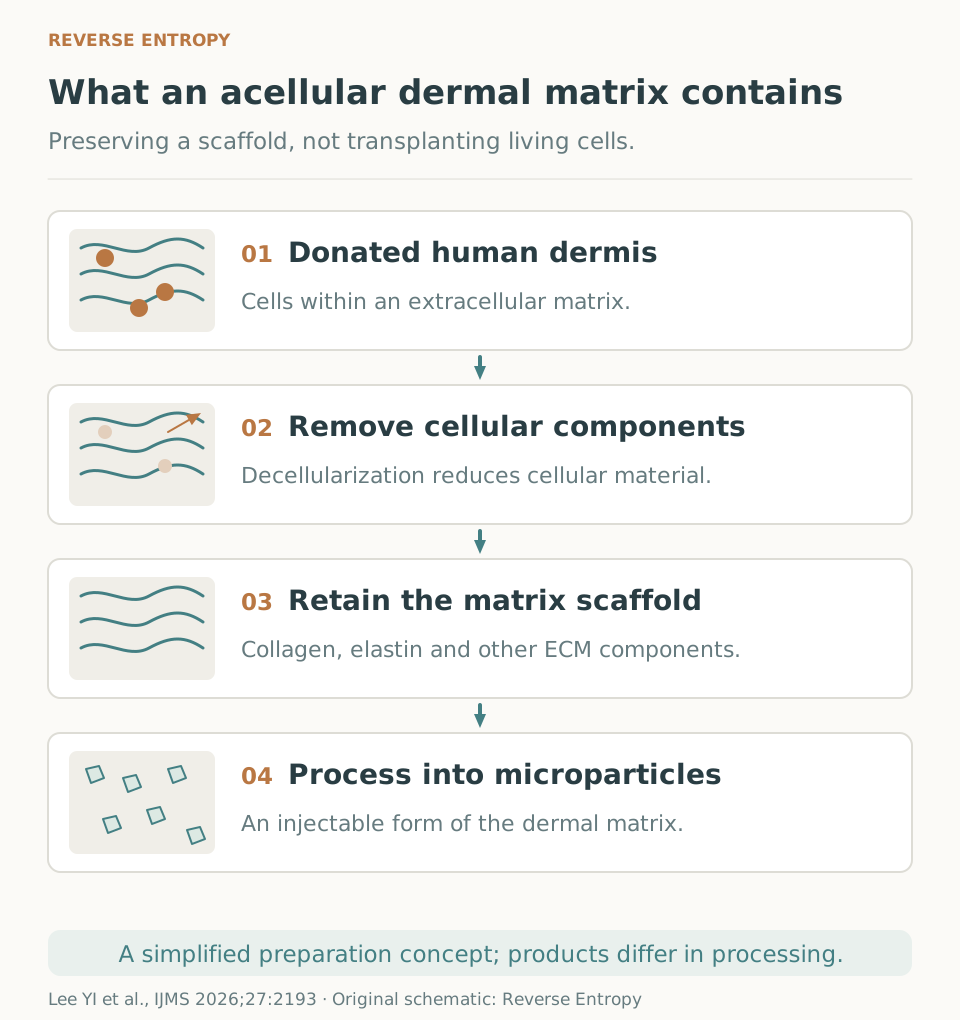
Recent ADM skin boosters process this material into an injectable form, such as fine particles. This is different from a treatment that injects living stem cells.
What interests me is the possibility of supplementing a matrix weakened by aging and helping the body’s own cells remodel tissue within it.
A study examining human tissue after ADM was used in breast reconstruction found that fibroblasts and several types of immune cells entered the material over time, and that new blood vessels formed. [1]
If this principle can be applied successfully to facial skin, I hope it could help restore skin density and elasticity.
2. Which ADM products are available?
As of October 30, 2026, the following are among the major brands whose launch in South Korea had been confirmed. This overview is based on official information from manufacturers and suppliers.
| Product | Companies involved in manufacture or supply | Formulation |
|---|---|---|
| Re2O / Re2O Fine | L&C Bio · Humedix | Particulated ADM; an additional Fine range |
| CellREDM | HansBiomed | Freeze-dried, finely powdered ADM |
| GCELLE RIBONNE | MS Bio · GC Wellbeing | Micronized ADM powder |
| juveàcell | DOF · VAIM | Prefilled products and v/g powder ranges |
Re2O and Re2O Fine
Re2O is a human-derived ADM product commercialized by L&C Bio and Humedix. Humedix’s official product information describes it as a human tissue product containing 150 mg of acellular dermal matrix. [2] [3]
Re2O Fine has also been launched. The company describes it as having smaller particles than the original Re2O. A launch symposium in June 2026 discussed experience with its use around the eyes and on the neck. [4]
Re2O was also the ADM used in the 20-week clinical trial discussed below. The formulation evaluated in that trial, however, combined Re2O with hyaluronic acid.
CellREDM
CellREDM is a HansBiomed product. According to the official description, donated dermis is decellularized, freeze-dried, and finely milled. The stated particle size is 75 micrometers or smaller. [5]
This approach delivers dermal matrix components as a fine powder. When comparing products, I would look beyond particle size to how the material distributes at the actual injection site and how the tissue responds over time.
GCELLE RIBONNE
GC Wellbeing announced the South Korean launch of GCELLE RIBONNE in March 2026. MS Bio processes the human tissue, and GC Wellbeing supplies the product through its distribution tissue-bank system. [6]
Its main material is also human-derived acellular dermal matrix, supplied as a micronized powder. Even within the ADM category, processing methods and the properties of the finished products need to be distinguished. [7]
juveàcell
juveàcell is a human dermis-derived product introduced by DOF and VAIM. It uses a decellularization technique involving supercritical carbon dioxide and was launched in a prefilled syringe format. [8]
Powder versions, juveàcell v and g, were added later. VAIM presents these alongside the existing 3% and 8% formulations, with v intended for facial areas and g for the body. [9]
The names are worth separating: juveàcell is a human-derived ADM product, whereas Juvelook uses PDLLA and hyaluronic acid. Similar names do not mean the materials or their interactions with tissue are the same.
Renuva uses matrix derived from adipose tissue
Another product available overseas is Renuva from MTF Biologics. It uses matrix obtained from donated adipose tissue and is described as a product for supplementing volume in areas where fat naturally exists. [10]
Unlike the dermis-derived ADM products above, it is an adipose tissue-derived ECM. They share the concept of using a tissue matrix, but differ in the tissue of origin and the intended application.
When choosing a product, I want to know more than its name and content. Which areas were treated with that exact formulation, and how long were they followed? Evidence of this kind will allow us to discuss the strengths of individual ADM products more precisely.
3. A clinical study has shown improvements in skin
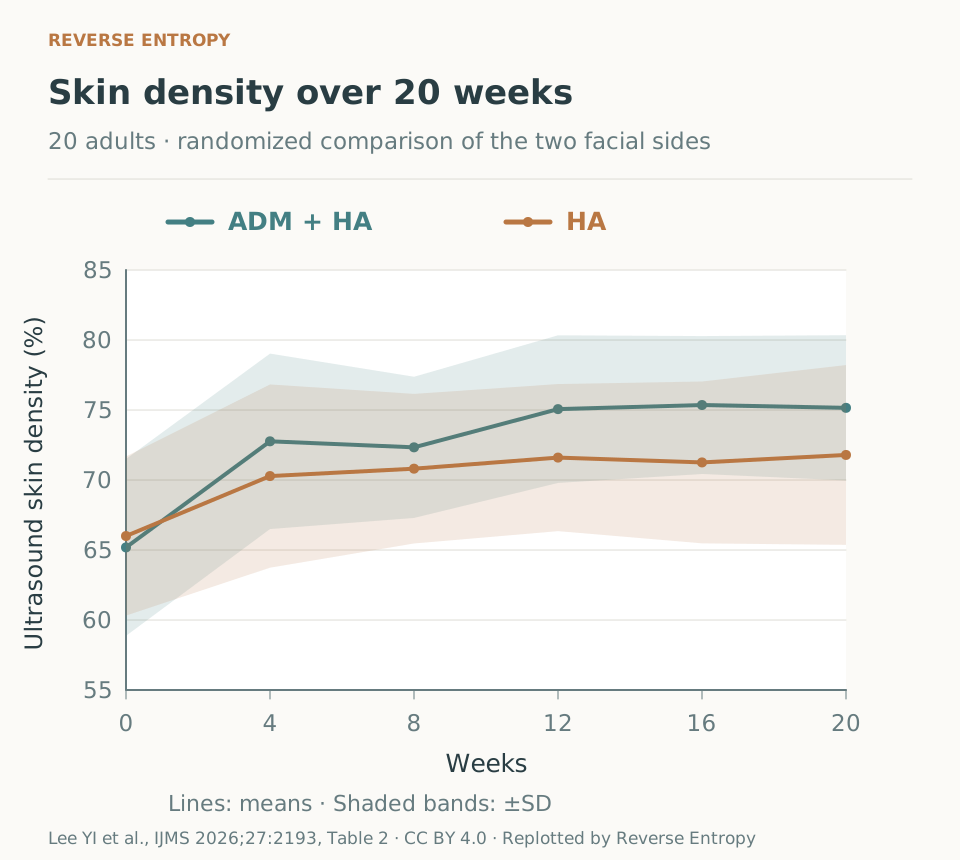
A clinical trial published in 2026 compared the two sides of the faces of 20 adults over 20 weeks.
One side received a mixture of particulated ADM and hyaluronic acid; the other received a hyaluronic acid formulation. The treatment side was randomized, and the evaluators were blinded to which material had been used on each side.
The ADM-containing formulation produced greater improvements in several measures, including skin density, elasticity, and hydration. No serious adverse events were reported during the study. [11]
What I would now like to see is how long the benefit lasts and what happens after repeated treatment. Adding several years of follow-up to the 20-week findings would make the decision about routine use clearer for me.
4. If ADM has been used for years, why wait again?
ADM has been used in reconstructive surgery for a long time. Injectable ADM is not an entirely new idea either. A study comparing sheet-form ADM with micronized injectable ADM in people was published as early as 2000. [12]
That accumulated experience is certainly useful.
What I am considering now, however, is the repeated use of particular recent products across different areas of facial skin. Particle size, injection depth, dose, and the number of repeat treatments differ from surgical implantation of a sheet.
I therefore want to build on the existing experience while also seeing long-term follow-up that matches the current product and the way it is used.
Reconstructive procedures are not usually repeated on a regular cosmetic-treatment schedule. They are performed for function and health, with a different balance of benefits and risks. In my view, a long history in reconstruction should not by itself be taken as proof of safety for repeated aesthetic skin treatments.
5. Three things I look for over the long term
Does the immune response settle appropriately?
When ADM is introduced, immune cells such as macrophages and cells that build tissue become involved. They participate in processing the material and establishing new tissue. What I watch is whether this response reaches an appropriate resolution.
If redness and swelling persist, or an inflammatory lump appears later, we need to understand what is happening around the material.
A case involving Cymetra, a micronized ADM previously used for vocal fold injection, documented a foreign-body reaction with giant cells after migrated material was surgically removed. It does not tell us the incidence with current facial products, but it shows that decellularized human tissue still interacts with the immune system. [13]
This is why I look at the source of the tissue, the removal of cellular components, processing methods, contamination control, and product traceability.
Do lumps appear later?
A palpable lump in the skin is called a nodule. Possible causes include a localized collection of material, inflammation or infection, and a granuloma in which immune cells surround the material.
In a 2022 study of 14 patients with HIV-associated facial lipoatrophy who received a mixture of cross-linked ADM and hyaluronic acid, one temporary subcutaneous nodule was reported. The formulation and conditions of use were different from those of current skin boosters. [14]
My focus is less on the small raised bumps that briefly appear immediately after injection and more on lumps that persist, or changes that emerge late after repeated treatment.
Does the skin stay soft?
With collagen, the amount is not all that matters. Its organization and the condition of the tissue matter too. We want skin that gains elasticity while continuing to move naturally.
If inflammation persists and tissue remodeling becomes abnormal, the tissue can become firm or tight like a scar. This is the pathological fibrosis I am concerned about.
Long-term evidence is needed to establish how often this occurs with current facial ADM products. Alongside before-and-after photographs, I want to assess softness to touch, movement during facial expression, and how naturally the treated area connects with surrounding tissue.
6. Can a problem be reversed?
There is another criterion that matters to me as much as effectiveness: how well can we respond if an unexpected problem occurs?
Hyaluronic acid used in hydration injections can be treated with a dissolving enzyme. PDRN, Rejuran, and PRP—platelet-rich plasma—are among the options I have favored in my own practice, where concerns about persistent nodules have been less prominent. Their risks still depend on the product, injection site, and technique.
ADM, however, cannot be dissolved with hyaluronidase.
A 2026 case report described suspected impairment of blood flow in the forehead after Re2O mixed with non-cross-linked hyaluronic acid was injected into the forehead and cheeks. Pain and skin lesions appeared two days after treatment. A photograph supplied by the patient at nine weeks showed residual atrophic scarring. The report cannot establish the precise mechanism or incidence, but it is relevant when considering both the properties of a material and the response to complications. [15]
If you have already undergone treatment, worsening pain, changes in skin color, or visual symptoms require immediate medical assessment. Persistent swelling or a growing lump should also be checked by the treating clinic.
Because the ability to manage a complication matters to me, I do not currently use PDLLA products such as Juvelook either. Concerns about delayed nodules, granulomas, and excessive tissue reactions influence that choice. A case of a granuloma requiring surgical removal after PDLLA injection has been reported. [16]
The fact that PDLLA is biodegradable is different from being able to dissolve it immediately if a problem occurs. I apply the same criterion to ADM.
7. I watched Rejuran for about five years before adopting it
I have long centered my skin-booster practice on PRP and PDRN. I did not start using Rejuran immediately after its launch. I observed it for about five years before introducing it, and now use it frequently.
With ADM, I am still at the stage of applying it in a limited way to myself and a few acquaintances and following the results. I will decide when to introduce it into routine patient care by considering both what I observe directly and the clinical evidence that accumulates.
The five years I refer to are not a deadline after which safety is automatically guaranteed. They are a personal adoption criterion that gives me time to review real-world experience and long-term data. Rare adverse effects require evidence much broader than the experience of a few people around me.
Because these products are made from actual human tissue, I also want to confirm donor consent, tissue origin, and traceability through processing and supply. Patients should receive a clear explanation of what material is being placed in their bodies.
I have high hopes, and I will keep watching
If ADM can supplement the matrix that supports the skin and help our own cells build healthy tissue within it, its value could be substantial.
The product range is expanding, and studies assessing actual skin improvement are emerging. I am following these developments with interest.
If enough experience shows that benefits last and skin stays soft after repeated procedures, ADM could become an important option in my practice.
References
- Boháč M, et al. What happens to an acellular dermal matrix after implantation in the human body? European Journal of Histochemistry. 2018;62:2873. Article.
- Humedix. Official Re2O product information. Product information.
- Huons Global. Humedix launches Elravie Re2O and enters a commercialization agreement with L&C Bio. November 18, 2024. Official announcement.
- Humedix. Re2O Fine launch symposium. June 25, 2026. Official announcement.
- HansBiomed. CellREDM official product information. Product information.
- GC Wellbeing. South Korean launch of the ECM skin booster GCELLE RIBONNE. March 25, 2026. Official announcement.
- GC Wellbeing. GCELLE RIBONNE official product information. Product information.
- VAIM. juveàcell Launching Symposium 2025. Official publication.
- VAIM. Launch of juveàcell v and g powder formulations. Posted June 4, 2026. Official publication.
- MTF Biologics. Renuva official product information. Product information.
- Lee YI, et al. Injectable Particulated Human Acellular Dermal Matrix Booster for Skin Restoration: An Integrated Randomized, Split-Face, Double-Blinded Clinical Trial and Preclinical Study. International Journal of Molecular Sciences. 2026;27:2193. Article.
- Sclafani AP, et al. Evaluation of acellular dermal graft in sheet (AlloDerm) and injectable (micronized AlloDerm) forms for soft tissue augmentation. Archives of Facial Plastic Surgery. 2000;2:130–136. Article.
- Bock JM, et al. Migration of Cymetra after vocal fold injection for laryngeal paralysis. Laryngoscope. 2007;117:2251–2254. Article.
- Kim J, et al. Treatment of Human Immunodeficiency Virus-Associated Facial Lipoatrophy With Hyaluronic Acid Filler Mixed With Micronized Cross-Linked Acellular Dermal Matrix. Journal of Korean Medical Science. 2022;37:e37. Article.
- Sung SW, et al. Vascular Complication Following Injection of Particulated Human Acellular Dermal Matrix: A Case Report. Journal of Cosmetic Dermatology. 2026;25:e71049. Article.
- Choi M, et al. Foreign-body granuloma formation in the lower eyelid after injection of poly-D,L-lactic acid as a collagen stimulator: a case report. Archives of Aesthetic Plastic Surgery. 2024;30:137–140. Article.
Research disclosure: One author of the 20-week trial disclosed serving as a consultant in the development of Re2O. The product descriptions draw on official manufacturer and supplier information; they are not results of a clinical trial comparing the products with one another.