“I am careful about sunscreen. Why do dark spots and skin problems keep appearing?”
When we talk about external causes of skin aging, sunlight usually comes first. Sun protection remains important.
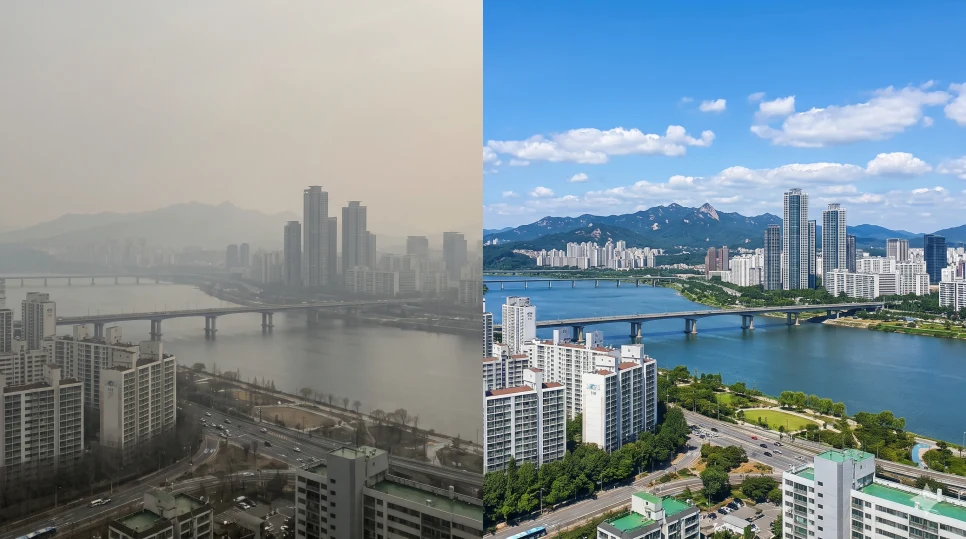
But sunlight is not the only thing our skin encounters. It is in contact with the air every day, including traffic emissions, fine particles, and other pollutants.
When I think about keeping skin healthy as it ages, I consider not only the products we apply and the procedures we receive, but also the environment our skin has to cope with throughout the day.
1. People exposed to more air pollution had more pigment spots
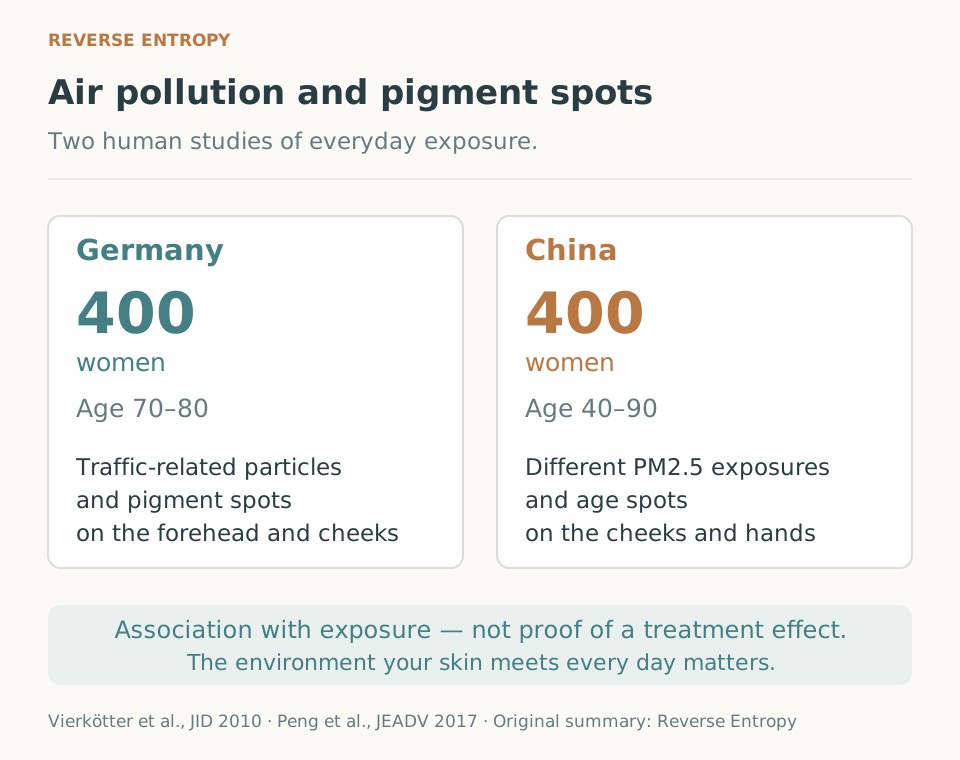
A study published in the Journal of Investigative Dermatology in 2010 examined skin aging and residential air pollution exposure in 400 women aged 70–80.
The researchers assessed their skin and compared estimates of exposure to traffic-related particles and soot. Even after adjusting for age and other potential influences, greater pollution exposure was associated with more pigment spots on the forehead and cheeks. The association with wrinkles was much less pronounced. The study of 400 women
Researchers later asked a similar question in China.
A study published in 2017 compared 400 women aged 40–90 living in two areas of Beijing with different levels of fine particulate matter. Women in the area with higher exposure had more severe age spots, or lentigines, on their cheeks and the backs of their hands. The study in Chinese women
These studies mainly examined brown pigment spots called lentigines. They do not explain every facial blemish or every case of melasma through a single cause.
Still, the finding that our everyday environment beyond sunlight may be linked to changes in skin pigmentation deserves attention.
2. Skin has sensors that respond to pollutants
When we imagine dust affecting the skin, we may picture particles blocking pores.
Researchers are interested not only in the physical particles, but also in how skin cells respond when exposed to pollutants.
One part of this process is the aryl hydrocarbon receptor, or AhR. Think of it as a sensor that detects various substances and helps regulate gene activity inside a cell.
Some organic compounds attached to particles can influence these pathways. The response depends on the substance and the conditions of exposure, and can involve inflammation and changes in the skin barrier.
Rather than treating AhR as a single switch that causes skin aging, it is more helpful to understand it as a link between environmental signals and skin cells.
One study makes this connection more concrete.
3. Researchers examined skin from people who lived in Denver and Seoul
In a study published in JCI Insight in 2021, researchers compared samples from the outermost skin layer of five people who had lived in Denver, in the United States, and Seoul, South Korea.
Samples collected in Seoul contained lower levels of some breakdown products of filaggrin. Filaggrin helps build the skin barrier, and substances produced as it breaks down help the outermost layer retain moisture.
The researchers went a step further, exposing cultured skin cells and skin models to fine particles collected in Seoul.
They identified a pathway in which AhR and the inflammatory signal TNF-α were involved in a reduction in filaggrin. Impaired barrier function was also observed in skin models and animal experiments. The human-sample and experimental study
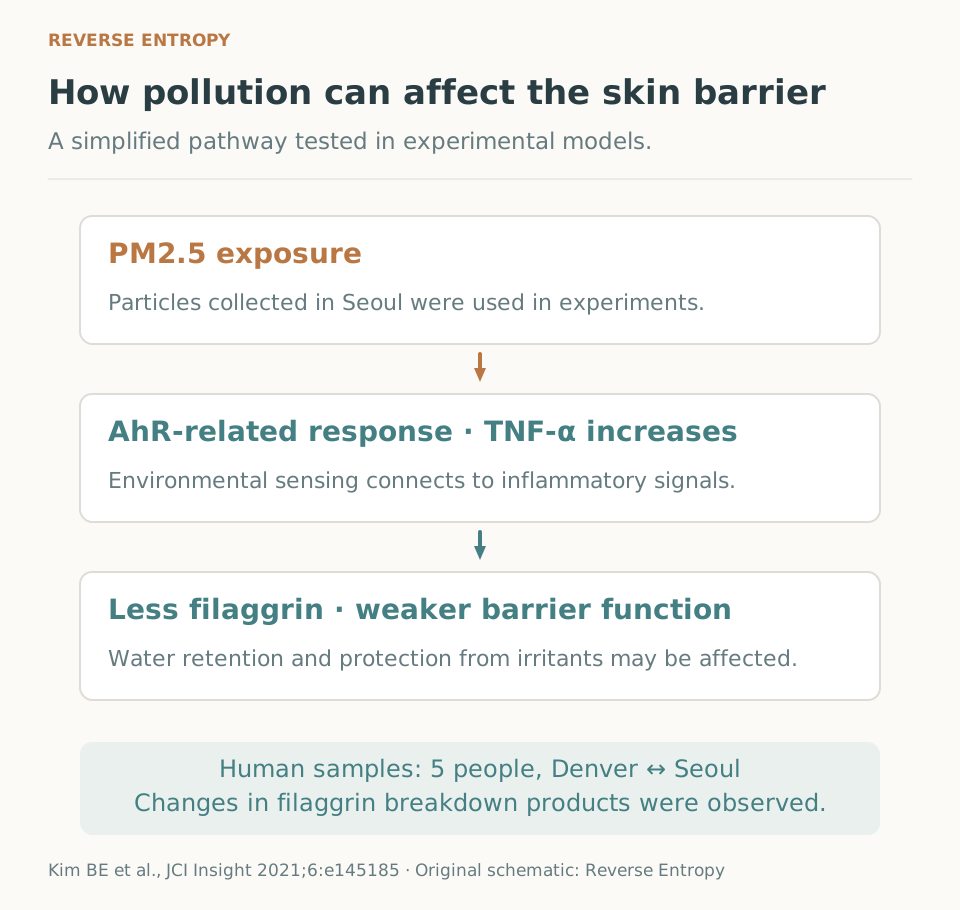
This connects an observation in people with a mechanism explored in experiments.
For me, it suggests that when pollution exposure is a concern, treating pigmentation alone is not enough: the condition of the barrier and any inflammation also need attention.
4. Does worrying about pollution mean we should scrub harder?
Once we imagine dust sitting on our skin, it is tempting to wash until it feels squeaky clean. Some people cleanse repeatedly or scrub with exfoliants and cleansing tools.
Yet the purpose of cleansing is to remove unwanted material from the surface. Irritating the skin until it feels tight or stings can make matters worse.
We need to remove the dirt while preserving the barrier.
Use a gentle cleanser with your fingertips and lukewarm water, without scrubbing or rough tools. If your skin is dry or itchy, find a moisturizer it tolerates well. American Academy of Dermatology: Face washing 101
Sensitive skin can become caught in a cycle of heavier makeup and harsher cleansing.
Dark spots and redness lead to thicker coverage; removing that makeup calls for more cleansing; the skin becomes less comfortable, and the cycle repeats.
Stabilizing the skin while reducing the burden of both makeup and cleansing can help reduce irritation that recurs every day.
I discussed this in more detail in Dry, Tight Skin: Why the Order of Treatment Matters.
5. Care on the outside and recovery within the skin belong together
Environmental exposure
Reduce unnecessary exposure on days with poor air quality, and maintain sun protection.
Cleansing
Wash as needed, while checking whether friction or repeated cleansing is making the skin sting.
The barrier
If there is tightness, flaking, or itching, reduce irritation and adjust moisturization.
Inflammation and pigmentation
Distinguish recurrent dermatitis and acne from melasma and lentigines, and choose treatment for the actual problem.
Procedure planning
Once the skin is stable, assess any remaining pigmentation and loss of firmness separately.
If skin is already red and stinging, I want to look first at the cause and the conditions needed for recovery. We can then plan pigment treatment or procedures targeting the dermis according to the concerns that remain.
I am also interested in research on antioxidant and regenerative signals. As we become better at measuring pollution-related skin changes and testing which interventions help people, care may become more specific.
My focus is on reducing the damage skin has to endure and supporting the recovery it needs, rather than simply adding more stimulation.
6. Fine particles are present indoors, too
A 2017 study examined the relationship between indoor PM2.5 exposure and skin aging.
Researchers directly measured indoor fine particles in 30 homes, then used those measurements and other information to estimate exposure in two larger groups.
In the first group, higher estimated indoor PM2.5 exposure was associated with higher scores for forehead pigment spots and upper-lip wrinkles. This gives us a reason to pay attention to indoor air as well as outdoor pollution. The 2017 study
Air purifiers can substantially reduce indoor fine particles.
In a randomized crossover trial involving 30 children with asthma, mean indoor PM2.5 concentrations were 17.0 µg/m³ with the filter off and 9.26 µg/m³ with it on. The air-purifier trial
A small Korean study that compared households before and after installing air purifiers also reported improvements in dermatitis measures among people with atopic dermatitis. The atopic dermatitis study
We spend a substantial part of each day indoors. Particles from outside can enter our homes, and activities such as cooking and cleaning can also generate small particles.
Protecting skin from air pollution means considering indoor air too. I think an air purifier is worth considering as one way to reduce indoor particulate exposure.
The environment skin meets every day is part of healthy aging
If your skin remains uncomfortable despite careful sunscreen use, look at what else keeps happening around it.
Air pollution, cleansing with too much friction, unsuitable cosmetics, and untreated inflammation may all contribute.
Studies in people have shown associations between air pollution and pigment spots. Skin-cell research helps explain how environmental signals can affect the barrier.
Good care for aging skin should go beyond adding new ingredients. It should also reduce the burden skin has to bear each day.
Alongside choosing a suitable procedure, I hope we will give equal attention to the everyday environment that helps its benefits last.
References
- Vierkötter A, et al. Airborne particle exposure and extrinsic skin aging. J Invest Dermatol. 2010;130:2719–2726. Paper
- Peng F, et al. Exposure to fine particulate matter associated with senile lentigo in Chinese women: a cross-sectional study. J Eur Acad Dermatol Venereol. 2017;31:355–360. First published online in 2016. Paper
- Kim BE, et al. Particulate matter causes skin barrier dysfunction. JCI Insight. 2021;6:e145185. Full text
- American Academy of Dermatology. Face washing 101. Guidance
- Ding A, et al. Indoor PM2.5 exposure affects skin aging manifestation in a Chinese population. Sci Rep. 2017;7:15329. Paper
- Lee GH, et al. Effects of Indoor Air Purifiers on Children with Asthma. Yonsei Med J. 2020;61:310–316. Paper
- Park HC, et al. Effect of air purifier on indoor air quality and atopic dermatitis. Allergy Asthma Respir Dis. 2013;1:248–256. Paper