“My skin feels fine when I put on cream, but by the afternoon it feels tight again.”
It is easy to assume that the moisturizer is not enough. The first ideas that come to mind are switching to a more expensive product, applying a thicker layer, or adding an injectable skin-hydration treatment.
I would first like to check one thing: is the skin short of water, or has the structure that holds water in become weaker?
Aging changes more than the amount of water in the skin. It also changes sebum on the surface and the composition of the lipids between the cells of the outermost layer. Dryness therefore needs to be considered in terms of water, lipids, and the conditions that allow skin to recover.
1. Should we remove all the oil from our skin?
When we are young, shiny sebum can feel like a nuisance. Makeup breaks down, pores look more obvious, and acne can make it seem as though less oil is always better.
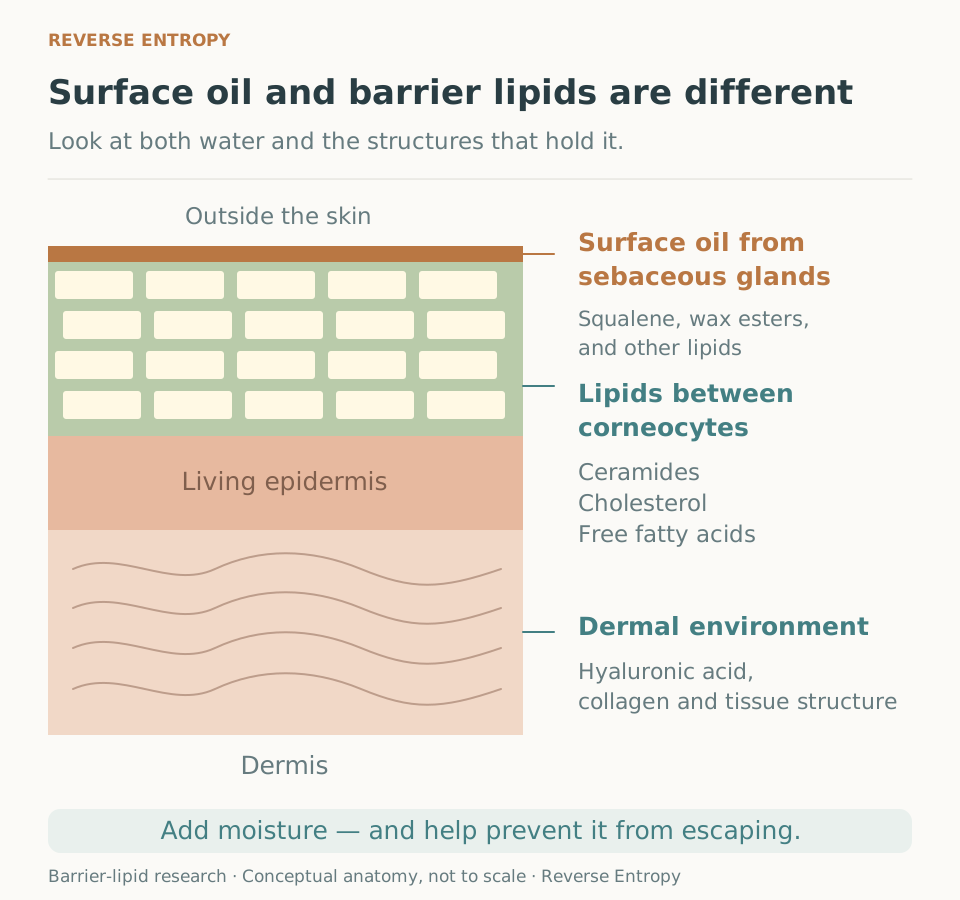
But sebum is a normal secretion that helps keep the skin surface supple. It contains a mixture of lipids, including squalene, wax esters, and triglycerides.
Sebaceous glands also deliver antioxidants to the skin surface. A human study found vitamin E in sebum and observed a relationship between sebum secretion and vitamin E at the skin surface. Thiele et al., human study.
For that reason, I do not regard reducing skin oil indiscriminately as good skin care. Controlling excessive sebum and acne matters, but we should not overlook the functions that help keep skin comfortable.
If skin already lacks oil, laser or radiofrequency procedures should not be chosen without considering that condition. A poorly matched procedure may offer less benefit and can leave the skin feeling worse.
2. Aging changes the composition of sebum as well as its amount
A study published in 2020 analyzed forehead surface lipids in 22 women aged 18–24 and 18 women aged 70–75.
The older group had less sebum, and the relative proportions of several lipids were different. Rigal et al., European Journal of Dermatology.
This shows why skin oil should not be assessed only as “too much” or “too little.” Which lipids are present, how much of each is present, and their condition can also change the properties of the skin.
Add hormonal changes, the body site, cleansing habits, and underlying skin conditions, and two people of the same age may experience dryness quite differently.
Too much oil is not ideal either. When excessive sebum is part of the problem, a suitably selected laser or radiofrequency treatment aimed at reducing it may help. The choice depends on the skin and the particular device and treatment settings.
3. The water barrier also lies between the cells of the stratum corneum
Alongside sebum, we need to consider the lipid barrier filling the spaces between corneocytes—the cells of the stratum corneum, the skin’s outermost layer.
Imagine that layer as a brick wall. The corneocytes are the bricks; the lipids packed between them are the mortar.
Important components include ceramides, cholesterol, and free fatty acids. They are mainly produced and organized as epidermal cells differentiate, helping prevent excessive water loss. Their location and composition differ from those of the sebum secreted onto the skin surface. Structure and function of stratum corneum lipids.
A 2025 study in Experimental Dermatology examined the stratum corneum of 58 adults with dry, eczema-prone skin.
Older age was associated with greater dryness, lower hydration, and differences in lipid composition. In particular, the proportion of shorter-chain species increased within one ceramide group. Williams et al., original study.
The point is not simply that all ceramides decrease. Changes in the types and organization of lipids can change the properties of the barrier.
If we think of dryness only as a shortage of water, applying moisturizer repeatedly may still leave us dissatisfied. Finding a formulation that works for our own skin is part of the process.
4. A moisturizer should attract water, soften the skin, and reduce evaporation
What should we look for in a moisturizer?
- Attracting water: humectants such as glycerin and hyaluronic acid.
- Softening the surface: formulations containing emollients such as squalane.
- Reducing water loss: occlusive ingredients such as petrolatum and dimethicone.
- Supporting barrier lipids: appropriately formulated combinations of ceramides, cholesterol, and fatty acids.
Most creams combine several of these functions. The whole formulation and the skin’s response matter more than the name of one ingredient. For sensitive skin in particular, I would first find a product that can be used comfortably and consistently, rather than layering on fragrance and multiple active ingredients.
Smell alone does not tell us whether fragrance has been added. Some products labeled “unscented” contain masking fragrance, while “fragrance-free” is a different claim. For sensitive skin, it is worth checking the ingredients and how the skin responds, rather than relying only on whether a product has a noticeable scent. American Academy of Dermatology guidance.
Adding more active ingredients can also add opportunities for irritation or a reaction. Rather than expecting dramatic effects from cosmetics, I prefer products that do the basic jobs of moisturizing and sun protection well.
Our skin changes with age, the season, and even the weather on a particular day. Instead of memorizing a particular lipid ratio or product as the answer for our skin, we should ask whether it actually feels less tight and less irritated. The balance that suits one person may not suit another.
5. Can skin boosters help?
If rough texture, fine lines, and lack of hydration remain concerns while the barrier is being managed, treatments targeting the dermis can also be considered.
One of the first materials worth considering is hyaluronic acid, which helps the skin hold water.
In a clinical trial that randomized 209 participants, intradermal treatment with the cross-linked hyaluronic acid formulation VYC-12L improved cheek roughness, fine lines, and measures of hydration compared with an initially untreated control group. VYC-12L randomized trial.
The dermis contains water-binding components such as hyaluronic acid, along with a collagen framework. In my approach, care for the surface barrier should accompany any treatment intended to improve hydration and texture within the dermis.
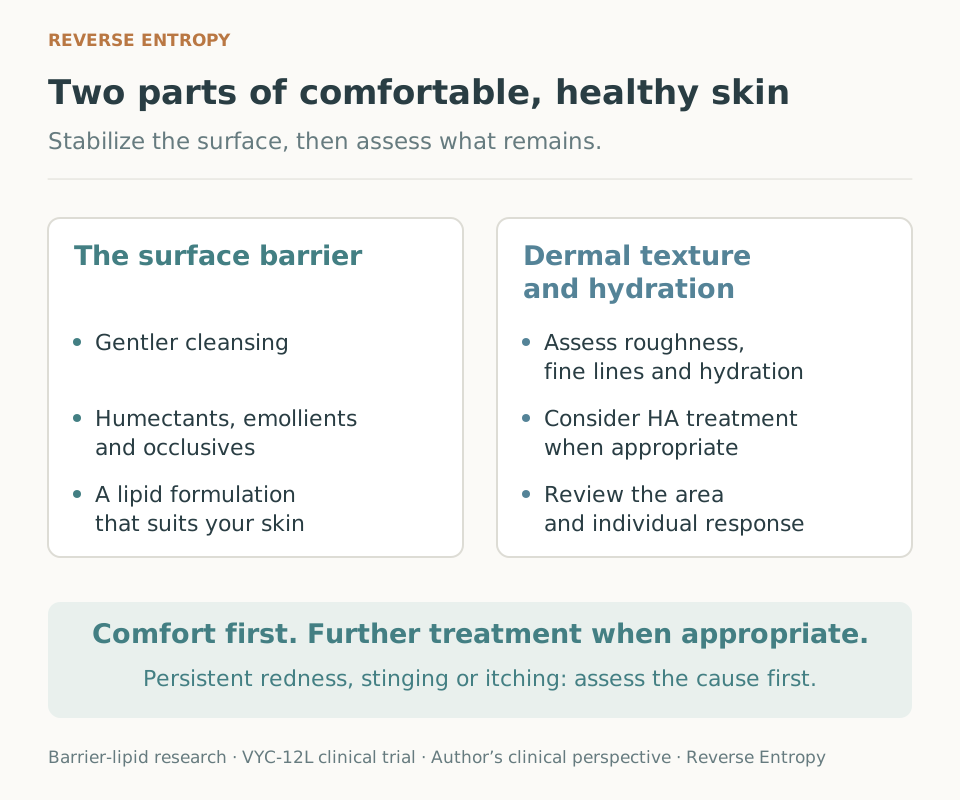
In my practice, I mainly use platelet-rich plasma (PRP), polydeoxyribonucleotide (PDRN), and Rejuran, adding hyaluronic acid formulations when appropriate.
I distinguish thin from thick skin, areas with fine lines from areas prone to swelling, and select the type of hyaluronic acid accordingly.
6. For dry skin, the order of treatment matters
So how should we look after the skin?
First, reduce the irritation placed on it.
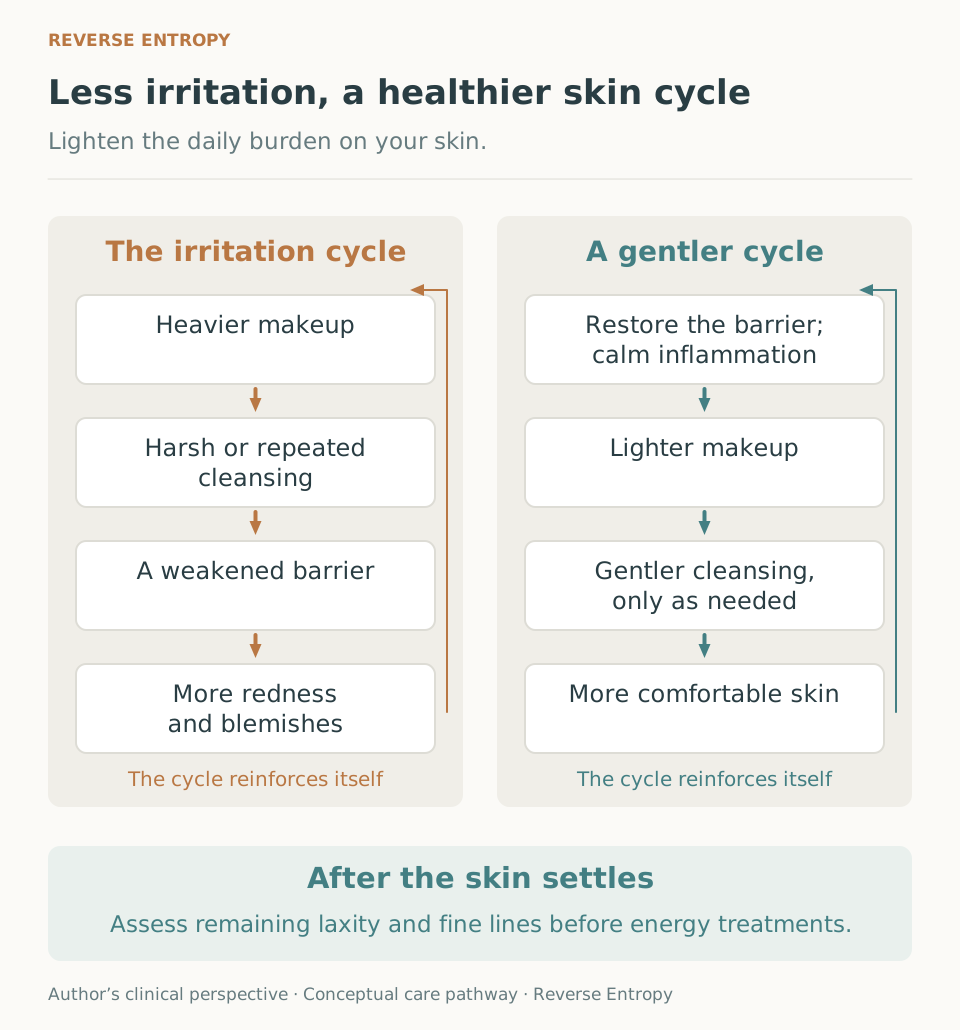
Harsh or excessive cleansing is a major source of barrier damage. I encourage people to minimize unnecessary cleansing and friction, while still gently removing makeup, sunscreen, and accumulated dirt.
When pigmentation or breakouts become a concern, it is tempting to use heavier makeup to cover them.
Heavier makeup can make removal more complicated. Deep cleansing and repeated washing then place more stress on the skin. If the barrier weakens and pigmentation or breakouts worsen, the urge to cover them with still more makeup grows.
We need to interrupt that cycle and create one in which improving skin also means less irritation.
Start by restoring the barrier and the balance of oil and water, calming inflammation, and combining this care with the treatments that are needed. Selected skin boosters may have a role in that plan.
As the skin improves and there is less to conceal, makeup can become lighter. Lighter makeup reduces the cleansing needed to remove it. Less irritation helps the skin feel more comfortable, which in turn can make it easier to rely less on makeup.
Once the skin feels comfortable, we can turn to any remaining loss of elasticity and wrinkles.
At that stage, stronger radiofrequency or laser treatments may be considered for persistent elasticity or fine-line concerns. Even then, decisions about whether to reduce sebum and which layer should receive heat must be based on the individual skin condition.
References
- Rigal A, et al. Skin surface lipid composition in women: increased 2,3-oxidosqualene correlates with older age. European Journal of Dermatology. 2020. Article.
- Williams SF, et al. The Impact of Age on the Lipidomic Profile of the Stratum Corneum and Associated Effects on Structure, Function and Overall Skin Health in Adults Predisposed to Atopic Dermatitis. Experimental Dermatology. 2025;34:e70192. Article.
- Thiele JJ, et al. Sebaceous gland secretion is a major physiologic route of vitamin E delivery to skin. Journal of Investigative Dermatology. 1999. Article.
- Role of lipids in the formation and maintenance of the cutaneous permeability barrier. Structure and mechanism reference.
- Optimal ratios of topical stratum corneum lipids improve barrier recovery in chronologically aged skin. Article.
- Alexiades M, et al. A Randomized, Multicenter, Evaluator-blind Study to Evaluate the Safety and Effectiveness of VYC-12L Treatment for Skin Quality Improvements. Dermatologic Surgery. 2023. Article.
- American Academy of Dermatology. Dermatologists’ top tips for relieving dry skin. Guidance on moisturizers and fragrance labeling.