“I hear aspirin prevents both heart disease and colorectal cancer. Wouldn't taking one tablet a day be a good idea?”
But we also hear the opposite.
“I hear that in healthy people, aspirin only increases the risk of bleeding.”
Which is right?
Both statements have evidence behind them. But they come from studies of different people. Aspirin's benefits and harms were not the same for patients who already had cardiovascular disease, people with a genetically increased risk of colorectal cancer, and older adults without a specific illness.
Rather than simply calling aspirin a good or bad medicine, I think we should first ask who is taking it, and what they are trying to prevent.
Today, I will look at cardiovascular prevention, healthy lifespan, and the prevention and recurrence of colorectal cancer.
1. How does aspirin prevent cardiovascular disease?
Aspirin's cardiovascular preventive effect comes mainly from its ability to stop platelets from clumping together.
Platelets are cell fragments needed to stop bleeding. But they also contribute to the formation of clots inside blood vessels. Aspirin helps reduce this clot formation. American Heart Association explanation
People often describe this as “thinning the blood,” but it does not mean washing away fatty deposits or cleaning out blocked arteries.
The problem is that this action has two sides.
Fewer clots form, but bleeding can occur more easily.
In addition to inhibiting platelet function, aspirin affects the production of substances that protect the gastrointestinal lining. Its vascular benefits therefore need to be considered alongside risks such as gastrointestinal bleeding and bleeding in the brain. USPSTF recommendation
An important medicine for people who have already had heart disease
Treatment to prevent another event in someone who has had a heart attack or certain ischemic strokes is called secondary prevention.
Randomized trials show that aspirin reduces serious vascular events in these patients. It is also sometimes used with other antiplatelet medicines after coronary stent placement. Combined analysis of randomized trials
By contrast, taking aspirin to prevent a first event in someone who has not had cardiovascular disease is called primary prevention.
Preventing recurrence in someone who is already ill and taking a medicine as a healthy person to prepare for the future are different issues. Keeping that distinction in mind helps us understand the studies that follow.
2. Daily aspirin did not extend healthy lifespan in 19,000 healthy older adults
This was the ASPREE study, published in the New England Journal of Medicine in 2018.
Researchers randomly assigned 19,114 older adults without cardiovascular disease, dementia, or a disability limiting independent living to aspirin 100 mg daily or placebo. Most were at least 70 years old, and median follow-up was 4.7 years.
The central question was simple.
Would aspirin extend the time people lived without death, dementia, or persistent physical disability?
The answer was no.
The hazard ratio for this composite outcome was 1.01, with no significant difference between the two groups. Major bleeding, however, increased. ASPREE full text
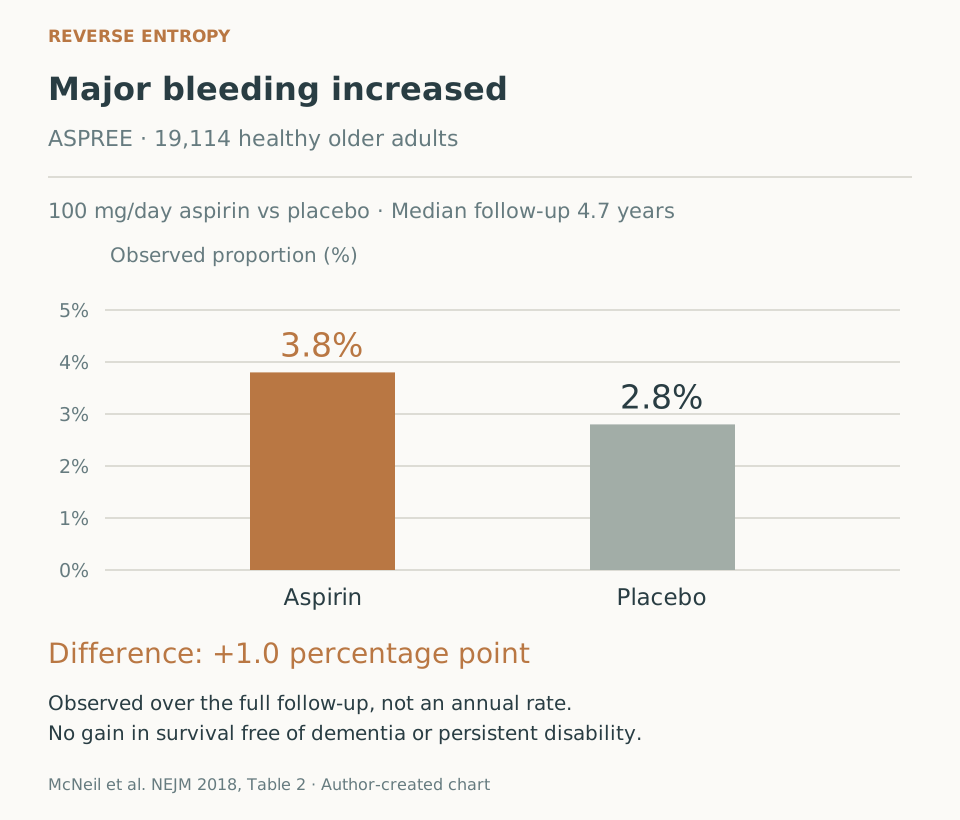
Source: McNeil JJ, et al. NEJM. 2018;379:1499–1508. Original graph of the proportions experiencing major bleeding in Table 2. Image source paper. Created by Reverse Entropy; no figures from the original paper were reproduced.
Major bleeding during follow-up · Proportion of participants
Aspirin group · 3.8%
Placebo group · 2.8%
The relative hazard of bleeding over time was 38% higher, while the difference in the observed proportions was approximately 1 percentage point.
In this trial, taking aspirin to live longer did not deliver the expected benefit for healthy older adults.
3. Yet there is evidence that aspirin can prevent colorectal cancer
Does that mean the claim that aspirin prevents colorectal cancer is wrong?
No.
A study published in The Lancet in 2010 followed cancer incidence and mortality over the long term in participants from earlier randomized aspirin trials.
In the pooled analysis, assignment to aspirin was associated with a 24% lower risk of colon cancer and a 35% lower risk of death from colon cancer over 20 years. The difference in rectal cancer was not statistically significant in the overall analysis. Original long-term follow-up analysis
Colorectal cancer is divided into colon cancer and rectal cancer according to where it develops. The clearer effect in this study concerned colon cancer.
As results like these accumulated, aspirin's potential to prevent colorectal cancer attracted attention.
However, these were long-term follow-up data from trials originally designed to prevent cardiovascular disease, and the participants' ages, doses, and treatment durations varied.
What, then, about people at particularly high risk of colorectal cancer?
4. The clearest example is Lynch syndrome, a hereditary high-risk condition
Lynch syndrome is a hereditary condition associated with abnormalities in genes that repair errors in DNA. It raises the risk of colorectal cancer and several other cancers. It is distinct from simply having a family member with colorectal cancer.
The randomized CAPP2 trial in these patients provides important evidence.
It assigned 861 people with Lynch syndrome to aspirin 600 mg daily or placebo. Results from an average of approximately 10 years of follow-up, including treatment and subsequent observation, were published in The Lancet in 2020.
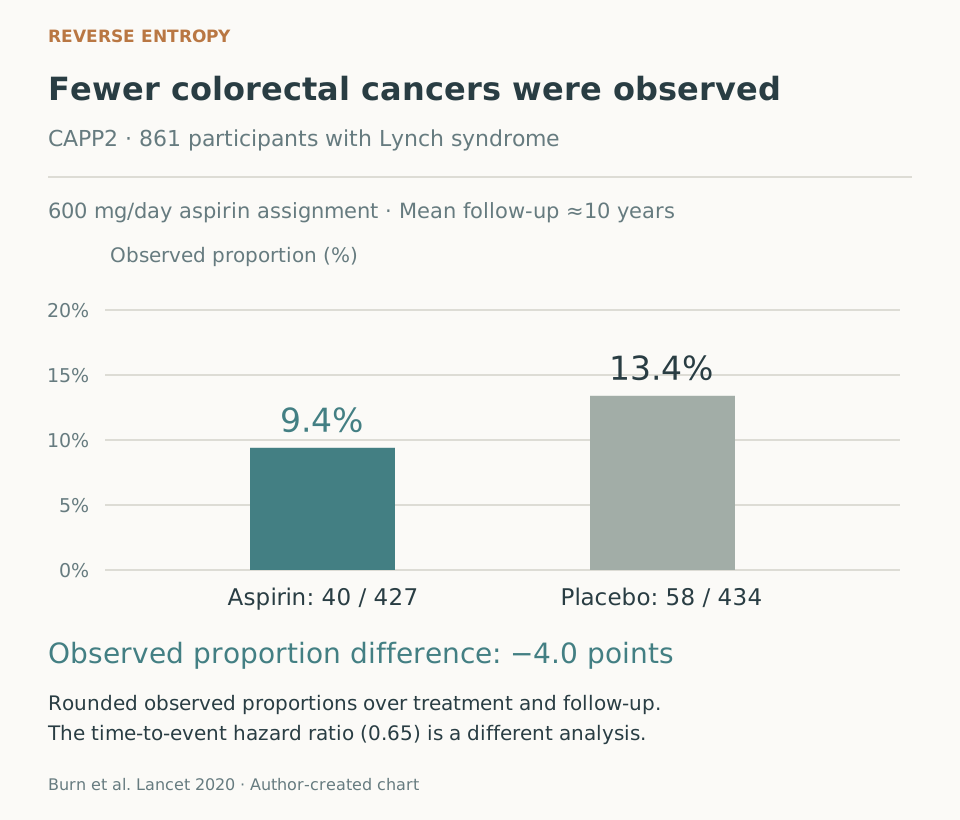
Source: Burn J, et al. Lancet. 2020;395:1855–1863. Original graph based on the number of colorectal cancer cases in each randomized group. Image source paper. Created by Reverse Entropy; no figures from the original paper were reproduced.
Colorectal cancer incidence · Number of patients · Proportion
Aspirin group · 40 of 427 · Approximately 9.4%
Placebo group · 58 of 434 · Approximately 13.4%
The hazard ratio in the analysis accounting for time to diagnosis was 0.65. This means the relative hazard of colorectal cancer was approximately 35% lower in the aspirin group. CAPP2 full text
A randomized trial had confirmed a colorectal cancer preventive effect in a specific high-risk population.
The UK's NICE guideline also recommends considering aspirin for more than two years to reduce colorectal cancer risk in people with Lynch syndrome. NICE guideline
Could a lower dose also work?
It would be better still if prevention could be achieved with less bleeding. Follow-up research therefore compared different doses.
The CaPP3 trial, reported in 2026, compared 100 mg, 300 mg, and 600 mg. The 100 mg group showed similar cancer patterns and less bleeding than the 600 mg group, adding support for the potential use of a low dose.
However, the trial did not meet all its prespecified statistical criteria to establish that the lower dose was noninferior. The dose should be decided in light of the latest evidence and the individual's bleeding risk.
5. A reduction in recurrence after colorectal cancer surgery has also been demonstrated
Another study took this a step further.
Beyond preventing cancer before it develops, it examined whether aspirin could reduce recurrence in people already treated for colorectal cancer.
The ALASCCA study, published in the New England Journal of Medicine in 2025, enrolled patients with colorectal cancer carrying certain genetic alterations.
It gave 626 patients who had undergone surgery aspirin 160 mg daily or placebo for three years. Their tumors had alterations in genes in the PI3K pathway, which is involved in cancer growth signaling.
Whereas Lynch syndrome concerns inherited cancer susceptibility, this study selected patients based on genetic alterations found in their tumors.
The results for the 314 patients with specific PIK3CA alterations, the primary analysis population, were as follows.
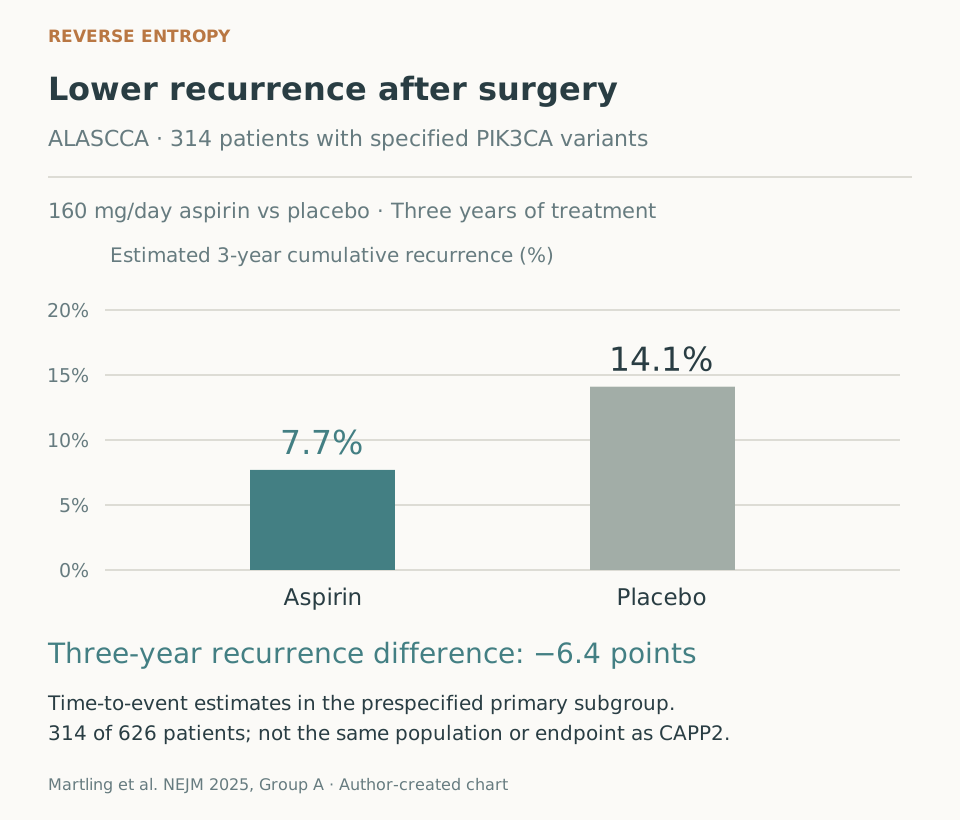
Source: Martling A, et al. NEJM. 2025. doi:10.1056/NEJMoa2504650. Original graph of the three-year cumulative recurrence rates in Group A. Image source paper. Created by Reverse Entropy; no figures from the original paper were reproduced.
Three-year cumulative colorectal cancer recurrence · Result
Aspirin group · 7.7%
Placebo group · 14.1%
The hazard ratio for recurrence was 0.49. The relative hazard of recurrence over time was approximately 51% lower, and the absolute difference in three-year recurrence rates was 6.4 percentage points.
Across the entire trial, severe adverse events occurred in 16.8% of the aspirin group and 11.6% of the placebo group. This does not mean that every event was caused by the drug, but it is a finding to consider when choosing treatment. ALASCCA paper
Which patients receive it matters
The ASCOLT trial, published in the same year, did not select patients by these genetic alterations.
It analyzed 1,550 patients with colorectal cancer who had completed standard treatment, using aspirin 200 mg for three years. Five-year disease-free survival was 77.0% with aspirin and 74.8% with placebo, a difference that was not statistically significant. ASCOLT paper
The populations, timing of treatment, and outcomes differed, making a direct one-to-one comparison difficult. Still, the studies show the growing importance of identifying which tumors may benefit, rather than applying aspirin in the same way to every patient with colorectal cancer.
I find this interesting. An old medicine can take on a new role if we identify more precisely the patients likely to benefit.
In these studies, aspirin was evaluated as an additional strategy alongside surgery and any necessary anticancer treatment.
6. Should healthy people also take it to prevent colorectal cancer?
We now return to the original question.
“If it works for certain patients, wouldn't it be good for me to take it in advance?”
To answer that, we need to ask whether healthy people receive the same benefit.
In 2026, JAMA Oncology published longer-term follow-up of the ASPREE participants described earlier.
Median follow-up, including observation after the trial ended, was 8.6 years. Neither a reduction in total cancer incidence nor a reduction in colorectal cancer incidence was demonstrated in the group assigned to aspirin in older age.
Guideline organizations also differ in their judgments.
In its 2021 guidance, the American Gastroenterological Association suggested low-dose aspirin for colorectal cancer prevention in some adults with a certain level of cardiovascular risk and low bleeding risk. By contrast, the US Preventive Services Task Force concluded in its 2022 update that evidence was insufficient to establish a reduction in colorectal cancer incidence or mortality in the general primary-prevention population. AGA guidance · USPSTF recommendation
When looking at this difference, I focus on the question: whose benefits outweigh their bleeding risk?
Even if people at high cancer risk obtain a meaningful preventive benefit, the benefit may be small for someone at low risk. The bleeding risk incurred during that time also has to be taken into account.
7. Who may need it, and who should be cautious?
The decision becomes much clearer when we separate the different situations.
A history of heart attack or stroke, a coronary stent, and similar situations
Aspirin may be an important treatment to prevent recurrence or blood clots. The treating physician determines how it is combined with other medicines and how long it is taken.
Middle-aged adults without cardiovascular disease
It may be used selectively after comparing cardiovascular and bleeding risks.
Healthy older adults
A benefit from starting it solely for longevity or anti-aging has not been demonstrated, and bleeding risk deserves particular attention.
I do not recommend it.
Lynch syndrome
I strongly recommend it for colorectal cancer prevention.
Patients with certain genetic alterations identified after colorectal cancer treatment
It can be discussed with the oncology and surgical teams as an additional strategy to prevent recurrence.
For example, the US Preventive Services Task Force recommends an individual decision about starting aspirin in adults aged 40–59 whose estimated 10-year cardiovascular risk is at least 10%.
It does not recommend starting aspirin at age 60 or older to prevent a first cardiovascular event. This does not mean that people already being treated for cardiovascular disease should stop taking it. USPSTF 2022 recommendation
8. What you should know if you take aspirin
A low dose or enteric coating does not eliminate bleeding risk
It is easy to assume that an enteric-coated tablet, designed to dissolve in the intestine rather than immediately in the stomach, must be safe.
But a secondary analysis of the ADAPTABLE trial published in 2023 did not find that enteric-coated aspirin significantly lowered bleeding risk compared with uncoated aspirin. Although the formulation itself was not randomized, enteric coating alone is no reason to be less concerned about bleeding. ADAPTABLE formulation analysis
Aspirin does not replace colonoscopy
Taking a preventive medicine and undergoing screening are separate matters.
In Korea in particular, colonoscopy is relatively inexpensive and physicians are skilled, making it possible to use screening actively to detect cancer early.
Even if you take aspirin, you should therefore continue screening appropriate to your age, family history, and previous polyp findings. ACG colorectal cancer screening guideline
If you already take prescribed aspirin, do not stop because of an article
If you are currently taking it, first establish why it was prescribed. In particular, aspirin prescribed after a heart attack or stent placement should not be stopped or changed without discussing it with the treating team. American Heart Association information
Closing thoughts: ask what benefit it offers you
I think we need to acknowledge two things at the same time when evaluating aspirin.
First, there is real evidence for colorectal cancer prevention. Randomized trials have shown prevention of cancer in Lynch syndrome and reduced recurrence in patients with colorectal cancer carrying certain genetic alterations.
Second, those findings do not mean that every healthy person should take it daily. In a large trial of healthy older adults, bleeding increased without a benefit in healthy lifespan.
From an anti-aging perspective, I also believe that the possibilities of medicines deserve careful consideration. To turn that potential into an actual benefit, we must also consider who receives the medicine.
The important question is this.
“Is the risk I can prevent large enough, and the risk I have to accept small enough?”
Aspirin is an important medicine for people who need it. But it is not a medicine everyone should add simply because they want to live longer.
When deciding whether to start or continue it, I hope you will first consider your own conditions and the purpose of prevention, rather than the medicine's reputation. I think that is the starting point for using aspirin properly.
References
1. Antithrombotic Trialists’ Collaboration. Aspirin in the primary and secondary prevention of vascular disease: collaborative meta-analysis of individual participant data from randomised trials. Lancet. 2009. Paper
2. American Heart Association. Aspirin and Dual Antiplatelet Therapy. Official information
3. McNeil JJ, et al. Effect of Aspirin on Disability-free Survival in the Healthy Elderly. N Engl J Med. 2018. DOI: 10.1056/NEJMoa1800722. Full text
4. Rothwell PM, et al. Long-term effect of aspirin on colorectal cancer incidence and mortality: 20-year follow-up of five randomised trials. Lancet. 2010. Paper
5. Burn J, et al. Cancer prevention with aspirin in hereditary colorectal cancer (Lynch syndrome), 10-year follow-up and registry-based 20-year data in the CAPP2 study: a double-blind, randomised, placebo-controlled trial. Lancet. 2020. Full text
6. NICE. Colorectal cancer, NG151. Recommendation 1.1.1: Prevention of colorectal cancer in people with Lynch syndrome. Guideline
7. Aspirin for cancer prevention in individuals with Lynch syndrome: first results from the CaPP3 multicentre, randomised, double-blind, non-inferiority trial. Lancet Gastroenterol Hepatol. 2026. Paper
8. Martling A, et al. Low-Dose Aspirin for PI3K-Altered Localized Colorectal Cancer. N Engl J Med. 2025. DOI: 10.1056/NEJMoa2504650. Paper
9. Aspirin after completion of standard adjuvant therapy for colorectal cancer (ASCOLT): an international, multicentre, phase 3, randomised, double-blind, placebo-controlled trial. Lancet Gastroenterol Hepatol. 2025. Paper
10. Orchard SG, et al. Cancer Incidence and Mortality With Aspirin in Older Adults: Follow-Up of the ASPREE Trial. JAMA Oncol. 2026. DOI: 10.1001/jamaoncol.2025.6196. Paper
11. American Gastroenterological Association. Chemoprevention for colorectal neoplasia. 2021. Recommendation
12. USPSTF. Aspirin Use to Prevent Cardiovascular Disease: Preventive Medication. 2022. Recommendation
13. Sleem A, et al. Effectiveness and Safety of Enteric-Coated vs Uncoated Aspirin in Patients With Cardiovascular Disease: A Secondary Analysis of the ADAPTABLE Randomized Clinical Trial. JAMA Cardiol. 2023. Paper
14. Shaukat A, et al. ACG Clinical Guidelines: Colorectal Cancer Screening 2021. Am J Gastroenterol. 2021. Guideline
#Aspirin #LowDoseAspirin #ColorectalCancerPrevention #ColorectalCancerRecurrence #LynchSyndrome #CardiovascularDisease #MyocardialInfarction #AntiplateletTherapy #BleedingRisk #AntiAging #HealthyLifespan #MedicalResearch #ReverseEntropy #ReverseEntropy #CheongdamHIN