There is a mammal that can live for more than 200 years: the bowhead whale.
With such a large body and such a long life, you might expect an enormous amount of damage to accumulate in its cells.
But a study published in Nature in 2025 offered an intriguing clue.
Bowhead whale cells repaired damaged DNA efficiently and accurately.
The secret to a long life may not lie only in avoiding damage. How well the body repairs damage once it occurs matters too.
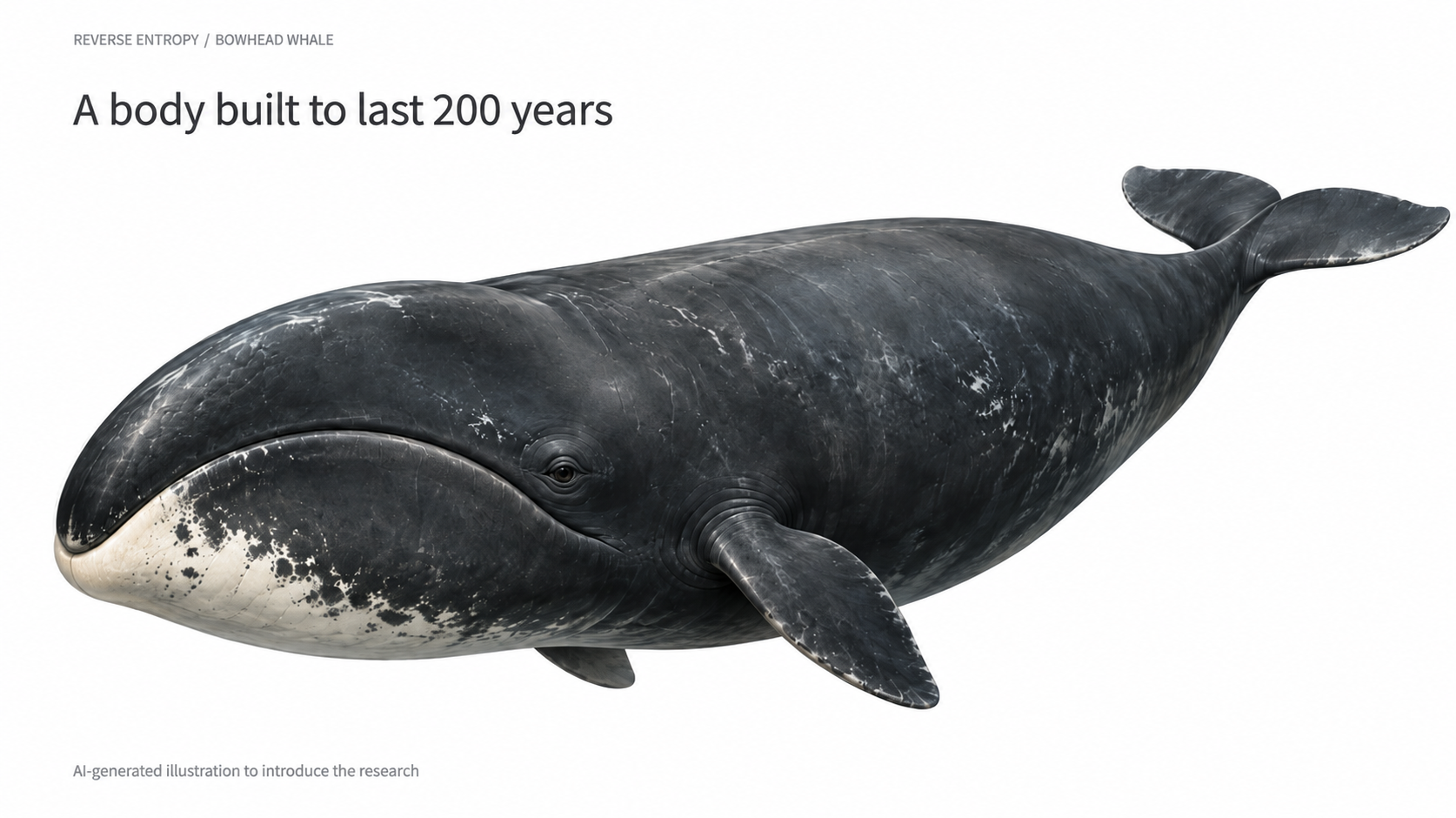
This is an AI-generated illustration of a bowhead whale, not an actual photograph or an animal used in the study. Bowhead whales are estimated to be capable of living for more than 200 years; this does not mean every individual reaches that age.
Source: Original artwork by Reverse Entropy. Species information: NOAA Fisheries. Research: Firsanov D et al., Nature, 2025.
Are whale cells inherently resistant to cancer?
The researchers examined how bowhead whale cells become cancerous.
They experimentally disrupted genes in whale cells (skin fibroblasts) and human cells to make them become cancerous.
Their expectation was that, because whale cells were more resistant to cancer, many more genes would have to be disrupted than in human cells before they became cancerous.
That was what they expected, but
the whale cells actually became cancerous more readily, with fewer genetic manipulations than the human cells. To use an illustrative example, if five layers of defense had to be dismantled in a human cell, only three might need to be dismantled in a whale cell.
When the researchers directly manipulated their genes in the laboratory, the whale cells became cancerous more easily than expected. It was therefore no longer possible to draw the simple conclusion that bowhead cells are inherently impenetrable cells that rarely turn cancerous.
Instead, whale cells were particularly good at repairing DNA damage, and fewer mutations were observed.
The key is the ability to put a torn blueprint back together
DNA contains the information a cell needs to function. Damage that breaks both strands at once is especially difficult to deal with.
Even if a torn blueprint is pieced back together, it is no longer the original blueprint if letters are missing or their order has changed.
Bowhead whale cells showed an advantage not only in how efficiently they repaired this damage, but also in how accurately they preserved the original information.
The researchers found that a protein called CIRBP played an important role in this process.
CIRBP stands for cold-inducible RNA-binding protein.
What does CIRBP do?
The moment DNA breaks,
CIRBP rushes to the damaged site and attaches to it.
It helps repair proteins assemble at the break and protects the broken DNA ends, supporting more efficient and accurate repair.
CIRBP was found at particularly high levels in bowhead whale fibroblasts and tissues compared with those of other mammals.
Normally, animals such as elephants and humans make cells self-destruct when their DNA is badly damaged.
Elephants, in particular, have 20 times as many copies of the tumor-suppressor gene TP53 as humans do, allowing them to eliminate suspicious cells ruthlessly.
Rather than adding more barriers that kill cells, bowhead whales deploy large quantities of CIRBP, adopting a strategy of repairing damaged DNA more efficiently and accurately and continuing to use the cells instead of discarding them.
This is the reason behind the earlier finding that artificially manipulated whale cells became cancerous more easily than human cells.
By helping to limit the accumulation of mutations through better DNA repair, CIRBP may reduce the need for multiple layers of a cell-suicide, or disposal, defense that acts only after mutations occur.
The effect was also observed in cultured human cells
The researchers made cultured human cells produce bowhead whale CIRBP.
This improved the two main DNA-repair pathways. They also observed effects that protected broken DNA ends and helped join them together.
The team also conducted experiments in fruit flies. Increasing the production of human or bowhead whale CIRBP extended survival and improved survival after radiation damage.
Original study: Firsanov et al., Nature, 2025
Removing damaged cells is not the only answer
Reading this study reminded me of the research on removing senescent cells that I introduced earlier.
Dangerous cells need to be cleared away. But can we maintain the body for a long time simply by continuing to remove cells that could still be repaired?
A city offers a useful comparison. Buildings that are about to collapse must be demolished, but there is no need to tear down every building with a small crack. We also need the ability to repair buildings properly and keep using them.
This does not mean bowhead whales never eliminate damaged cells. It means that the particular strength highlighted by this study was their ability to repair DNA accurately.
What I hope to learn from long-lived animals
It would be difficult to say that this study has identified an anti-aging ingredient we can use right away.
The effects and safety of increasing CIRBP in people have not yet been established.
Even so, I personally have high hopes for this protein.
As its name suggests, CIRBP is a protein induced by cold temperatures.
Evolution in an environment that required a lifetime in the icy Arctic Ocean may well have maximized this protein,
and the possibility of increasing CIRBP expression in the human body through cold exposure or particular drug stimuli is being explored as a direction for future anti-aging research.
What needs to be studied next is clear.
We should look not only at how much damage was prevented, but also at how accurately existing damage was repaired.
I believe we need the combined ability to protect healthy tissue, repair cells that can be repaired, and remove cells that have become dangerous.
A body that regains its function after damage, rather than one that never breaks down. Bowhead whales have given us a clue to studying that capacity for repair.
References
1. Firsanov D, et al. Evidence for improved DNA repair in the long-lived bowhead whale. Nature. 2025;648:717–725. Full text
2. Author correction to the paper above. It concerns the title and data-access information, not a change to the findings discussed in this article. Correction
3. NOAA Fisheries. Bowhead whale lifespan and ecology. Resource
#BowheadWhale #LongevityResearch #DNARepair #CIRBP #AntiAging #CellularSenescence #LifespanResearch #ReverseEntropy