Following my earlier discussion of melatonin, I would like to talk a little more about insomnia today.
As I briefly mentioned there, many people complain of insomnia while regularly consuming caffeine. Most do not realize that caffeine may be the cause of their insomnia.
For example, some people can drink coffee in the afternoon and fall asleep as soon as their head touches the pillow.
It is easy for them to think that coffee does not have much effect on their sleep.
But falling asleep quickly is different from sleeping well throughout the night. Even if you fall asleep quickly, you may wake more often or get too little deep sleep.
That does not mean everyone needs to give up afternoon coffee. Along with when you drink it, you need to consider the amount of caffeine and how you usually sleep.

Source: Luke Chesser / Wikimedia Commons / CC0 1.0 / Reduced in size. The original and license are linked in the references.
Falling asleep alone does not tell the whole story
Rather than eliminating fatigue, caffeine masks the signal that says “I am sleepy.”
While we are awake, a substance called adenosine builds up in the brain.
It signals to the body that it is time to rest.
Caffeine blocks the transmission of that signal, temporarily making us feel less sleepy. That is different from recovering from fatigue.
The problem is that caffeine's effects can remain at night.
Falling asleep does not mean it has no effect on your sleep.
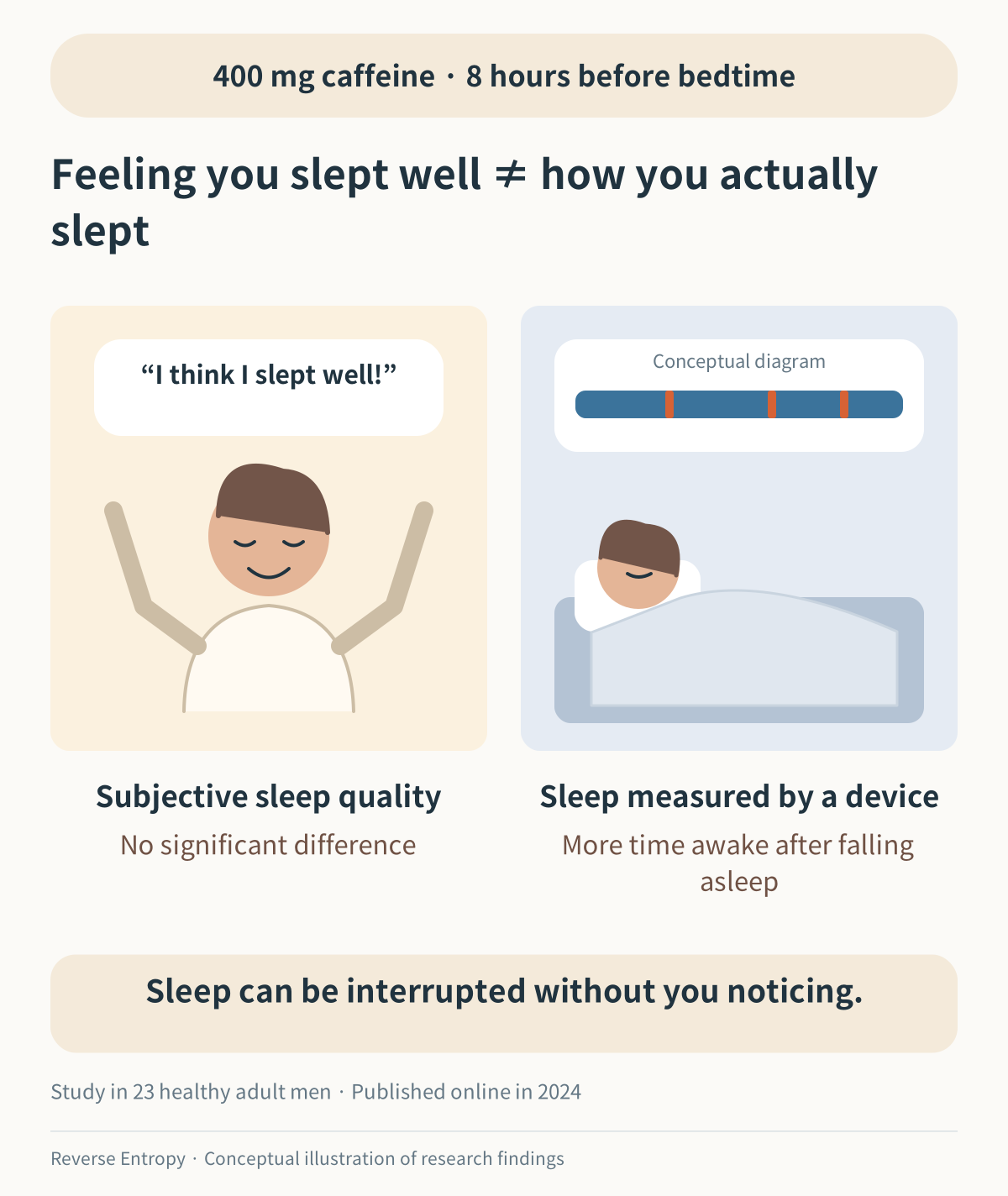
In a study published online in 2024, 23 healthy adult men compared their sleep on days when they took caffeine with days when they did not.
When they took 400 mg of caffeine eight hours before bedtime, the time they spent awake during the night increased by approximately 29 minutes.
Here is the important part: there was no clear difference in the participants' own ratings of their sleep quality.
The equipment recorded signs of interrupted sleep, but the difference did not appear in their own sleep-quality assessments.
That is why it is difficult to judge caffeine's effects solely from the feeling that “I sleep well even when I drink coffee.” What matters is not just whether you fall asleep, but how continuously you sleep through the night.
One cup and a high dose are different, even in the same afternoon
Fortunately, 100 mg of caffeine did not produce a statistically significant difference in sleep in the experiment.
The effects of 400 mg were clearer. When taken four hours before bedtime, it shortened total sleep time by approximately 51 minutes. Even when taken 12 hours before bedtime, it changed some measures of falling asleep and deep sleep.
We should not conclude from this that 100 mg is a sleep-safe threshold for everyone.
People vary greatly in how caffeine disrupts their sleep.
For reference, 400 mg of caffeine is roughly the amount in two or three cups of coffee.
In everyday life, however, the caffeine amount listed on the product is more useful than the number of cups.
The amount per cup varies with serving size, beans, and brewing method. If you add an energy drink or a pre-workout supplement to a large coffee, you may be consuming more than you think.
The US FDA's description of 400 mg a day as an amount not generally associated with negative effects for most adults is not a guarantee that this amount will leave sleep unaffected. Guidance about total daily intake and a threshold for protecting nighttime sleep need to be distinguished.
Source: Szűcs László / Wikimedia Commons / CC0 1.0 / Reduced in size. The original and license are linked in the references.
Start with your bedtime, rather than a fixed afternoon cutoff
It is difficult to set one cutoff, such as “none after 2 p.m.,” for everyone. Someone who goes to bed at 10 p.m. and someone who sleeps in the early hours of the morning have different intervals between coffee and bedtime. People also differ in how quickly they process caffeine and how sensitive they are to it.
If you do not feel refreshed in the morning or often wake during the night, late caffeine and high-dose products are worth looking at first. Try moving your last intake earlier or reducing the amount, and record any changes while keeping bedtime and waking time as consistent as possible.
You can note the time you drank coffee, the product's caffeine content, whether you felt you woke during the night, and how sleepy you were the next day. This is an observation of daily habits to help narrow down the cause, not a diagnostic method for sleep disorders. If things improve, your current amount or timing may have been placing a burden on you.
Check tea and other drinks when replacing coffee, too
Some people switch from coffee to black or green tea. Both contain caffeine, so the fact that they are not coffee does not mean you can drink them without limit in the evening. Check caffeine in chocolate, some other drinks and supplements, and over-the-counter medicines as well. Cola in particular is often the culprit behind insomnia.
Decaffeinated coffee is a lower-caffeine option, but it is not the same as “zero caffeine.” Sensitive individuals should check product information and observe their own responses. If you have been drinking a lot every day, reducing it gradually rather than stopping everything abruptly can help lessen uncomfortable withdrawal symptoms.

Source: Dalia fathallah / Wikimedia Commons / CC BY-SA 4.0 / Original image unedited. The original and license are linked in the references.
References and photo credits
Gardiner et al. Dose and timing effects of caffeine on subsequent sleep. Sleep. Published online October 8, 2024. Original randomized crossover trial in humans
US Food and Drug Administration. Guidance on caffeine intake, sensitivity, decaffeinated coffee, and reducing consumption. Official FDA information
Coffee photograph: Luke Chesser. Original and CC0 notice. Clock photograph: Szűcs László. Original and CC0 notice. These two photographs have only been reduced in size and are available under CC0 1.0.
Black-tea photograph: Dalia fathallah. Original photograph, CC BY-SA 4.0. Used without editing the original.
#Coffee #Caffeine #Sleep #Decaf #SleepHabits #HealthInformation #ReverseEntropy