Today's topic is a relatively simple but important one: blood pressure.
For anti-aging, vascular health is of the greatest importance.
The easiest way to assess vascular health is to measure blood pressure.
Yet blood pressure that is high at the clinic often falls into the normal range at home.
It can be confusing to know which reading to trust.
In this situation,
blood pressure may have risen temporarily because of nervousness at the clinic,
or the difference may reflect measuring at different times or in different positions at home.
It is also possible that hypertension is genuinely present.
Let's look more closely.
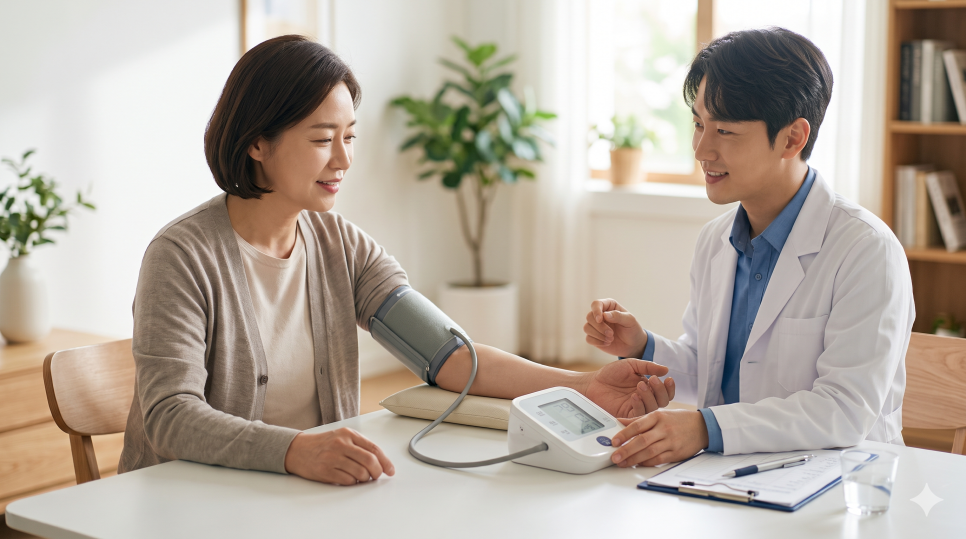
Do not disregard a clinic reading just because readings at home are lower
In a person who is not taking medication, high office blood pressure with blood pressure that is not high at home is called white-coat hypertension.
The reverse pattern, blood pressure that is not high at the clinic but is high at home, is called masked hypertension.
These differences are difficult to distinguish by how you feel or by a single measurement.
The Korean Society of Hypertension's 2026 clinical practice guideline recommends using out-of-office measurements alongside office measurements for accurate diagnosis and assessment of treatment.
If the results at the two locations continue to differ, the clinician reviews the home blood-pressure record
and, when needed, uses 24-hour ambulatory blood-pressure monitoring.
Morning and evening home measurements alone cannot tell us what blood pressure is doing during sleep.
Morning: before breakfast and medication. Evening: before bed
The basic approach is to measure at home in the morning and evening under similar conditions each day.
In the morning, measure after using the bathroom and before breakfast and your usual morning blood-pressure medication.
In the evening, measure before going to bed. This does not mean skipping medication or changing the time you take it on your own just to obtain a measurement.
If you have been given a specific measurement and medication schedule, follow those instructions.
Before measuring, sit quietly in a chair for five minutes.
Avoid coffee, exercise, smoking, alcohol, and bathing for the preceding 30 minutes,
and do not talk or look at your phone during the measurement.

Source: Ante Samarzija / Unsplash, Unsplash License. https://unsplash.com/photos/lsmu0rUhUOk
Where you place your arm changes the reading too
Use a validated automatic upper-arm monitor and choose a cuff that fits your arm circumference.
The cuff is the inflatable band that wraps around your arm.
Rest your back against the chair, keep your feet on the floor, and do not cross your legs.
Support your arm comfortably on a table so that the middle of the cuff is at heart level.
Avoid holding your arm up without support or resting it low on your lap.
Arm position can seem like a minor detail, but it matters more than you might think.
In a 2024 randomized crossover trial, 133 adults in the United States took turns using different arm positions.
Blood pressure readings were higher with the arm resting on the lap or hanging at the side than with the arm supported on a table.
Record both readings, not just the lower one
After the first measurement, wait one to two minutes and measure again.
Take two readings each morning and two each evening. Even if the first is high, do not select only the second for your record.
Record the date, time, and both readings so that the clinician can interpret them properly.
If the monitor stores readings, bring the original stored record as well.
For an initial assessment, it is best to measure on seven consecutive days if possible.
The 2026 Korean guideline advises measuring for at least three days, preferably seven consecutive days, for initial diagnosis, and excluding the first day's readings when calculating the average. Keep the first day's records rather than deleting them, and discuss how to interpret the full record and the average at your appointment.

Source: Mike Tinnion / Unsplash, Unsplash License. https://unsplash.com/photos/3ym6i13Y9LU
At home, the thresholds are 135 and 85, not 140
In the 2026 Korean guideline, the home blood-pressure thresholds for diagnosing hypertension are systolic pressure of at least 135 mmHg or diastolic pressure of at least 85 mmHg.
These differ from the office thresholds of 140 or 90 mmHg.
These numbers are not treatment targets for everyone either.
If you already take medication, your target can vary with age, coexisting conditions, and symptoms.
Do not reduce or stop medication just because a home reading is low. Bring your records and discuss them with your clinician.
If very high readings recur, do not delay seeking medical care.
If you develop chest pain, shortness of breath, sudden weakness or paralysis, or difficulty speaking, seek emergency help first, such as by calling 119 in South Korea, rather than continuing to measure or calculate averages.
References
Korean Society of Hypertension. 2026 Clinical Practice Guideline for Hypertension, 6th edition: home blood-pressure measurement, Figure 11, diagnostic thresholds, and treatment targets. The revised PDF linked from the official notice was consulted.
Korean Society of Hypertension Home Blood Pressure Forum position statement, 2022: morning/evening measurement conditions and device selection. Consult alongside the latest guideline.
Liu et al. ARMS randomized crossover trial, 2024: differences in readings by arm position. JAMA Internal Medicine, doi:10.1001/jamainternmed.2024.5213.