What we can begin doing when memory starts to decline
When your memory no longer feels as sharp as it used to, worry often comes first. You may wonder whether this is an unavoidable part of aging or fear that it will continue getting worse.
A Korean clinical trial has now reported that exercise and nutritional support may help even people whose cognitive function has already declined.
The study was published in the international journal Age and Ageing on October 27, 2026.
At two public health centers in Korea, 140 older adults were divided into two groups. One group received exercise and nutritional support for six months.
The group that participated in the program showed an average improvement in cognitive test scores 2.3 points greater than the group receiving usual care.
Some of the difference was still present six months after the program ended. Original study
(I use “older adults” here for convenience, but compared with the past, many people today do not look old even in their 60s and 70s.
To me, this is the clearest evidence that taking care of yourself can help you stay young longer. Do not give up on living youthfully.)
What this study established was a change in measures of cognition and daily functioning, not a reduction in the onset of dementia.
What I particularly welcome is that the researchers actually intervened in people whose function had already begun to decline and observed improvement.
Let us take a closer look.
AI disclosure information
The study compared 140 Korean older adults with cognitive impairment
The study took place at public health centers in Pyeongchang, Gangwon Province, and Hanam, Gyeonggi Province.
Participants were aged 60–80 years, with an average age of 75.
All had confirmed cognitive impairment but could still perform daily activities relatively independently.
People who had already been diagnosed with dementia or were taking dementia medication were excluded.
The researchers randomly assigned participants to two groups. Seventy joined the exercise and nutrition program, while the other 70 received usual public health center care and educational materials.
Random assignment helps reduce differences such as healthier people exercising more in the first place. Rather than simply observing people who exercise and those who do not, the study examined what changed when a program was actually provided.
Another important point: it could be done at home
Participants were recruited through the public health centers, and the exercise sessions were designed so that they could join from home using their own smartphones.
There are times when I know I should exercise but find the thought of going to the gym a real chore.
I like this result because it shows that exercising with a trainer from home can also be effective. (I am a homebody.)
Twice a week, they exercised at home with a professional
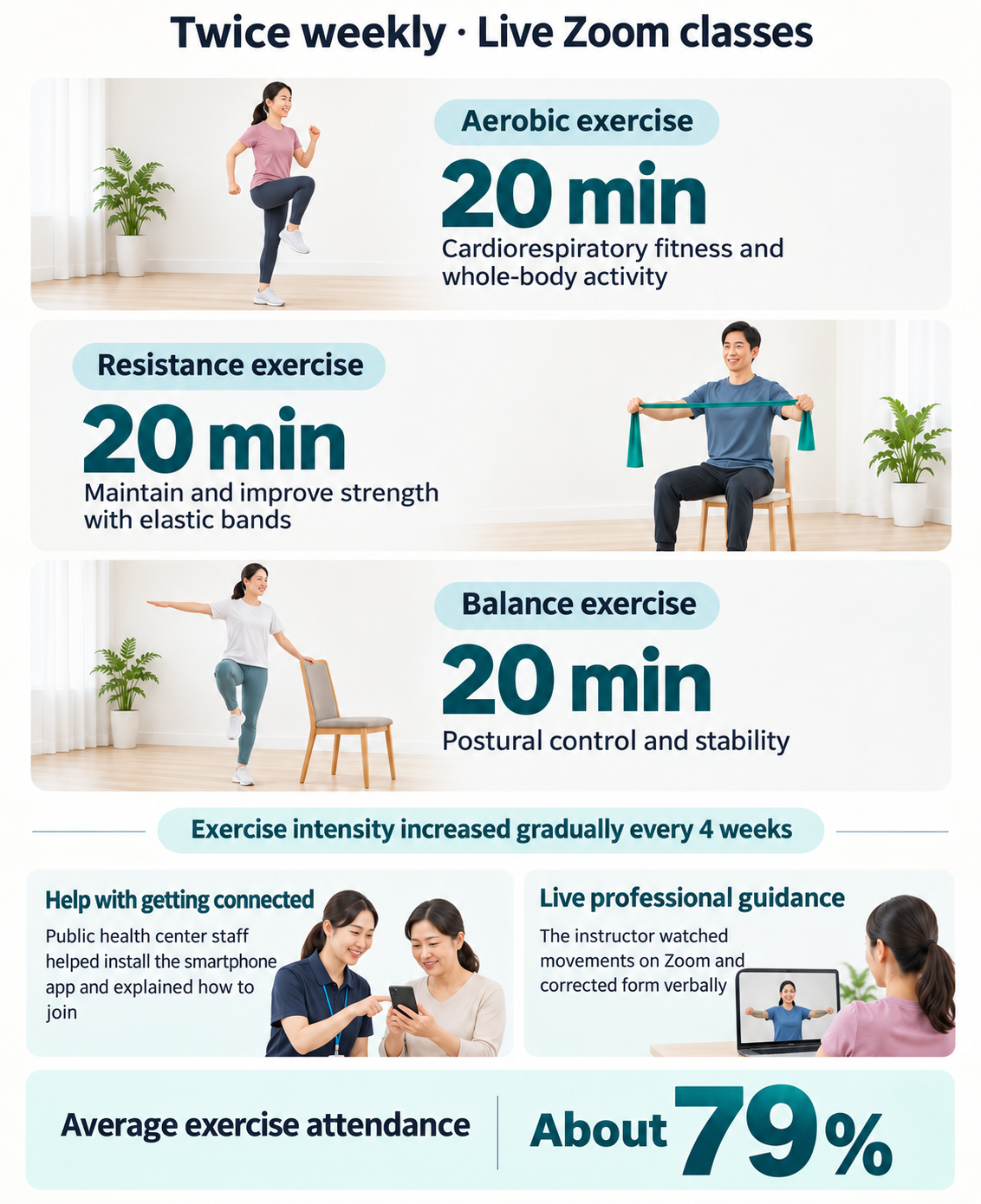
Exercise sessions were held twice a week for 60 minutes each. Three types of exercise were included equally within the hour.
20 minutes of aerobic exercise: cardiorespiratory fitness and overall physical activity capacity
20 minutes of resistance exercise: maintaining and improving muscle strength
20 minutes of balance exercise: postural control and stability
Elastic bands were used for resistance exercise, and exercise intensity was increased gradually every four weeks.
Participants connected through the videoconferencing program Zoom.
A professional exercise instructor watched their movements in real time and gave verbal corrections to their form. At the beginning, public health center staff also helped install the program on their smartphones and taught them how to connect.
I think this is an excellent approach. Even when we know exercise is good for us, starting on our own and keeping it up can be difficult.
There was a structure: connect at a set time, learn exercises suited to your condition, and have an instructor monitor your progress.
This helped maintain a high average exercise attendance rate of about 79%.
Nutrition was addressed alongside movement
At the start of the program, the researchers assessed nutritional status and provided individual dietary counseling with a dietitian.
Participants were also asked to consume an additional total of 16 g of protein per day, divided into two servings.
When recommending exercise in older age, we need to look at eating habits as well. For someone eating less or not getting enough protein, physical activity and the nutrition needed for recovery should be considered together.
There is also research suggesting that protein intake is particularly important in older age. I will cover this another time.
This study likewise combined exercise and nutrition in a single program. Its results are therefore best understood as the effects of exercise, dietary counseling, and protein supplementation together, rather than the effect of protein supplementation alone.
Surprisingly, some of the benefits remained six months after the program ended
The main assessment tool was the MoCA-K, the Korean version of a cognitive screening test. It is scored out of 30 and examines not only memory but also attention, language, planning and judgment, and visuospatial abilities.
After six months, the exercise and nutrition group showed an average improvement in test scores 2.3 points greater than the control group. The 95% confidence interval was 1.4–3.1 points.
The researchers also assessed participants six months after the program had ended. At 12 months from the start of the study, the intervention group's change in score from baseline was still an average of 1.1 points greater than that of the control group. The 95% confidence interval was 0.3–2.0 points.
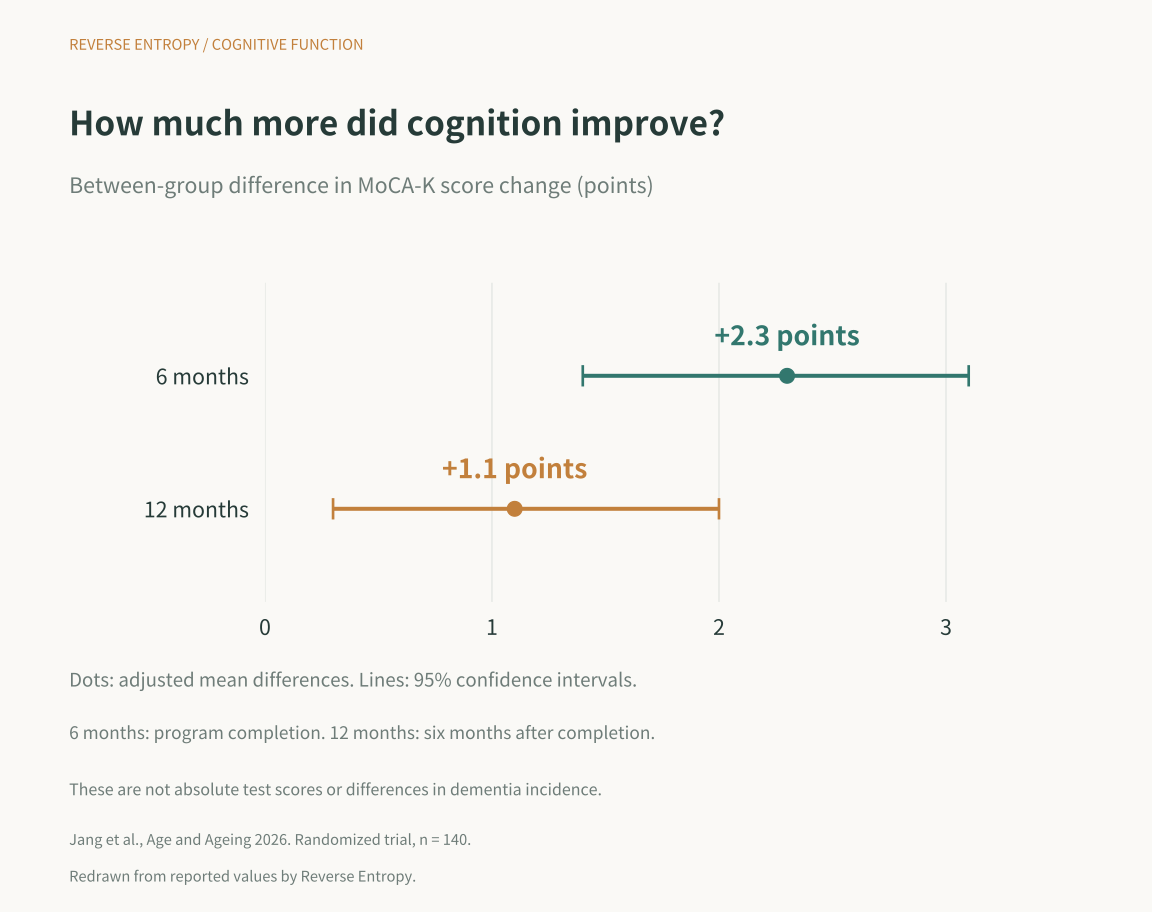
Source: Jang GY et al., Age and Ageing, 2026;55:afag310. Reconstructed by Reverse Entropy from the paper's published figures. Image source Original graphic by Reverse Entropy.
I look at two things together here: cognitive function improved while the intensive program was being provided, and some of that difference remained afterward.
The way the difference narrowed over time also gives us something to consider. The researchers did not measure every aspect of participants' subsequent lifestyles, so we cannot attribute the reduction to a single cause. But it prompts the question of how to keep such programs going in everyday life.
I believe health management needs to become part of daily living rather than end as a one-off event.
Why is moving the body connected to the brain?
Exercise supports cardiovascular health and the management of blood pressure and blood glucose.
Because the brain needs a continuous supply of energy and oxygen, we have to consider the vascular and metabolic condition of the whole body as well.
Another perspective is neuroplasticity: the brain's ability to change in response to stimulation and experience.
For example, a separate randomized trial published in 2011 analyzed imaging data from 120 older adults. An increase in the volume of the hippocampus, which is involved in memory, was observed in the group that performed aerobic exercise for one year.
Study on the hippocampus and exercise
These studies suggest that even an aging brain may still be able to respond to stimulation in everyday life. Several pathways may act together, including vascular and metabolic changes and the adaptation of neural circuits.
The Korean study did not establish each of those pathways individually. However, by showing that exercise and nutritional support in daily life can lead to actual changes in cognitive function, it gives this question a clinical connection.
I want to view exercise as something broader than simply building muscle or controlling weight. It is an activity that repeatedly stimulates the whole body to maintain its function.
When starting, think about sustainability before the amount of exercise
Exercise in this study totaled 120 minutes a week. Of that, 40 minutes was aerobic exercise; the rest was resistance and balance exercise. This is a useful example of the composition of a program in which benefits were observed.
For older adults beginning to exercise, I believe it is important to start at a level suited to their current abilities and increase gradually.
Rather than overdoing it from the outset and giving up after a few days, the activity needs to be something they can repeat consistently.
You can also consider combining aerobic activity such as walking with activities that address strength and balance. In older age, the ability to stand and move safely is important alongside the ability to exert strength. Exercise and maintaining function in older adults
Nutrition should be checked too. Look at whether usual food intake and protein intake are adequate. When intake needs to be adjusted because of a condition such as kidney disease, the plan should be tailored to the individual's situation.
If you are concerned about memory decline, you can also begin lifestyle measures while seeking a medical assessment of the cause. Memory changes can have several causes, and assessment can help identify the support and management approaches you need. Memory changes and assessment
Anti-aging also means protecting the ability to live independently
In this study, I pay as much attention to the use of public health centers and smartphones to run the program as I do to the 2.3-point result.
Professionals guided the exercise, increased the intensity gradually, and supported diet and protein intake. Alongside researching new treatments, there is value in making it possible to continue the health practices we already know in real life.
I believe one goal of anti-aging is to remain able to move, think, and manage daily life independently for a long time.
This study showed that even people with existing cognitive impairment may have room to improve those functions. I hope this approach develops into longer-lasting programs, and that we can establish what difference it makes to long-term brain health.
There are things we can begin while waiting for new treatments: learn exercises suited to our abilities, pay attention to our meals, and create an environment that helps us keep going.
If you are worried that your memory is not what it used to be, how about starting with an exercise plan?
References
1. Jang GY, Jo S, Baek JY, et al. Remote multicomponent intervention for older adults with cognitive impairment in community settings: multisite randomised controlled trial. Age and Ageing. 2026;55(10):afag310. Published October 27, 2026. Full text
2. Erickson KI, et al. Exercise training increases size of hippocampus and improves memory. PNAS. 2011;108:3017–3022. This is an exercise and brain-imaging study separate from the Korean trial discussed here. Paper
3. U.S. National Institute on Aging (NIA). Health benefits of exercise and physical activity · Memory changes and aging
#CognitiveFunction #Memory #ExerciseForOlderAdults #ResistanceExercise #AerobicExercise #BalanceExercise #Frailty #Protein #BrainHealth #AntiAging #Healthspan #MedicalResearch #ReverseEntropy #CheongdamHin