When people decide to lose weight, joining a gym is often the first thing they do. This time, they tell themselves, they will be determined, work up a sweat, and exercise more to lose the weight.
In a weight-management consultation, there is something I want to understand before increasing exercise: how hungry the person becomes afterward, and what—and how much—they then eat.
Someone can work hard at exercise, only to develop a stronger appetite, eat more, and end up exhausted.
What matters to me is the order of treatment and the role of each part. First, establish a way to manage appetite and food intake. Then use exercise primarily to protect muscle and strength during weight loss. Here is why.

1. Calories burned during exercise do not translate directly into weight loss
When planning exercise, we often make a simple calculation: use more energy, and body weight should fall by the corresponding amount. But if exercise also changes appetite and food intake, the actual result can be different.
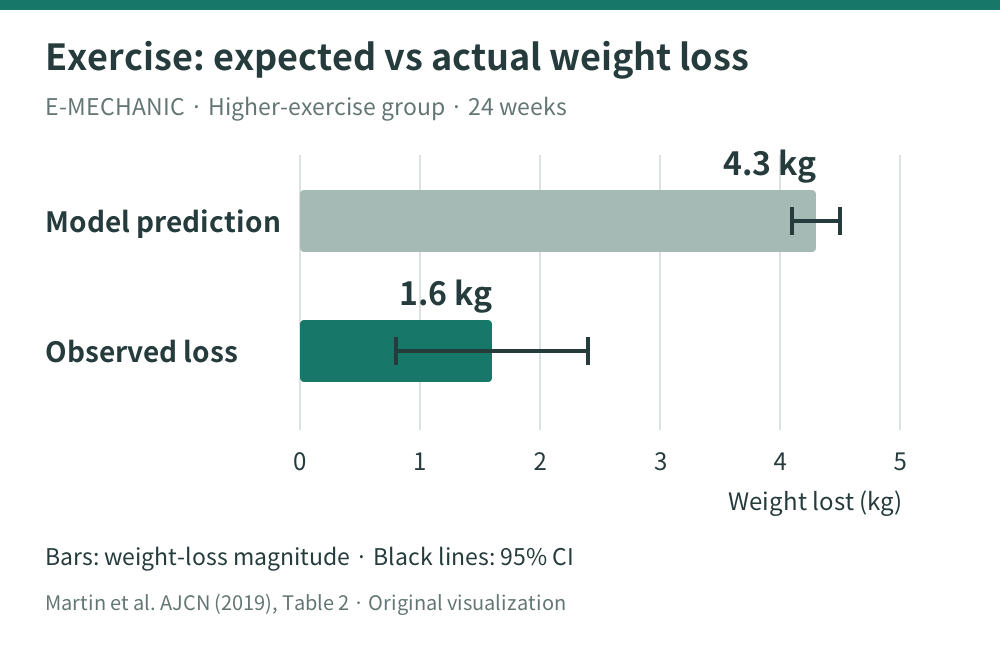
The E-MECHANIC randomized trial, published in 2019, followed 198 adults with overweight or obesity for 24 weeks. Daily energy intake rose by about 91–124 kcal in the exercise groups, while it barely changed in the no-exercise control group. [1]
In the higher-exercise group, an energy-balance model predicted a loss of about 4.3 kg, but actual weight loss was about 1.6 kg. Participants did lose weight—just less than expected from the energy they expended through exercise. The researchers identified increased food intake as the main explanation.
Put simply, they ate more after exercising, offsetting part of the energy they had used.
If you are eating more after exercise, the important question is how to handle that hunger. Appetite responses differ from person to person, so I pay attention to eating patterns after exercise rather than simply whether someone exercises.
2. How Mounjaro or Wegovy and exercise can work together
When a patient with substantial excess weight comes to me for a weight-management consultation, I sometimes tell them not to exercise initially.
The urgency to lose weight quickly can lead people to overdo it. They may injure themselves, or find that their appetite increases enough to undermine their weight-management efforts.
Eventually, the burden becomes too much and they suddenly stop. Their appetite remains, but the exercise does not, and the weight returns. I have seen this situation many times.
When a patient is motivated to exercise, I therefore may start weight management and exercise alongside medication such as Wegovy or Mounjaro. I guide them toward using the minimum dose that meets their needs, rather than increasing it indiscriminately.
In my view, repeatedly increasing the dose while focusing only on falling body weight can undermine the plan and increase the likelihood of medication-related adverse effects.
For roughly the first three months, I tell patients not to fixate on their weight. What I monitor is whether exercise triggers more hunger, or whether they develop an urge to eat late at night.
I increase the dose only as far as needed to bring those symptoms under control. Instead of asking someone to spend all their effort resisting post-exercise hunger, medication, when appropriate, can help create the conditions that allow them to keep exercising.
In this combination, the main benefit I seek from exercise is not additional weight loss. My priority is stimulating muscle and maintaining strength during weight loss, rather than burning a few hundred extra calories each session.
Manage appetite and food intake with medication, and use exercise to build a body that will still serve you after the weight has come off. That is the synergy I have in mind.
3. Strength matters more than muscle quantity alone
A randomized trial by Green and colleagues, published in Nature Medicine on November 9, 2026, compared 120 adults with overweight or obesity over 40 weeks. All received tirzepatide. One group continued its usual activities; the other added supervised resistance training three times a week. [4]
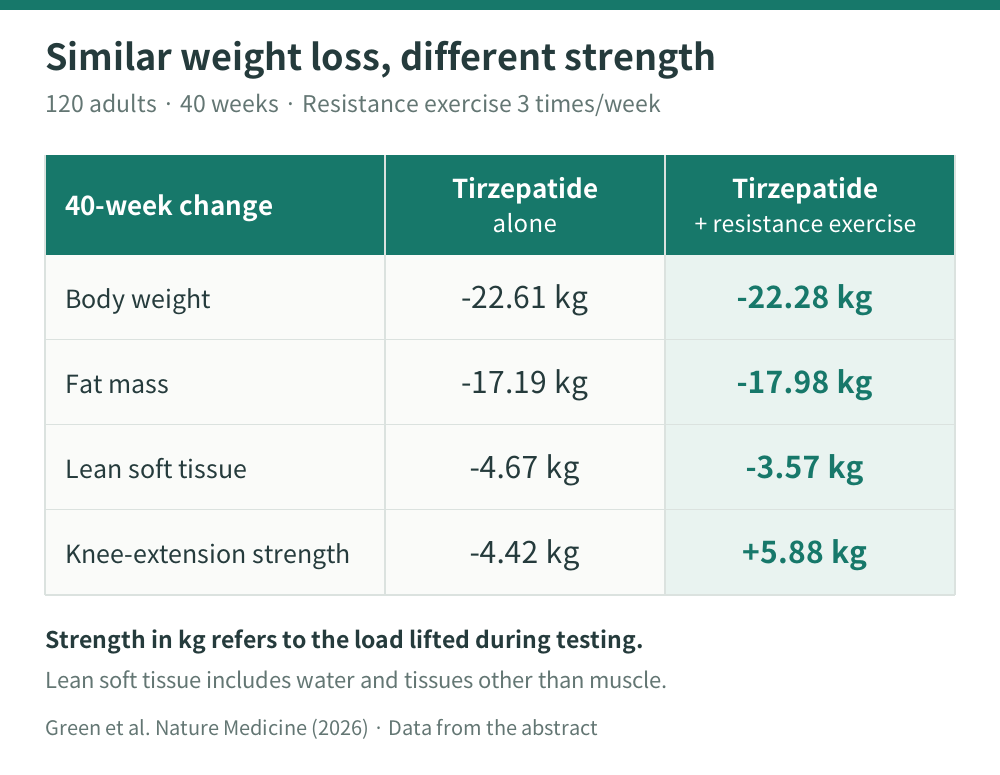
Weight and fat loss did not differ significantly between groups. The exercise group lost less lean soft tissue, although the difference in quantity was modest. The difference in strength was much more striking: strength increased in the exercise group.
I think this result asks us to reconsider the goal of weight management. Judged only by the number on the scale, the groups look similar. But ask what kind of body remains after treatment, and the story changes.
Alongside “How much lighter have you become?”, we should ask, “How much strength can that body produce?”

What I mean by “lower-dose medication plus exercise”
When using Wegovy or Mounjaro, I care more about how appetite and food intake respond at a given dose than about the dose number itself. If they are adequately controlled at a lower dose, I do not keep increasing it.
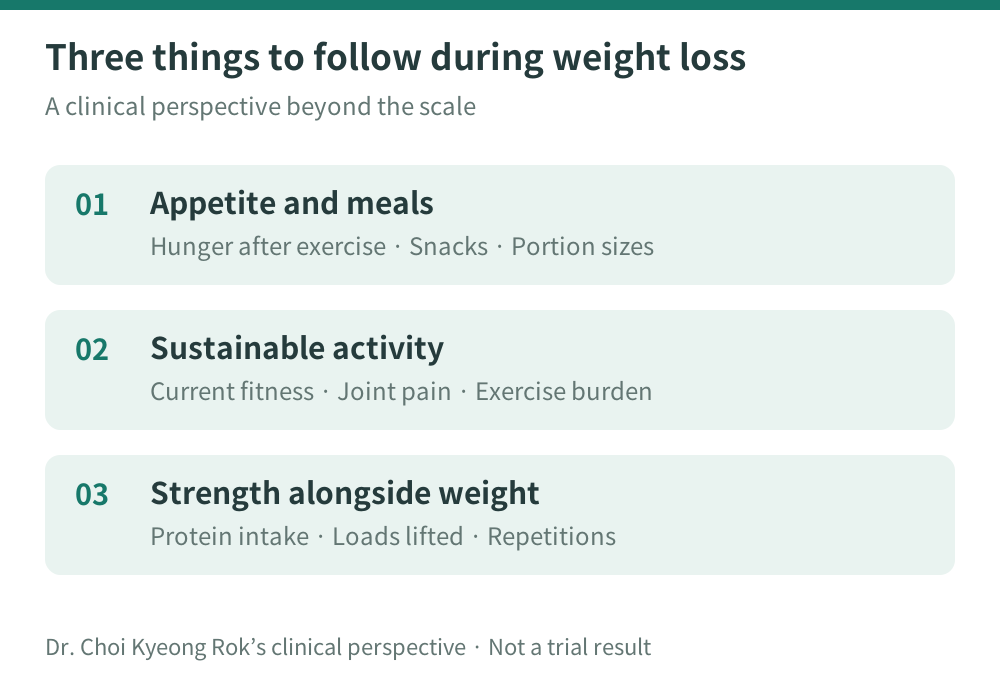
First, look at appetite and meals before and after exercise
How strong is the hunger afterward? Are late-night eating and snacks increasing? Does an exercise day become permission to overeat? Some people need to address these patterns before adding more exercise time.
Second, find activity the person can manage now
If someone has substantial excess weight, joint pain, or difficulty exercising, there is no reason to start with breathless, strenuous workouts. Walking, lower-impact aerobic activity, and appropriately adjusted resistance exercise can be chosen according to current fitness and pain.
The first step is to find sustainable activity and ease the pressure to prove that exercise is producing weight loss.
Third, follow strength as well as body weight
As weight falls during medication treatment, I consider it important to review food and protein intake alongside exercise performance. Gradually increasing the weight lifted or the number of repetitions also matters.
The goal of exercise is to leave someone with a body that can support their life and activities in the years ahead.
Letting go of the idea that exercise is primarily a way to lose weight allows us to appreciate its real value. We exercise to become healthier.
References
- Martin CK et al. Effect of different doses of supervised exercise on food intake, metabolism, and non-exercise physical activity: The E-MECHANIC randomized controlled trial. American Journal of Clinical Nutrition. 2019;110:583–592. DOI
- Jensen SBK et al. Exploratory analysis of eating- and physical activity-related outcomes from a randomized controlled trial for weight loss maintenance with exercise and liraglutide single or combination treatment. Nature Communications. 2022;13:4770. Article
- Friedrichsen M et al. The effect of semaglutide 2.4 mg once weekly on energy intake, appetite, control of eating, and gastric emptying in adults with obesity. Diabetes, Obesity and Metabolism. 2021;23:754–762. DOI
- Green DJ et al. Resistance exercise to attenuate lean mass loss during tirzepatide therapy for obesity: a randomized controlled trial. Nature Medicine. November 9, 2026. Article
- Lundgren JR et al. Healthy Weight Loss Maintenance with Exercise, Liraglutide, or Both Combined. New England Journal of Medicine. 2021;384:1719–1730. DOI