Forehead lines may soften after botulinum toxin treatment, yet the eyes can feel heavy, or the outer ends of the eyebrows can rise into an unexpectedly sharp arch. Why can reducing the strength of a wrinkle-making muscle change the face in these ways?
Because the forehead muscle does more than make wrinkles. It also lifts the eyebrows. In some people, it helps compensate for a field of vision narrowed by a low brow or drooping eyelid skin.
To understand botulinum toxin treatment, we need to look at what the muscle was doing before treatment, as well as where the wrinkles are.
The muscle that lifts the eyebrow is different from the one that opens the eyelid
The frontalis, the muscle in the forehead, raises the eyebrows. On the other side of the balance, muscles including the corrugator, procerus, and orbicularis oculi pull the brows downward or inward. The position and shape of the eyebrows depend partly on the balance of these forces.
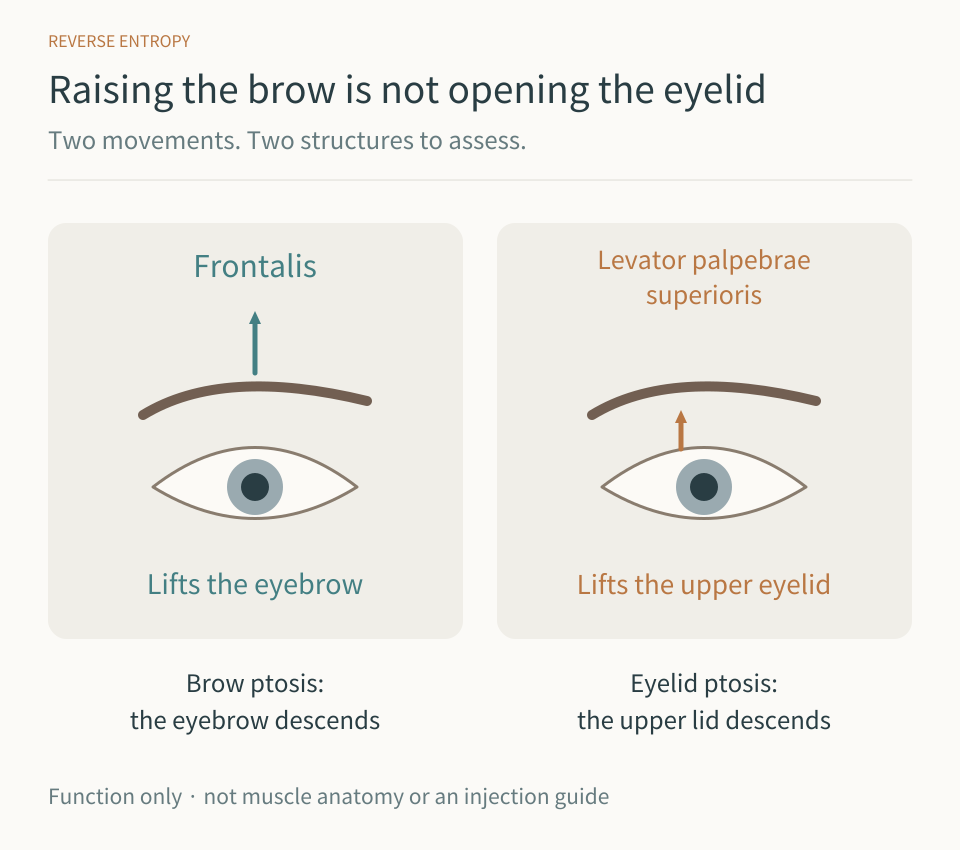
There is an important distinction here. The frontalis primarily lifts the brow. The main muscle that directly raises the upper eyelid is deeper inside the eyelid: the levator palpebrae superioris.
Raising the brow can make the eye look more open, but these are not the same function. After treatment, we therefore need to distinguish a lowered eyebrow from an upper eyelid that is itself drooping.
Heavy eyes and a raised outer brow have different explanations
People with loose upper-eyelid skin or difficulty opening their eyes may unconsciously use their forehead to raise their eyebrows. The resulting horizontal lines may reflect compensation for changes around the eyes, as well as habitual expression.
If the frontalis is weakened substantially in that situation, some of the force supporting the brow is lost. The eyebrow may descend, leaving the area above the eye feeling heavy. This is brow ptosis.
If the toxin affects the levator, the upper eyelid itself may droop. This is eyelid ptosis. Both may be described as “my eyes look smaller,” but the cause differs, so we need to identify which structure has moved downward.
A pointed, elevated outer brow—often called a Spock brow, or a “samurai eyebrow” in Korea—is another situation. If central forehead movement is reduced while relatively more activity remains in the lateral frontalis, the outer brow can rise prominently.
The shape can change simply because different regions retain different amounts of muscle activity.
Even similar foreheads can move in different directions
Similar-looking wrinkles do not necessarily mean the underlying movement is the same. In some people, forehead skin moves predominantly upward when they raise their brows. In others, the upper and lower forehead move in different directions.
The three-dimensional images below, published in 2025, demonstrate this difference. The colors and arrows represent the magnitude and direction of skin displacement. They are not photographs comparing treatment results.
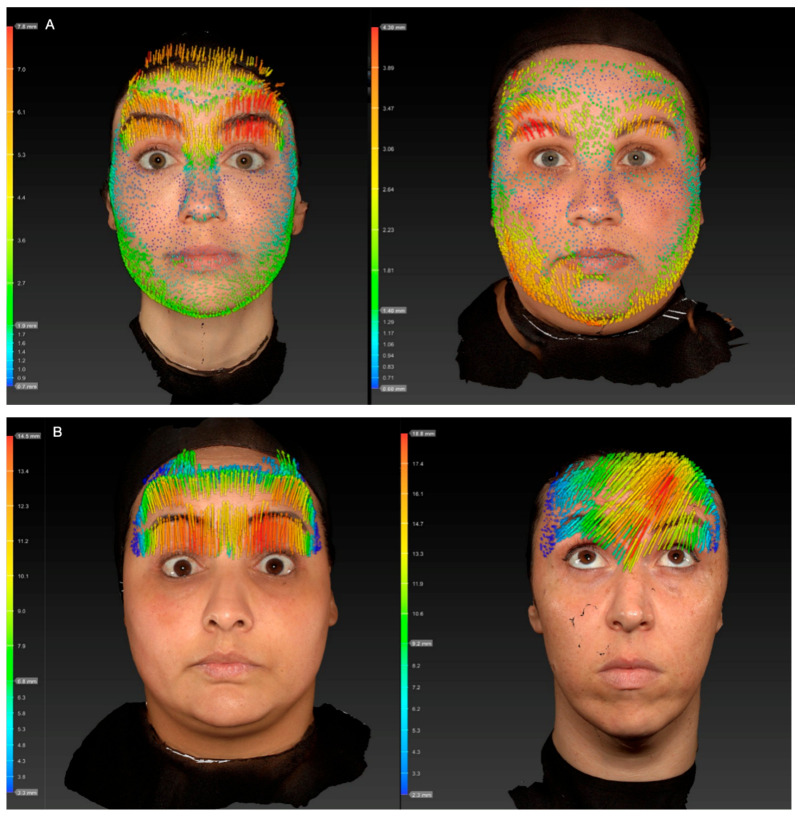
Source: de Sanctis Pecora et al. Why, When, and How to Treat Dynamic Forehead Lines with Botulinum Toxin Type A. Toxins. 2025;17:603. Article · CC BY 4.0.
This is why it matters to observe the face while the person raises the eyebrows, frowns, and relaxes. Injecting at equal intervals along static wrinkle lines cannot capture all these differences in movement.
What if forehead lines improve after treating only the frown area?
Another interesting study illustrates the relationship between neighboring muscles. In a 2025 study, 18 adults received botulinum toxin only in the glabella—the frown area between the eyebrows—with no injections into the forehead.
Treatment was given on days 0, 90, and 180. Participants were assessed again 30 days after each treatment, with the final assessment at about seven months.
Wrinkle scores improved in the forehead as well as the glabella. The median forehead wrinkle score fell from 3 at baseline to 1 at the final assessment. Read the pilot study.
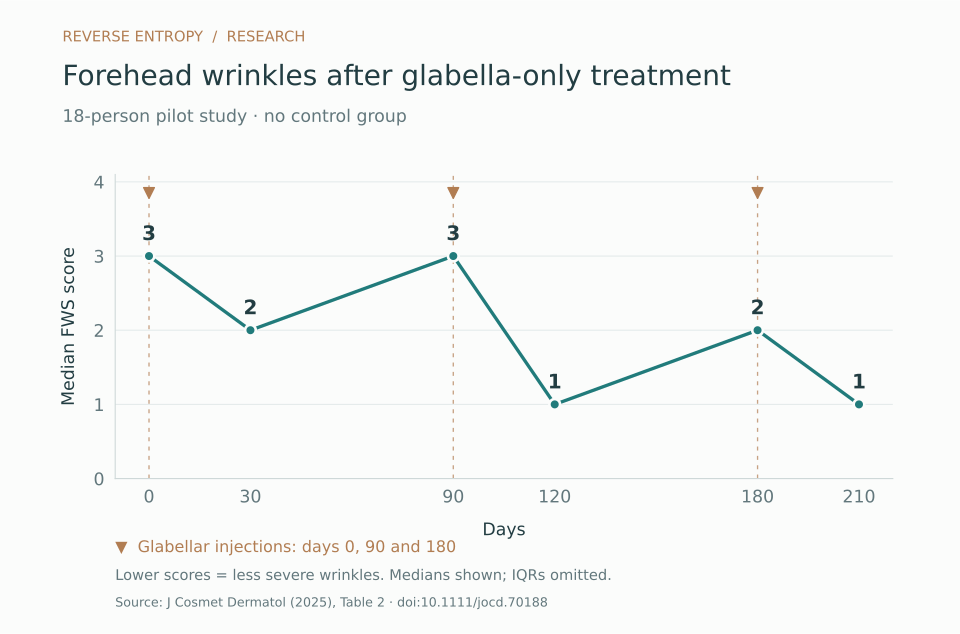
Source: Continuous Improvement of Frontal Rhytids Following Glabella Only Treatments With Neuromodulators—A Clinical Prospective Pilot Study. Journal of Cosmetic Dermatology, 2025. Table 2. Chart: Reverse Entropy.
The researchers suggested that reducing the pull of the brow-depressing muscles may also reduce how hard the opposing frontalis needs to work to maintain the same position. They did not directly establish this pathway with electromyography or a similar method.
There was also no significant change in measured eyebrow position. I would therefore read this as evidence that altering the balance between neighboring muscles can affect wrinkles, rather than as proof that treating the glabella alone produces a large brow lift.
My goal is to consider wrinkles and function together
My doctoral dissertation in medical science also concerned botulinum toxin. It is one of my favorite treatments because it can be highly effective and, in aesthetic practice, persistent adverse effects are uncommon.
I particularly value a preventive approach, before expression lines become deeply established. With appropriate assessment and treatment planning, this can offer substantial benefit with few unwanted effects. Still, temporarily limiting muscle movement can cause discomfort or an unnatural expression.
We need to balance reducing forehead lines with keeping the eyes comfortable to open and preserving natural expression. The same treatment intensity should not be applied to someone whose brows are already low or who relies heavily on compensatory forehead activity.
I therefore consider not only the face at rest, but also how the person uses the muscles, differences between the two sides, and the original positions of the eyebrows and eyelids. Muscle depth and surrounding anatomy matter alongside dose and injection location.
If volume loss or loose skin is present, those issues can be assessed separately. Depending on the cause, treatments such as radiofrequency or filler may also help.
If the eyes feel heavy or the brow shape changes after treatment, the first step is to determine whether the brow has descended or the eyelid itself is drooping, rather than automatically adding more toxin.
Botulinum toxin reduces muscle force. Understanding whether that force was creating wrinkles, compensating for sagging, or balancing other muscles is central to achieving a natural result.
References
- de Sanctis Pecora et al. Why, When, and How to Treat Dynamic Forehead Lines with Botulinum Toxin Type A. Toxins. 2025;17:603. DOI.
- Continuous Improvement of Frontal Rhytids Following Glabella Only Treatments With Neuromodulators—A Clinical Prospective Pilot Study. Journal of Cosmetic Dermatology. 2025. DOI.
The first expert paper disclosed support from Merz and authors’ relationships with industry. The second pilot study reported no conflicts of interest.