A new view of hair loss, revealed by data from more than 2.4 million cells.
When our hair starts thinning, we often think, “The follicles must be getting old and dying,” or, “The stem cells that make hair must be disappearing.”
But a recently released study showed a somewhat different picture.
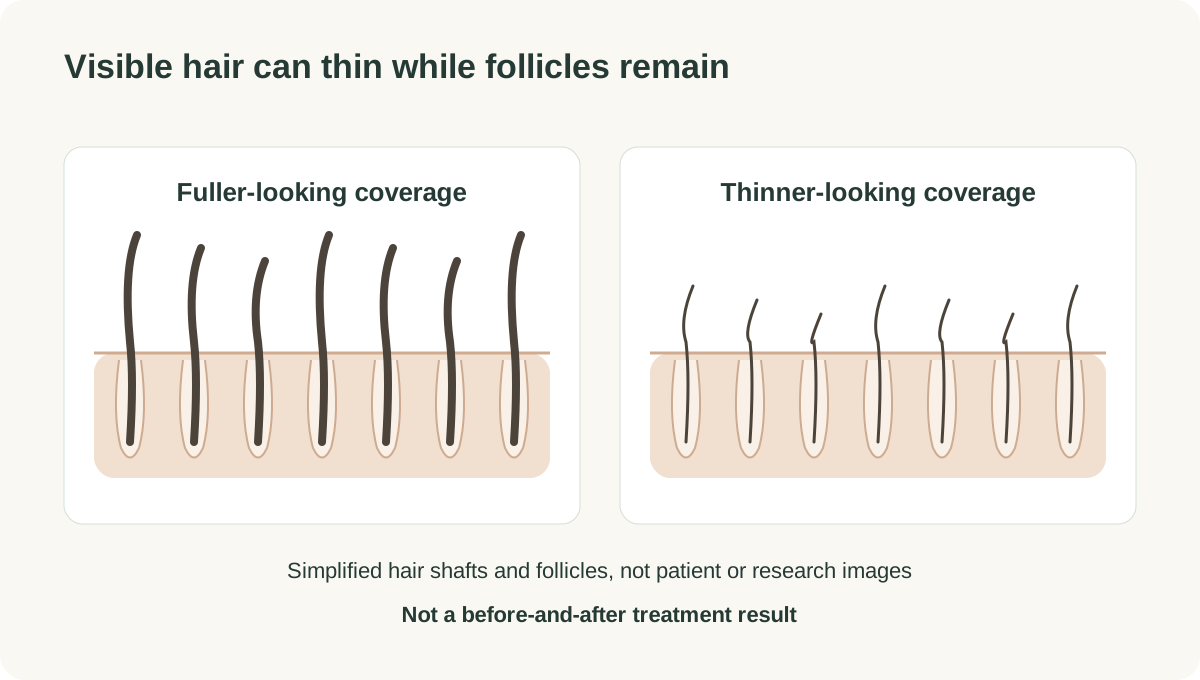
Even with age, the epithelial stem cells of the hair follicle remained relatively well preserved. The problem was the environment in which those cells worked.
This is a point I often make: the surroundings can matter more than the stem cells alone.
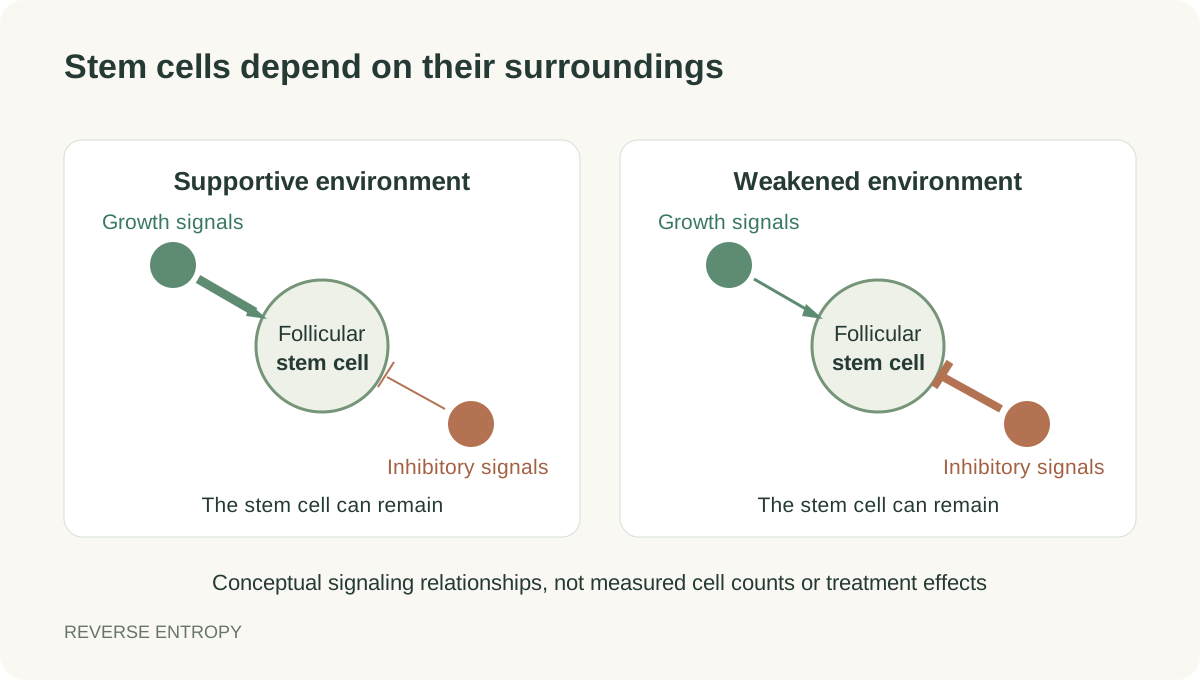
In short, the stem cells were still there, but the signal telling them to “make hair again” was weakening.
🌱 Stem cells cannot work alone
It is easy to imagine stem cells as all-purpose cells that can create anything on their own. In reality, they cannot.
Think of a hair follicle as a small factory that produces hair.
A factory building does not make products by itself. It needs power, materials, and a signal to start production.
Stem cells are similar. They need signals from neighboring cells and an appropriate environment to function properly.
The surroundings in which stem cells live and work are called the stem cell niche.
🔬 More than 2.4 million cellular measurements
The researchers analyzed scalp samples from 22 healthy males aged 3 to 77 and six patients with androgenetic alopecia, or male-pattern hair loss.
They did more than look at the cells' shapes under a microscope. They examined which genes individual cells were using, which genes they were poised to use, and where the cells were located within the scalp.
Across the three analyses, the combined cell data totaled approximately 2.48 million. About 2.12 million of those were spatial data, which included information on the cells' positions in the tissue.
With age, the signal to “make hair” weakened
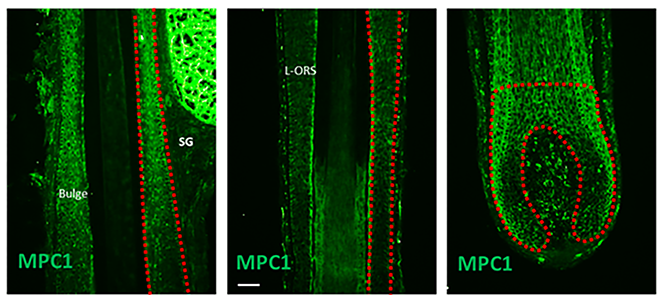
The researchers focused on cells around the follicle called hDSCs.
You do not need to remember the name. Their role is what matters.
These are a stem-cell population on the dermal side of the follicle. They act like managers, sending regenerative signals.
Through signals such as WNT, FGF, IGF, and PTN, they tell neighboring cells, “Let's start making hair again.”
With age, however, hDSCs became fewer and more dispersed from their usual positions. Several regenerative signals also weakened.
Meanwhile, the epithelial stem-cell population that makes hair remained relatively well preserved.
It looked less like a factory disappearing and more like the managers needed to run it becoming less effective.
Male-pattern hair loss went a step further
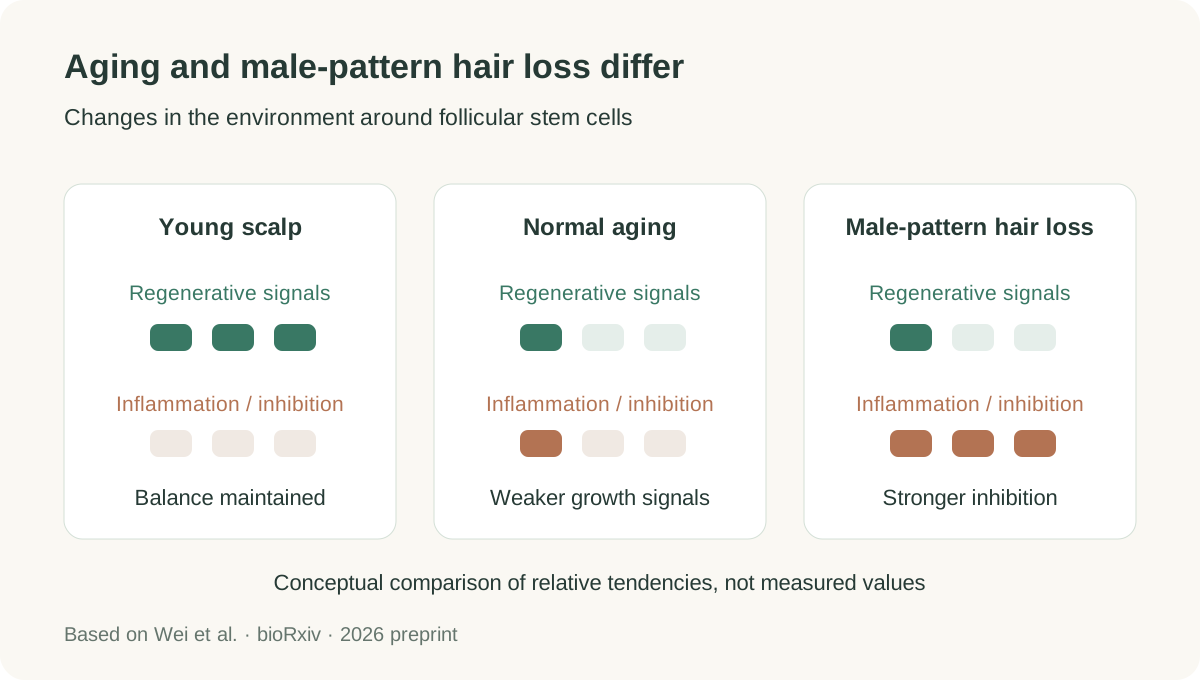
Age-related thinning and androgenetic alopecia (AGA) did not show exactly the same pattern.
In normal aging, the most prominent change was a reduction in “grow” signals.
In male-pattern hair loss, there was an additional strengthening of the environment that says, “Do not grow.”
Immune cells were involved, too
In scalps with progressing male-pattern hair loss, a population of immune cells called TREM2-positive macrophages increased.
Inflammatory signals such as IL-1 and OSM were also linked to an environment in which follicles found it harder to resume growth.
Growth signals decreased ↓
Inflammatory and inhibitory signals increased ↑
These changes occurred together.
Inflammatory signaling also increased in normal aging. In male-pattern hair loss, however, increases in particular immune cells and changes in the inhibitory environment were more pronounced.
😴 Being dead is different from being alive but inactive
The researchers interpreted some follicular epithelial stem cells in male-pattern hair loss as having entered a state resembling deep quiescence.
In everyday language, they seemed to be deeply asleep.
Stem cells being completely absent and stem cells remaining but failing to work properly are different problems from a treatment perspective.
That raises the next question: could we wake them up again?
🧪 So the researchers tried adding PTN
Among the regenerative signals that declined in both aging and male-pattern hair loss, the researchers focused on a protein called PTN, or pleiotrophin.
What matters is that they did not stop at a computer analysis.
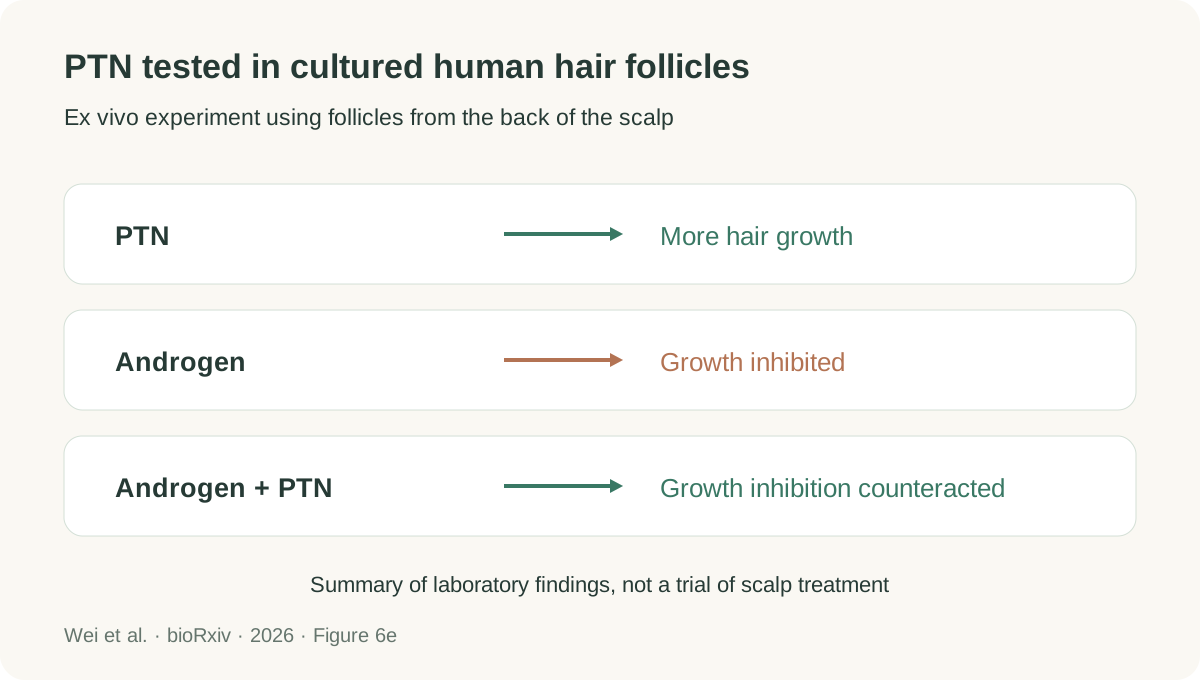
They cultured actual human hair follicles in the laboratory and treated them with PTN.
The experiment used anagen, or actively growing, follicles taken from the still-haired back of the head of patients with androgenetic alopecia undergoing hair-transplant surgery.
Hair grew longer in follicles treated with PTN than in the controls. PTN also counteracted the inhibition of hair growth when it was given alongside androgen.
Adding a regenerative signal changed the growth response of real human follicles.
Could PTN become a new treatment for hair loss?
This is the part that excites me.
Of course, this was not yet a clinical trial in which PTN was administered to people's scalps to treat hair loss.
The findings came from follicles removed from the back of patients' heads and grown under limited laboratory conditions. They do not mean that every follicle in a long-balding area will grow again.
We still need to study delivery to the scalp, the right dose, how long any effect lasts, and long-term safety.
But I also do not think we should dismiss it as “only a laboratory study.” A growth response was demonstrated in actual human follicles.
The important next question is whether that effect can be reproduced in patients' scalps.
I hope that, after sufficient clinical testing, it can develop into a treatment that patients can actually use.
If efficacy and safety are established, it could broaden the possibilities for treatments that adjust the environment so that follicles still alive can work again.
Let me briefly explain a skin booster I use
D-ALL is the name I gave to a combination injection I developed to support recovery and regeneration after skin procedures.
Laser and radiofrequency procedures stimulate the skin, with their effects emerging through the subsequent recovery and collagen-remodeling processes.
For a long time, I have thought: helping the skin recover well afterward matters just as much as delivering the stimulus.
That idea led me to create D-ALL.
🧬 The “D” in D-ALL stands for DNA
D-ALL is built around salmon-derived DNA ingredients. That is where the D comes from.
I added “ALL” to express the combination of several ingredients I selected with safety as an important consideration.
D for DNA, plus ALL for the ingredients used together. “D-ALL” is easy to remember, isn't it?
Any other association the name brings to mind is coincidental. I have also registered D-ALL as a trademark.
Its main ingredient, PDRN, has been used particularly in patients with wounds that do not heal well.
That is why I use it to help support recovery after procedures.
Then I tried applying the idea to the scalp
While using D-ALL for skin recovery, I naturally wondered, “Could it also help the environment around hair follicles?”
For patients with hair loss, I now use a scalp combination injection adapted from the skin formulation of D-ALL.
One difference from the skin version is the addition of botulinum toxin.
The rationale is to help reduce inflammation in the scalp and improve blood flow, effects proposed in this area of treatment research.
In treating patients, I have repeatedly observed encouraging clinical responses.
These are observations from my own practice, however. They should be distinguished from results of a controlled clinical trial.
I am considering writing a paper on this work one day.
Why am I seeing these responses in patients? What part do the DNA-based and other regenerative ingredients play, and what is the role of botulinum toxin?
Does scalp blood flow change? Does the inflammatory or immune environment change? Are other regenerative signals involved?
I do not yet know the exact answer. That is why I think it is worth studying.
The next step is to compare objective measures, such as hair density, shaft thickness, and standardized photographs, over a defined period, while separating out the effects of other treatments used at the same time.
Now, back to the main point.
🌱 The fact that stem cells remain is encouraging
If follicular stem cells vanished completely every time hair loss progressed, we would have to recreate what had been lost.
But this study suggests a somewhat different possibility: in some follicles, stem cells may remain but not be functioning properly.
That could broaden the goal of treatment.
Restore the surrounding environment so that the stem cells we already have can work again.
PTN is an interesting candidate that points toward that possibility.
This story does not end with hair loss
I see this as a study of hair loss, but also as aging research.
There are stem cells in the skin, muscles, intestines, and blood-forming system, too.
A decline in regenerative ability with age may not always be caused simply by stem cells disappearing.
The stem cells may remain, while regenerative signals weaken, inflammatory signals increase, and communication with neighboring cells becomes disrupted.
This study illustrates that possibility in fine detail in hair follicles. Whether other organs can be helped in the same way needs to be tested separately.
Adding new cells may not be the only thing that matters
In regenerative medicine, people often ask, “Could adding stem cells make us younger?”
Before that, we can ask another question: could we get the stem cells already in our bodies to work again?
To do so, we need to look beyond the stem cell itself and consider the neighboring cells, the immune environment, and regenerative signals together.
We do not yet know whether PTN will become an actual treatment. But if sufficient research establishes its efficacy and safety, I could consider adding it to the ingredients in my D-ALL injection.
Not only replacing what has disappeared, but enabling what is still alive to work again.
I believe this will be an important direction for hair-loss treatment and the future of regenerative medicine.
📚 References
- Wei X, Xu Y, Du J, et al. Spatiotemporal atlas resolves the mesenchymal–epithelial stem cell axis governing human hair follicle aging and pathology. bioRxiv. Released September 23, 2026. Preprint, not yet peer reviewed. Original paper
- Squadrito F, et al. The effect of PDRN, an adenosine receptor A2A agonist, on the healing of chronic diabetic foot ulcers: results of a clinical trial. Journal of Clinical Endocrinology & Metabolism. 2014;99(5):E746–E753. Original paper
- Intradermal Injection in Balding Region Versus Intramuscular Injection in Surrounding Muscles: A Split-Scalp, Randomized Trial on BoNT for Androgenetic Alopecia. Dermatology and Therapy. 2024;14:1671–1682. Original paper
- Lima-Galindo AA, et al. Subcutaneous Versus Combined Subcutaneous and Intramuscular Botulinum Toxin for Androgenetic Alopecia: A Randomized Clinical Trial. Actas Dermo-Sifiliográficas. 2025;116(9):959–966. Original paper