Health-checkup season has come around again.
Every year I tell myself I will get it done early, yet it seems I end up rushing in December. Today I would like to explain one important test you can consider at your checkup.
Here is my conclusion first: if a parent, sibling, or child has had gastric cancer, please make sure you know your Helicobacter pylori infection status. If infection is confirmed, I strongly recommend eradication treatment. [1]
I am not suggesting that everyone take antibiotics preventively. I am referring to adults with a family history of gastric cancer and confirmed H. pylori infection.
If you do not know whether you are infected, I recommend checking at a health examination. H. pylori is one of the causes of cancer for which we can describe the biological pathway in detail—and clinical trials have shown that removing the cause actually reduces gastric cancer.
It is one of the relatively few cancer-prevention measures supported by both a mechanism and clinical outcomes. [2] Let us look more closely.
1. H. pylori lives in the stomach—and can cause gastric cancer
Helicobacter pylori is a bacterium that can settle in the mucus covering the stomach lining and persist for many years. The International Agency for Research on Cancer classified it as a human carcinogen in 1994. [2]

There are two main paths by which it contributes to gastric cancer.
The first is long-lasting inflammation. Infection causes chronic inflammation in the stomach lining. In some people, precancerous changes such as atrophic gastritis and intestinal metaplasia develop, increasing the risk of gastric cancer. [2]
The second is direct interference with growth signals in stomach cells. CagA, a protein produced by some H. pylori strains, enters gastric epithelial cells. Experiments have shown that it disrupts signaling proteins such as SHP-2. The bacterium does more than cause inflammation: it can also alter how cells behave. [3]
Eradication treatment removes the source of these repeated carcinogenic stimuli to the stomach lining.
2. A Korean trial in people with a family history found fewer gastric cancers
A paper released on January 29, 2020, in the New England Journal of Medicine tested this question directly.
Researchers at Korea’s National Cancer Center randomly assigned 1,838 H. pylori-infected adult first-degree relatives of people with gastric cancer to eradication treatment or placebo. The main analysis included 1,676 participants, followed for a median of 9.2 years. [1]
The treatment group included 832 people and the placebo group 844. Gastric cancer developed in 10 and 23 people, respectively: 1.2% versus 2.7%.
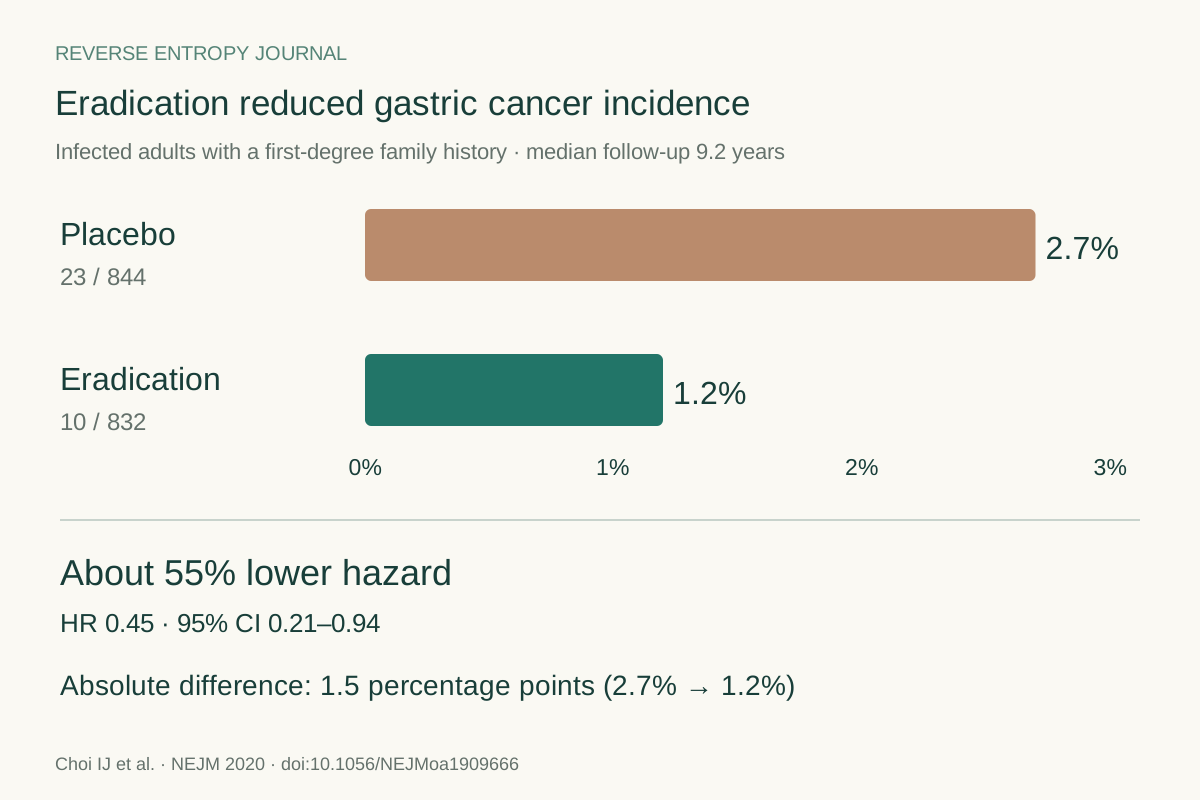
The hazard of gastric cancer was about 55% lower in the eradication group: the hazard ratio was 0.45, with a 95% confidence interval of 0.21–0.94. The absolute difference between the reported incidence proportions was 1.5 percentage points. [1]
The outcome measured here was actual gastric cancer. Demonstrating prevention in a randomized trial of Korean people with a family history provides direct evidence for recommending treatment.
3. Modern eradication treatment starts with antibiotics suited to resistance
Once the need for treatment is clear, the next question is how to eliminate the bacterium reliably.
Antibiotic resistance is an important issue in current practice. In a Korean multicenter registry study published in 2025, 33.3% of strains that underwent culture-based susceptibility testing were resistant to clarithromycin. It is becoming harder to prescribe the same once-effective combination to everyone. [5]
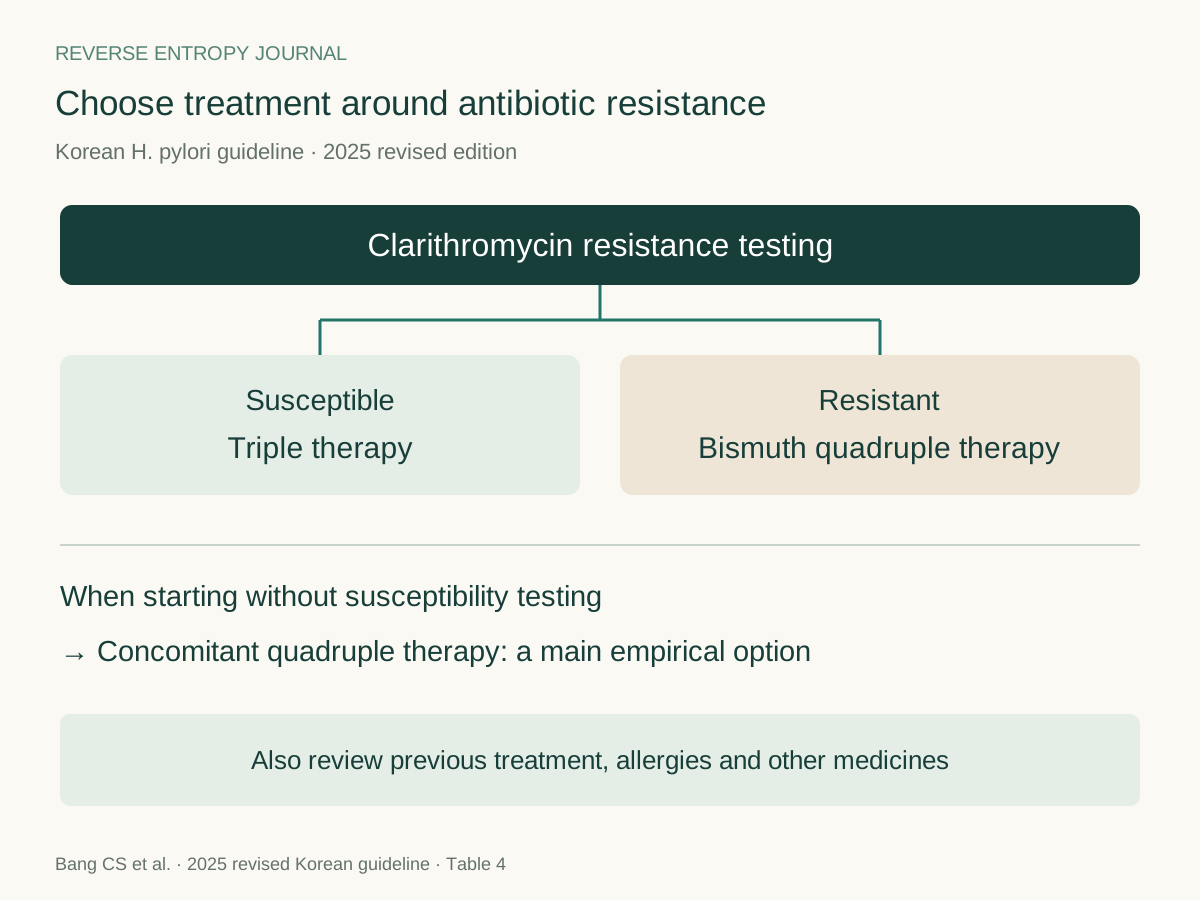
The 2025 revised Korean H. pylori guideline, released in June 2026, also emphasizes treatment tailored to resistance testing. When clarithromycin resistance can be checked by PCR or another method, the result guides the combination. When treatment begins without testing, an appropriate quadruple regimen is selected. [4]
The treatment combinations are as follows.
When clarithromycin susceptibility is confirmed: an acid suppressant + amoxicillin + clarithromycin.
For initial treatment without susceptibility testing: an acid suppressant + amoxicillin + clarithromycin + metronidazole, called concomitant quadruple therapy.
With clarithromycin resistance, in some retreatment situations, or with penicillin allergy: an acid suppressant + bismuth + tetracycline + metronidazole, called bismuth quadruple therapy.
Treatment usually lasts one to two weeks, depending on the combination. The revised Korean guideline recommends ten-day concomitant quadruple therapy as a main first-line option when susceptibility testing is unavailable.
The choice of acid suppressant has also expanded. In addition to proton-pump inhibitors (PPIs), some combinations use a potassium-competitive acid blocker (P-CAB), such as tegoprazan. Suppressing stomach acid creates a more favorable environment for the antibiotics to work. [6]
The starting point is to choose a combination that fits both the resistance result and the patient’s circumstances.
4. What side effects can occur, and how should they be handled?
During eradication treatment, a bitter or metallic taste, nausea, diarrhea, and abdominal discomfort can occur. [7] [8] [9]
In the family-history trial described above, adverse events were reported by 53.0% with the seven-day triple regimen used at that time, versus 19.1% with placebo; the paper described them as mild. The types and frequency of side effects vary with the regimen prescribed today. [1]
Here are points to know about individual medicines.
Amoxicillin: diarrhea, nausea, or a rash may occur. Tell the prescriber beforehand if you have a history of a severe penicillin allergy.
Clarithromycin: a bitter taste, altered taste, and gastrointestinal discomfort may occur. Interactions with certain cholesterol-lowering and antiarrhythmic medicines, and the risk of QT prolongation, need to be checked. Combining it with simvastatin or lovastatin is contraindicated.
Metronidazole: a metallic taste and nausea are possible. According to the prescribing information, avoid alcohol during treatment and for at least three days afterward.
Tetracycline: it can irritate the esophagus and increase sensitivity to sunlight. Take it with sufficient water, and check the timing so that it is not taken together with iron, calcium, certain antacids, or dairy products. It should not be used during pregnancy.
Bismuth: the tongue or stool may temporarily turn dark. This usually resolves after treatment. However, sticky, tarry stool accompanied by dizziness or other signs suggesting bleeding requires medical attention.
For mild discomfort, contact the prescribing clinic so that symptoms can be managed while completing the planned course. Difficulty breathing or swelling of the face or lips requires immediate emergency care. Persistent severe diarrhea or bloody stool should be reported promptly, because antibiotic-associated colitis and other causes need to be assessed. [7] [8]
5. Treatment is not complete until eradication has been confirmed
It is helpful to schedule the test of cure when planning treatment.
At least four weeks after finishing the antibiotics, a urea breath test or stool antigen test can confirm whether H. pylori has been eradicated. Feeling better does not tell us whether the bacterium is gone. [10]
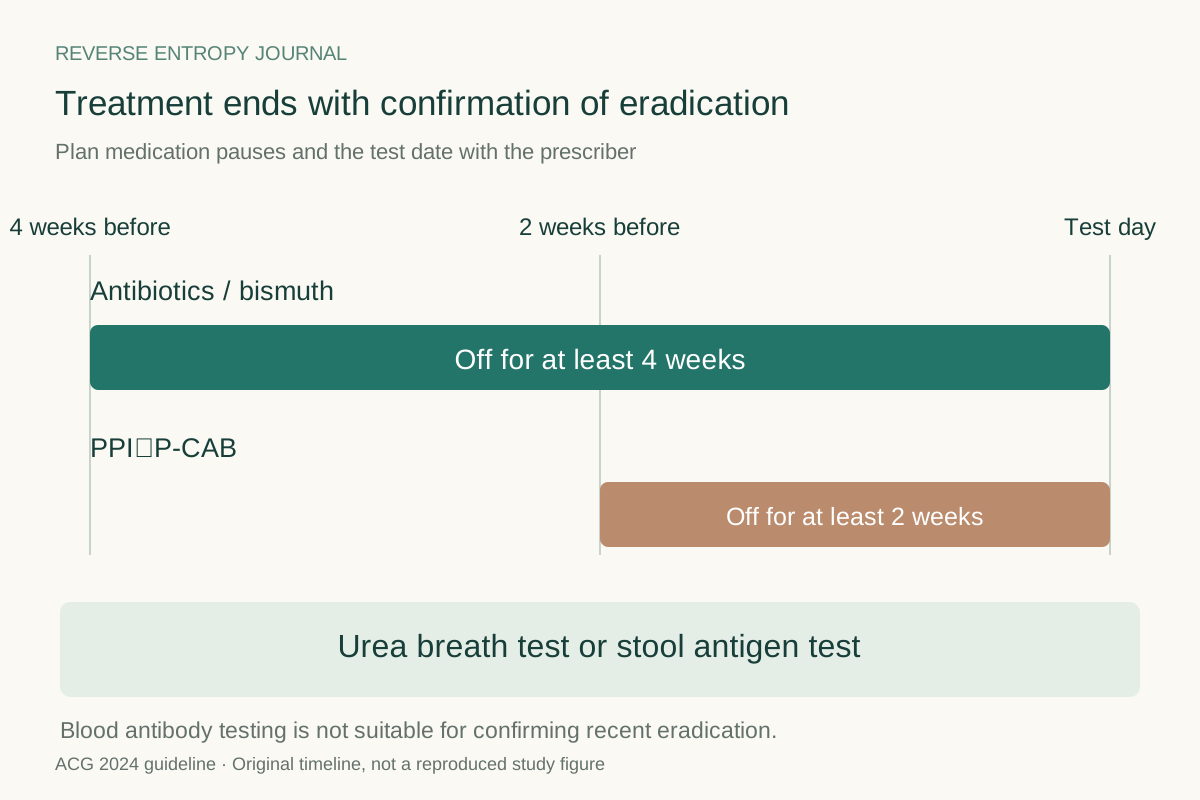
Agree on the medication-pause dates and test date with the prescriber. If infection persists, the next regimen is chosen in light of previously used medicines and resistance. [10]
6. Combine eradication with appropriate endoscopic follow-up
Eradication and endoscopy each have a role in gastric-cancer prevention. Eradication reduces a carcinogenic stimulus; endoscopy checks the stomach lining and helps detect lesions early.
If atrophic gastritis or intestinal metaplasia is already present, following the lining after eradication is particularly important. Continued surveillance intervals should be based on the family history and endoscopic findings. [12]
Removing the cause and detecting problems early together form the prevention strategy needed by people with a family history of gastric cancer.
H. pylori eradication removes a cause of cancer, and has been shown to reduce actual gastric-cancer incidence.
If you have a family history, do not stop at worrying. Please start by checking your H. pylori test result.
References and official sources
- Choi IJ et al. Family History of Gastric Cancer and Helicobacter pylori Treatment. NEJM. 2020. Published online January 29, 2020.
- National Cancer Institute. Helicobacter pylori and Cancer.
- Higashi H et al. SHP-2 tyrosine phosphatase as an intracellular target of Helicobacter pylori CagA protein. Science. 2002. Online December 13, 2001.
- Bang CS et al. Evidence-Based Guidelines for the Diagnosis and Treatment of Helicobacter pylori Infection in Korea: 2025 Revised Edition. Published June 8, 2026.
- Korean Registry on the Current Management of Helicobacter pylori (K-Hp-Reg). Gut and Liver. 2025. doi:10.5009/gnl240489.
- Park JY et al. Tegoprazan-Based Triple Therapy for Helicobacter pylori Eradication. Helicobacter. 2026. doi:10.1111/hel.70106.
- DailyMed. Amoxicillin prescribing information.
- DailyMed. Clarithromycin prescribing information.
- DailyMed. PYLERA (bismuth, metronidazole, tetracycline) prescribing information.
- Chey WD et al. ACG Clinical Guideline: Treatment of Helicobacter pylori Infection. American Journal of Gastroenterology. 2024.
- American College of Gastroenterology. Guideline commentary: testing for eradication and PPI/P-CAB pauses. 2024.
- Morgan DR et al. ACG Clinical Guideline: Diagnosis and Management of Gastric Premalignant Conditions. 2025.
#HelicobacterPylori #GastricCancerPrevention #FamilyHistory #EradicationTreatment #Antibiotics #Gastroscopy #ReverseEntropy #HINClinic