Does intermittent fasting help us lose weight and make the cells in our bodies healthier?
Many people fast with those hopes in mind. But the picture changes if an environment that helps cells grow is also favorable to abnormal cells.
In a mouse study published in Nature in 2024, intestinal stem cells became better at regenerating once the animals started eating again after a fast.
At the same time, intestinal tumor formation also increased under the experimental conditions.
This does not show that intermittent fasting causes cancer in humans. It does, however, challenge the idea that better regeneration must always mean better health.
The key period was not the fast, but eating again afterward
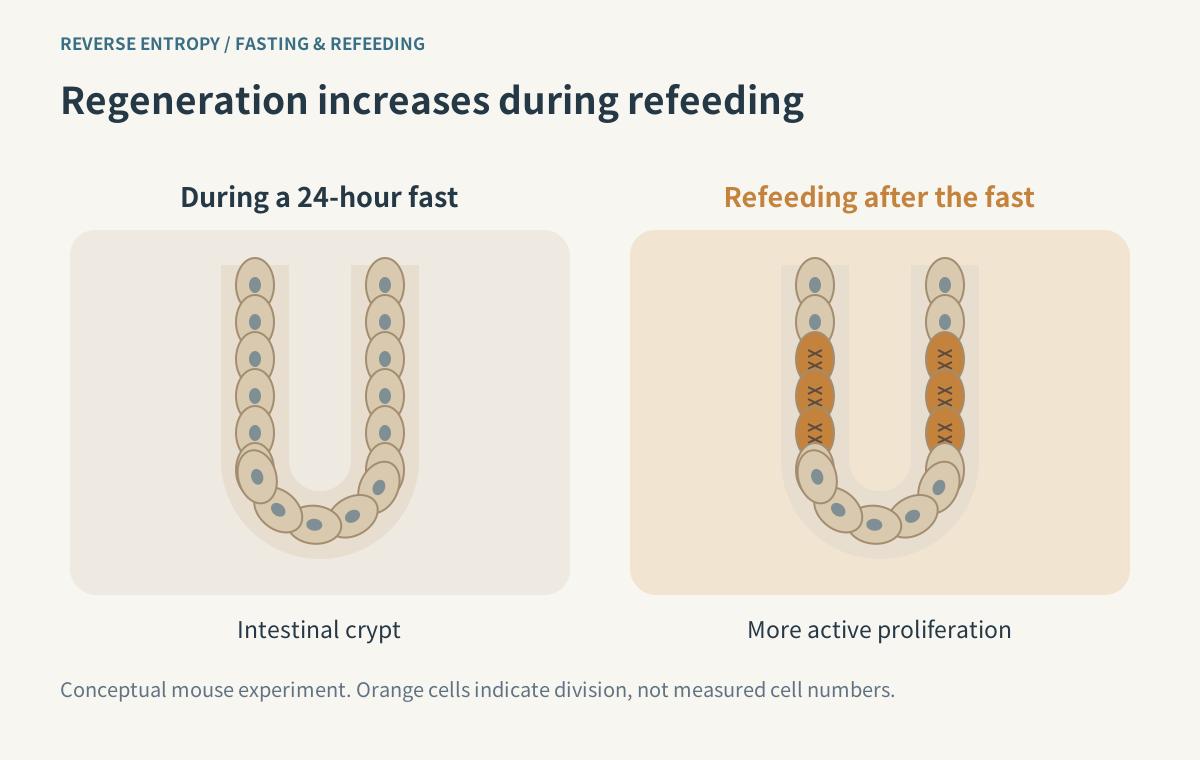
The researchers compared mice that ate freely, mice that fasted for 24 hours, and mice that fasted for 24 hours and then ate again for another 24 hours.
The strongest increase in intestinal stem-cell proliferation and regenerative capacity occurred in the group that had resumed eating after the fast.
The inner lining of the intestine is constantly being replaced with new cells. Intestinal stem cells supply the cells needed for that renewal.
When nutrients arrived after the fast, the work of building new tissue became more active.
The mTORC1 signaling pathway, which regulates cell growth, was activated,
and polyamine metabolism and protein synthesis, both involved in cell growth and division, also increased.
Put simply, eating again sent growth signals to the cells and equipped them to make new cells.
Source: Original concept created by Reverse Entropy based on Imada S et al., Nature, 2024. The original AI-generated concept has been recreated here as a localized vector diagram.
Original study: Imada et al., Nature, 2024
What if the “brake” on proliferation is broken?
Making new cells efficiently is important for recovery. But the mechanisms that prevent cells from multiplying more than necessary also need to work.
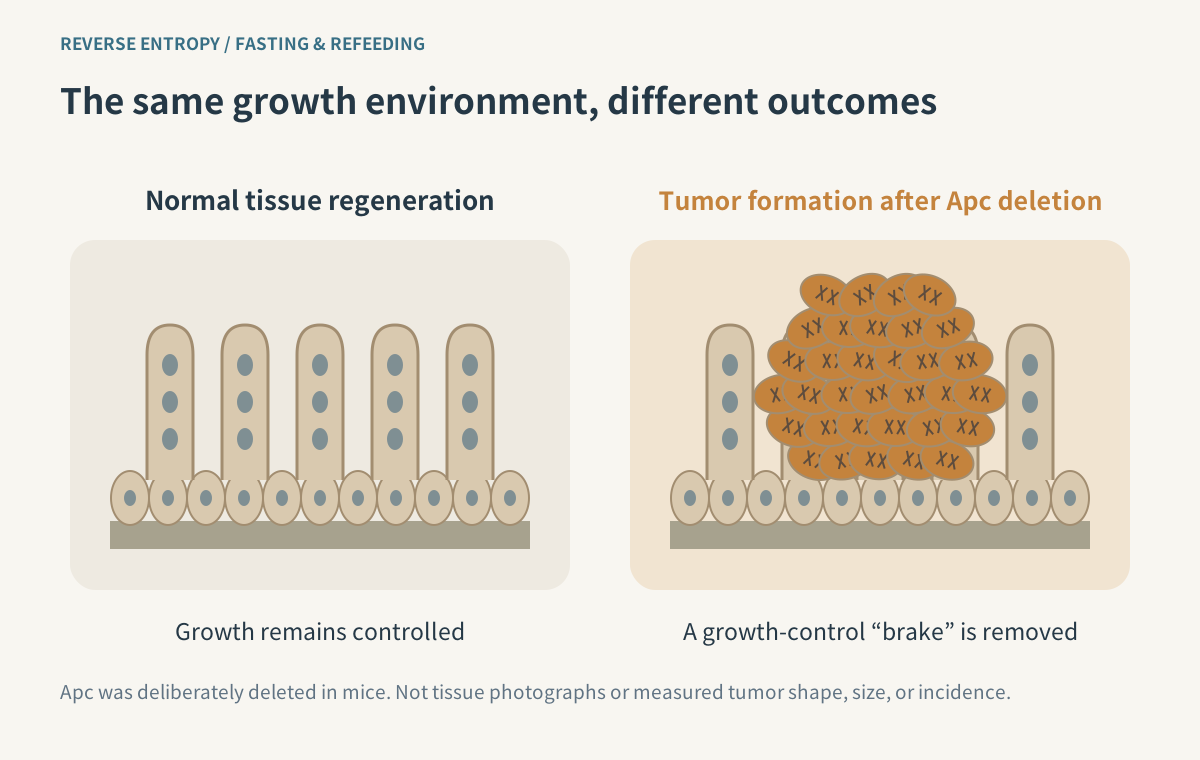
The researchers deleted a tumor-suppressor gene called Apc in intestinal stem cells. They had removed one of the brakes controlling proliferation.
When they did this during refeeding, intestinal tumor formation increased compared with doing so during fasting or ordinary feeding.
The growth environment that supported regeneration also helped cells that had lost their brake to form tumors.
Conversely, experiments that inhibited the mTORC1 pathway or polyamine synthesis reduced the refeeding-associated boost in regeneration or tumor formation.
This is a clue that the same growth pathways are involved in both effects.
It is important to note that the study did not show that fasting damaged the Apc gene.
The researchers deliberately deleted the gene.
Source: Original concept created by Reverse Entropy based on Imada S et al., Nature, 2024. The original AI-generated concept has been recreated here as a localized vector diagram.
Experimental conditions and results: Figures 5 and 6 and the accompanying text of the original paper
Repeated fasting and refeeding showed the same tendency
The researchers did not stop after a single fast.
They repeated a 24-hour fast followed by refeeding for a total of 10 cycles over 20 days.
The result followed the same pattern.
Even with repeated fasting, the environment during the return to eating could favor tumor formation in cells carrying particular mutations.
That does not mean you need to be overly worried.
There is no need to read these findings as evidence of a cancer risk from intermittent fasting in humans.
A 24-hour fast in a mouse is not the same as time-restricted eating in a person,
and this experiment also involved deliberately deleting a particular gene.
The question I take from this study is closer to this:
Along with asking how long we fast, should we not also look at what happens in the body when we start eating again?
I think the study offers a hint that what we eat when we break a fast matters.
Repeated-fasting experiment: Figure 5h–i of the original paper
Still, I no longer prioritize intermittent fasting as much as I once did
My thinking about weight management has changed over the past few years.
In the past, I tried intermittent fasting myself and recommended it to patients.
Restricting the eating window was a very useful way to reduce food intake.
But the arrival of GLP-1-based treatments such as Wegovy and Mounjaro has substantially changed our treatment options.
The use of earlier appetite suppressants was limited by side effects and the limited evidence for long-term health benefits.
With GLP-1-based treatments, however, studies showing health benefits and even improved survival in specific patient populations have been appearing one after another.
We can now use drug treatments that act on appetite and metabolism in appropriate patients under medical supervision, rather than relying only on enduring hunger.
That is why I find fewer reasons than before to choose intermittent fasting for weight control.
In fact, I personally use a small amount of a GLP-1-based treatment as part of my approach to anti-aging.
I give myself a low dose of Wegovy each week.
My main goals are blood glucose control and changes in lifestyle habits, rather than weight loss.
But this is my clinical perspective, not the conclusion of a study directly comparing fasting with low-dose medication, and I am not recommending it to everyone.
Think of it as a kind of personal experiment.
Once I have gathered enough data, I plan to write about it, so please give me a little time.
To sum up, what matters to me is improving weight and metabolic health, and maintaining those improvements over the long term. Intermittent fasting is just one of several ways to pursue that goal.
The two faces of regeneration
What struck me most in this paper was that the same growth pathways were involved in both regeneration and tumor formation.
It is not enough to say that cells are multiplying well. Which cells are multiplying, and under what conditions, matter. Even as we speak, a flood of health information and anti-aging knowledge is coming out.
In this age of information overload, what worries me most
is the possibility of spending years on an anti-aging treatment that ultimately turns out to have been misguided.
To prevent that kind of outcome,
I believe we need to study the latest information diligently,
keep questioning whether the treatment we are using is the best option,
put safety first,
and adjust our approach as we learn.
References
1. Imada S, et al. Short-term post-fast refeeding enhances intestinal stemness via polyamines. Nature. 2024;633:895–904. Published online August 21, 2024. Original paper · Free full text
2. MIT. Study reveals the benefits and downside of fasting. August 21, 2024. The researchers' explanation
3. Wegovy official prescribing information · Mounjaro official prescribing information. These US documents were consulted for drug mechanisms and dose-adjustment principles; prescribing in Korea follows Korean-approved labeling.
#IntermittentFasting #Fasting #Refeeding #IntestinalStemCells #AntiAging #CancerResearch #WeightManagement #Wegovy #Mounjaro #GLP1 #ReverseEntropy