Jonathan has lived for almost 200 years
There is a tortoise believed to have been born around 1832.
His name is Jonathan.
At approximately 194 years old in 2026, he is the oldest living land animal listed by Guinness World Records.
Born in the Seychelles, he now lives on the island of Saint Helena in the South Atlantic.
When Jonathan was born, there were no cars, airplanes, or telephones.
Yet he is still eating well and moving around. He does show signs of aging, including loss of sight from cataracts.
What on earth has allowed Jonathan to live so long?
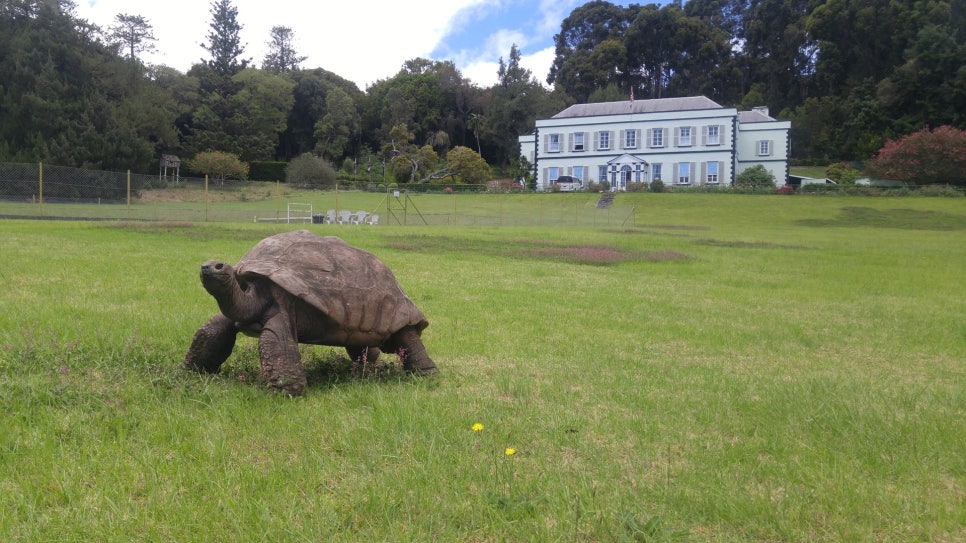
Source: Kevstan / Wikimedia Commons. This is the version reproduced in the original blog, with no further image changes for this translation. Photo source / CC BY-SA 4.0
On October 7, 2026, a study analyzing Jonathan's genome and DNA methylation patterns was released in the international journal Science Advances.
Although his overall methylation pattern showed features of aging, some gene-regulatory regions had low entropy resembling that of young tortoises.
This does not mean his whole body was young.
It means that the regulatory patterns in some important regions were relatively less irregular.
The same DNA is used differently in different parts of the body
Most cells in our bodies have the same DNA.
Yet skin cells make skin, muscle cells produce movement, and nerve cells transmit information.
Why do they do different jobs despite having the same blueprint?
A cooking analogy may make this easier to understand.
Think of DNA as a very thick cookbook.
Skin cells find the pages they need for skin, while muscle cells find the pages they need for muscle and cook accordingly. They use the same book, but the results are different.
DNA methylation is one of the mechanisms that regulates how this book is used.
It is the attachment of a small chemical mark called a methyl group to particular DNA bases. You can think of it as a sticky note placed in the book.
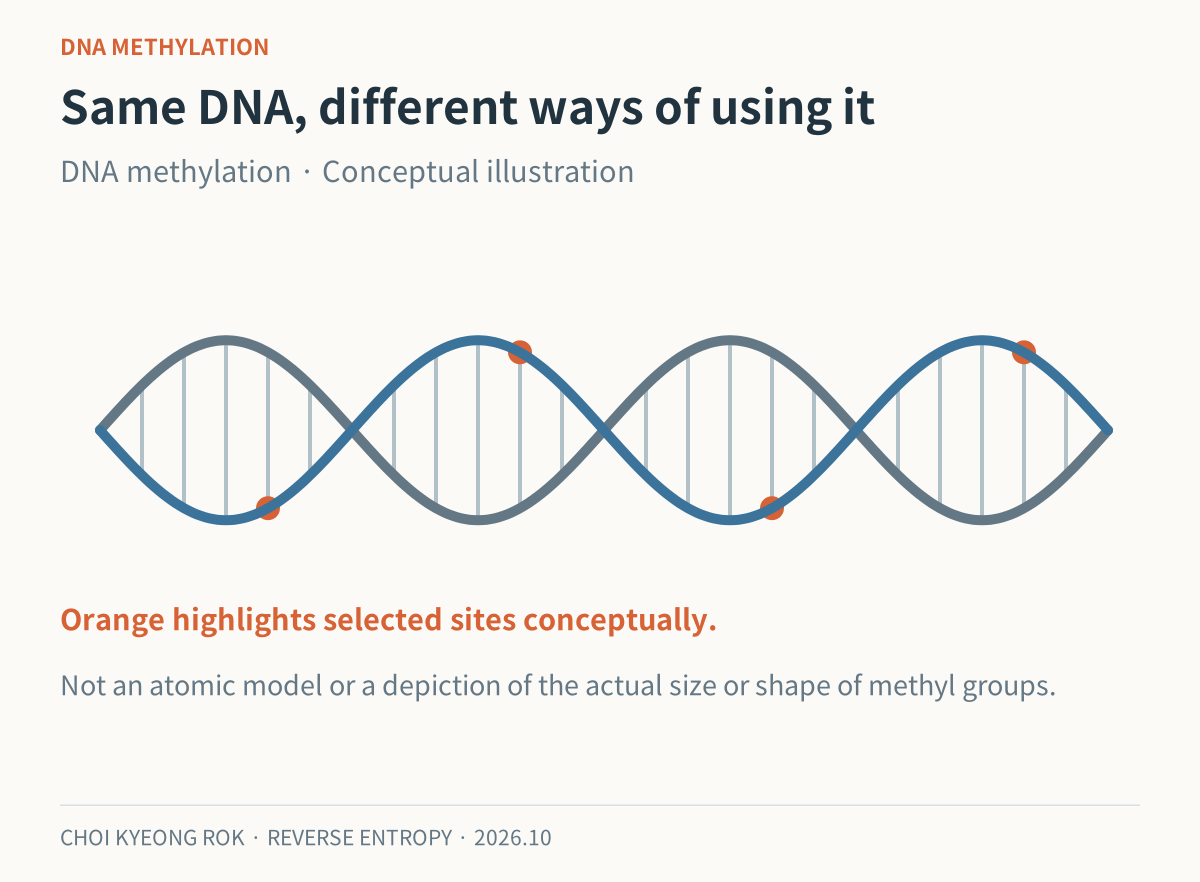
Source: Original artwork by Reverse Entropy. The original used AI-generated visual elements and separately edited text. This localized version is a newly drawn vector concept diagram.
Methylation helps regulate gene activity without changing the DNA sequence itself.
However, more methylation does not always mean that a gene is switched off.
Gene activity is regulated differently depending on where the marks are attached.
The “pattern of sticky notes” changes with age
DNA methylation patterns change as aging progresses.
In some regions, the differences in methylation states observed across DNA molecules can increase.
Methylation entropy is one mathematical measure of this uncertainty and diversity.
It may sound difficult, but a library provides an easy analogy.
When books are arranged according to consistent rules, it is easy to predict where the next book will be. If they are scattered without a pattern, that becomes harder.
With DNA methylation too, we can analyze how consistent the observed states are and how diversely they are mixed.
“Order” here is a statistical concept
This is not a direct measurement of physical disorder throughout a cell.
It is a statistical measure of irregularity in DNA methylation states.
It does not mean that the DNA is physically tangled or damaged, either.
So what did the pattern look like in Jonathan, who has lived for almost 200 years?
The overall pattern was aged, but some regions were different
Jonathan's methylation pattern generally showed features of an old animal.
But some gene-regulatory regions looked different.
The researchers reported certain promoter regions with low entropy in Jonathan and young tortoises, but relatively higher entropy in the other older tortoises used for comparison.
A promoter is a DNA regulatory region involved in initiating the reading of a gene.
The genes associated with these regions included genes involved in mitochondrial energy production and RNA processing.
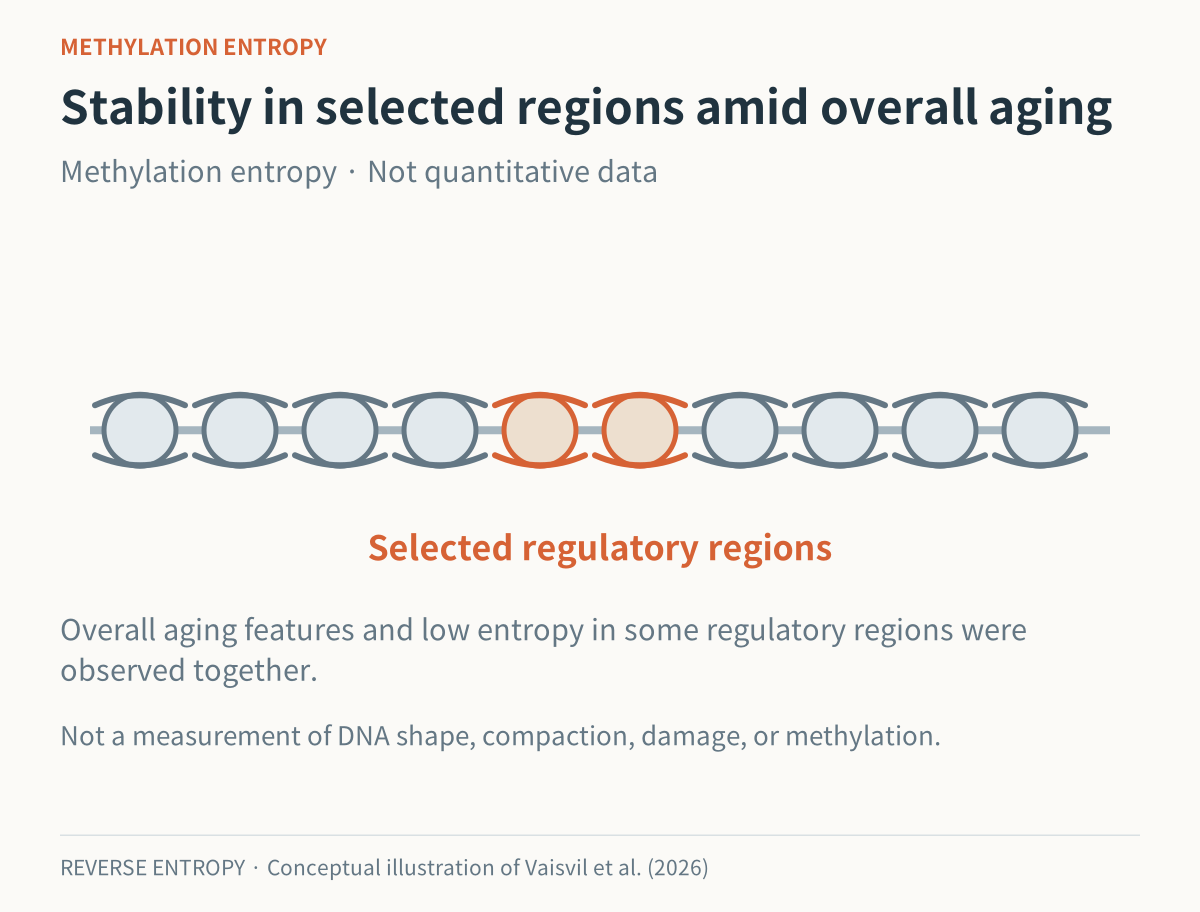
Source: Original artwork by Reverse Entropy. Conceptual illustration of the findings of Vaisvil et al., 2026. The original used AI-generated visual elements and separately edited text. This localized version is a newly drawn vector concept diagram.
The important point is that this is not a story about “everything being young despite being 194 years old.”
The persistence of low entropy in some gene-regulatory regions over such a long time may offer a clue to longevity.
Of course, this is exploratory research in animals. We cannot generalize that the same differences occur in humans. Still, it provided a hint that mitochondria and RNA transcription are important elements essential to longevity.
Why genes related to energy production?
Cells constantly use energy to stay alive.
A major organelle responsible for this is the mitochondrion.
It is often called the “powerhouse of the cell.”
Using substances derived from food and oxygen, it plays an important role in making ATP, the energy currency cells can use.
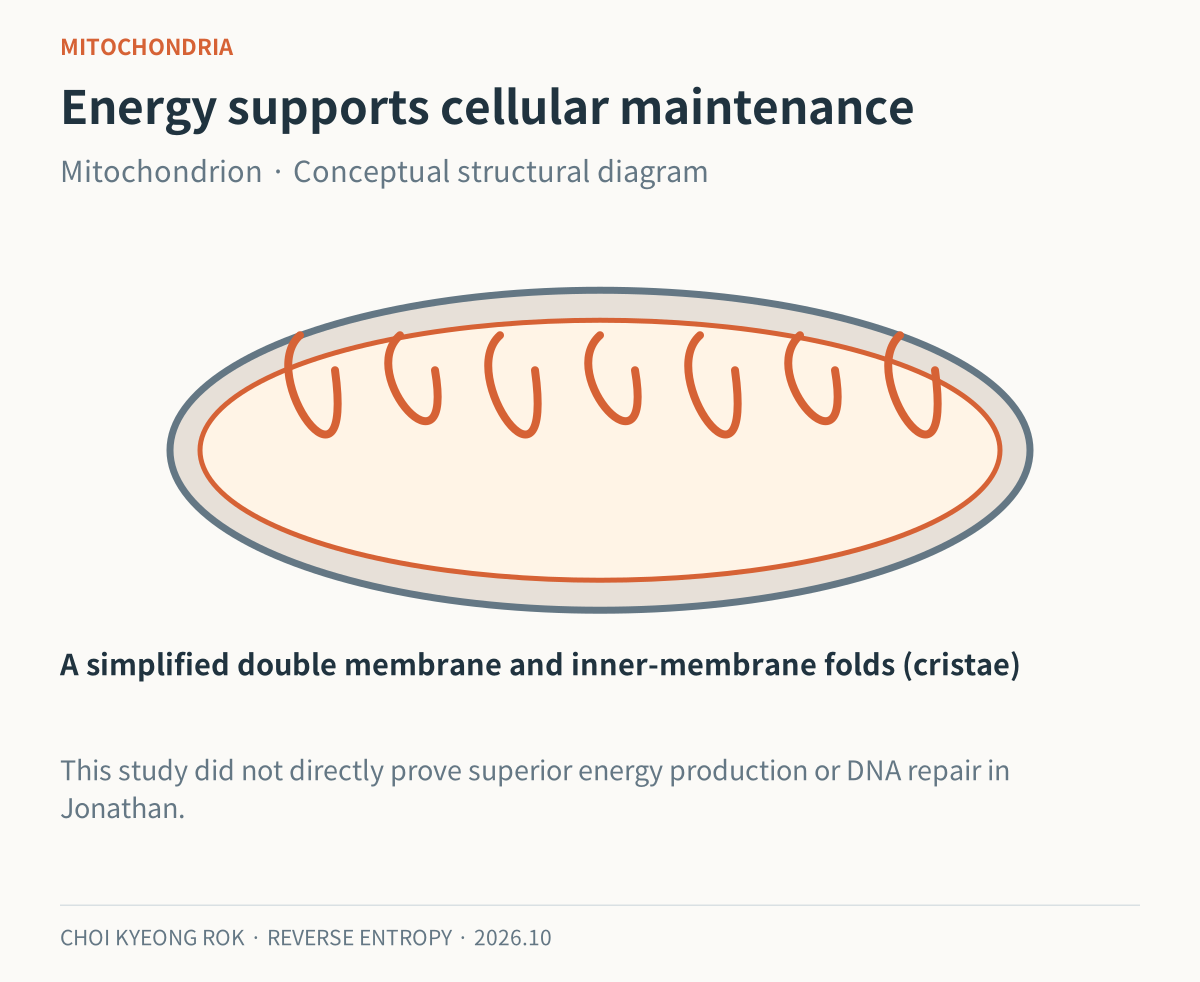
Source: Original artwork by Reverse Entropy. The original used AI-generated visual elements and separately edited text. This localized version is a newly drawn vector concept diagram.
Energy is needed for more than moving the body.
It is also needed to repair DNA damage, make necessary proteins, and maintain normal cellular functions.
So if the regulation of genes involved in energy production stays stable for a long time, we can consider the possibility that this may also help cellular maintenance.
RNA processing matters too. RNA participates in the processes that connect information stored in DNA to actual cellular functions.
Did he also have special longevity genes?
The researchers analyzed Jonathan's DNA sequence as well.
Their comparative analysis reported Jonathan-specific variants in several genes.
These included candidates related to DNA repair, tumor suppression, and telomere maintenance.
Telomeres are structures that protect the ends of chromosomes. They are essential for protecting DNA.
There is one point to be careful about.
Finding a variant and showing that the variant extended lifespan are different things.
More individuals and functional experiments are needed to determine whether these features caused his longevity or simply happened to coexist in Jonathan.
Rather than fully uncovering the secret of longevity, the study identified candidates worth following up.
Would lowering entropy make humans younger too?
Here we come to the most important question.
Could people live longer if they lowered their methylation entropy?
At present, we do not know.
Low entropy may have helped preserve stable functioning.
Conversely, some methylation patterns may have persisted for a long time because the animal's functioning was stable to begin with.
The direction of cause and effect has not been established.
Nor is lower entropy necessarily always better.
Gene regulation needs to change according to cell type and circumstances. Preventing even necessary changes may not be helpful.
What needs to be established is which regulatory states it is beneficial to maintain, in which regions, and to what extent.
This asks a different question from a biological-age test
Epigenetic clocks that estimate age from DNA methylation patterns have been developed in recent years.
However, different clocks estimate different things. Some predict chronological age, while others aim to reflect measures related to disease risk or the pace of aging.
These tests and this study both examine DNA methylation, but they ask different questions.
An age-estimation test asks:
“What age does this pattern resemble?”
This longevity study asked:
“What regulatory patterns remain in an animal that has lived an exceptionally long time?”
Predicting age accurately and finding and changing the causes of aging are different tasks.
This study has not established the causes of longevity either. But it provides clues for the next experiments.
What does living a long time mean preserving?
What interests me more than the number of years Jonathan has lived, 194, is that low entropy was observed in some gene-regulatory regions even after such a long time.
We think of aging as a process in which damage accumulates.
That is a valid explanation. But cells do not merely suffer damage.
Every day, they work to maintain their condition by repairing DNA, making proteins, and producing energy.
Perhaps, then, the key to longevity lies not only in sustaining less damage, but also in the ability to deal with damage and maintain normal functioning.
Perhaps living a long time means being able to preserve important regulatory systems in the body as time passes.
I hope future anti-aging research will go one step beyond lowering the number we call age.
Which functions in our bodies are breaking down, and how can we preserve those functions for longer?
How old might Jonathan live to be? I hope I will be able to write a congratulatory post when he celebrates his 200th birthday.
References
Vaisvil B, Schmitt DP, Jones A, et al. Epigenetic insights into extreme longevity in the world's oldest terrestrial animal, Jonathan. Science Advances. 2026;12(41):eadw8887. Released online October 7, 2026.
Vanderbilt University Medical Center. An extremely old giant tortoise named Jonathan may hold the secret to a long, healthy life: Study. October 7, 2026.
Research institution announcement
Guinness World Records. Oldest living land animal / oldest chelonian. Jonathan's estimated age and history.
#AntiAging #LifeExtension #LongevityResearch #Jonathan #194YearOldTortoise #DNAMethylation #Epigenetics #MethylationEntropy #Mitochondria #BiologicalAge #AgingResearch #CellularAging #ReverseEntropy