Is growth hormone really a “hormone of youth”?
The name growth hormone seems to fit naturally with youth.
A hormone that helps us grow, build muscle, and repair the body.
Does that mean we should supplement more of it as we get older?
A finding in humans, however, raises exactly the opposite question.
Cancer and diabetes were very rare in people whose growth-hormone signals were not properly transmitted.
Even more interestingly, these people were not lean.
The condition at the center of this paradox is Laron syndrome.
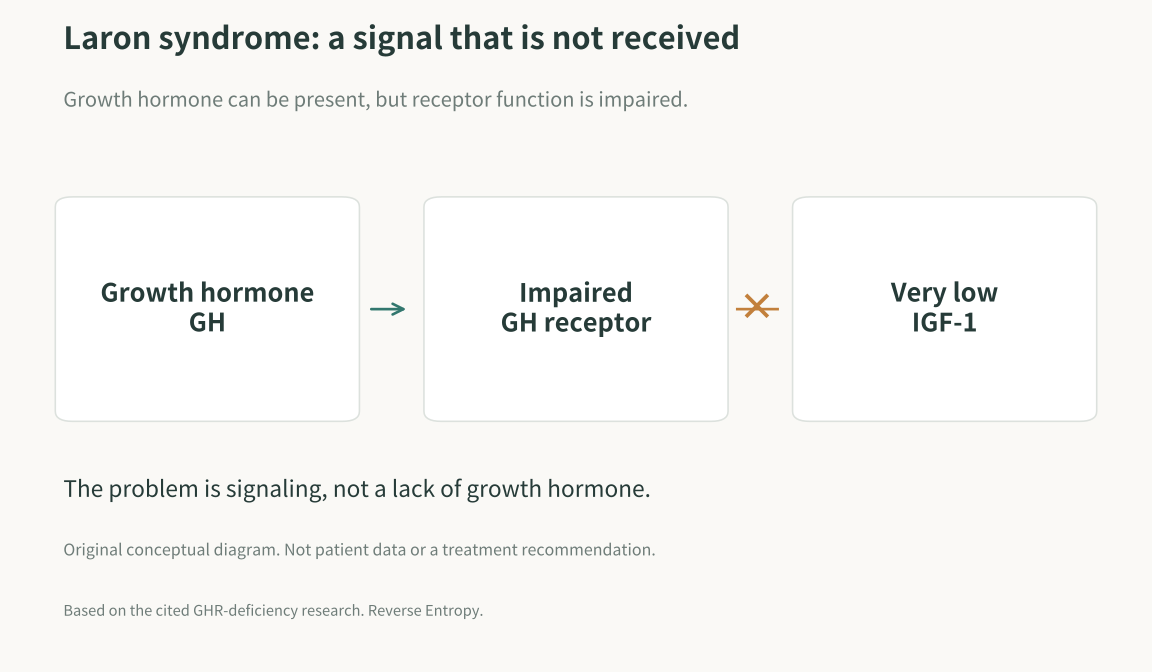
Growth hormone is present, but the body cannot hear its signal
Laron syndrome is not caused by a shortage of growth hormone.
For growth hormone to act, the cell’s growth hormone receptor, or GHR, must receive its signal.
Normally, this process promotes production of IGF-1, or insulin-like growth factor 1, in the liver and other tissues.
IGF-1 is an important signal that helps the body grow.
In Laron syndrome, however, genetic abnormalities impair receptor function.
Even when growth hormone is sufficient or elevated, the signal is not transmitted properly, and IGF-1 becomes very low.
The hormone is not missing; its message is not getting through.
The result is severe short stature and changes in body composition.
This rare disease attracted attention in aging research because it offered a way to examine what happens in humans whose growth signaling has been weak throughout life.
Twenty-two years of observation: one cancer case and no diabetes
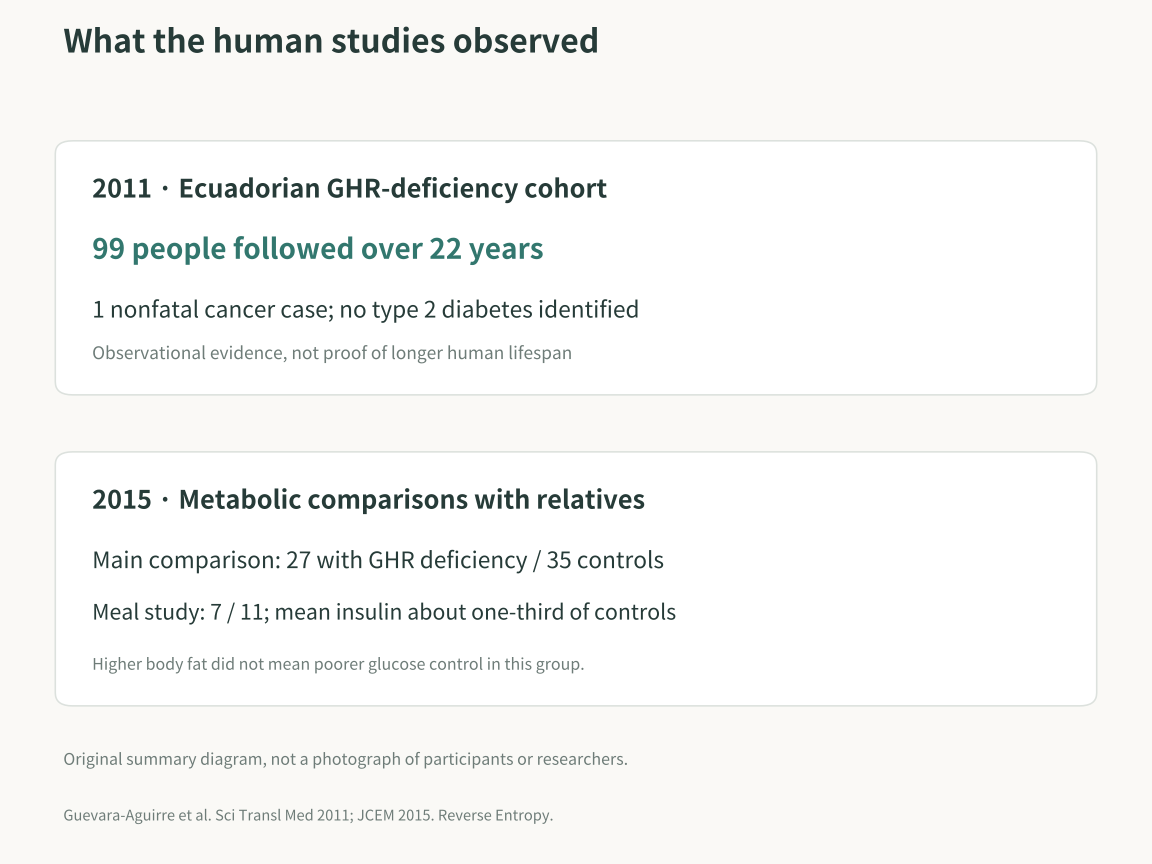
In 2011, a study of an Ecuadorian population with growth hormone receptor deficiency was published in Science Translational Medicine.
Researchers had followed 99 people since 1988.
They also examined information on 53 people who had died before monitoring began, along with illness and mortality information on 1,606 relatives without receptor deficiency.
The observed cohort had one identified cancer case; the person survived after treatment.
No cases of type 2 diabetes were identified.
Cancer and diabetes were reported among the relatives, however. pmc.ncbi.nlm.nih.gov
An observational study of a population with a rare genetic disorder cannot, of course, determine treatment for the general population.
But it is enough to raise one question.
Is stronger growth-promoting signaling always better throughout life?
More body fat, but less insulin needed
Body fat is a particularly interesting part of this story.
People with Laron syndrome characteristically have a high body-fat percentage.
The familiar connection we tend to make is that more body fat increases insulin resistance, making progression to type 2 diabetes more likely.
This group showed a different combination.
The main comparison in a 2015 follow-up study included 27 adults with receptor deficiency and 35 relative controls.
Even though age, sex, and BMI were matched, the receptor-deficient group had a higher body-fat percentage.
Yet their fasting insulin, blood glucose two hours after a glucose load, and triglycerides were lower.
In a separate small meal experiment, seven people with receptor deficiency and 11 controls received the same high-calorie meal.
The receptor-deficient group’s mean insulin concentration was about one-third that of the controls, and their blood glucose was also lower. academic.oup.com
That means less insulin was needed to regulate blood glucose.
The researchers interpreted this in connection with higher insulin sensitivity.
Having more body fat and having difficulty controlling blood glucose are not exactly the same information.
This does not mean obesity is harmless.
These people have a distinctive genetic and hormonal environment.
The insight is that the amount of fat alone cannot fully explain metabolic health.
Growth signals can also favor damaged cells
Normal cells need growth signals.
But what happens if damaged cells use those signals too?
The GH–IGF-1 axis and its downstream growth-related pathways are involved in cell growth and survival.
They are also connected with mTOR, which responds to nutritional status to regulate protein synthesis and cell growth.
Functions that build normal tissue can overlap with functions that help abnormal cells survive.
The 2011 study also included cell experiments using serum from the patients.
Human mammary epithelial cells exposed to that serum had less DNA damage under oxidative stress and a stronger apoptotic response, the process by which cells eliminate themselves.
This did not fully establish why cancer was less common in the patients’ bodies.
It does, however, provide a clue that an environment with weaker growth signaling can change how cells respond to damage.
It makes me reconsider the phrase “keeping cells alive.”
Protecting healthy cells is important.
But if a cell is irreversibly damaged, removing it may be better for the body as a whole.
Helping every cell survive and protecting a person’s health may not be the same objective.
Longevity in mice must be distinguished from longevity in humans
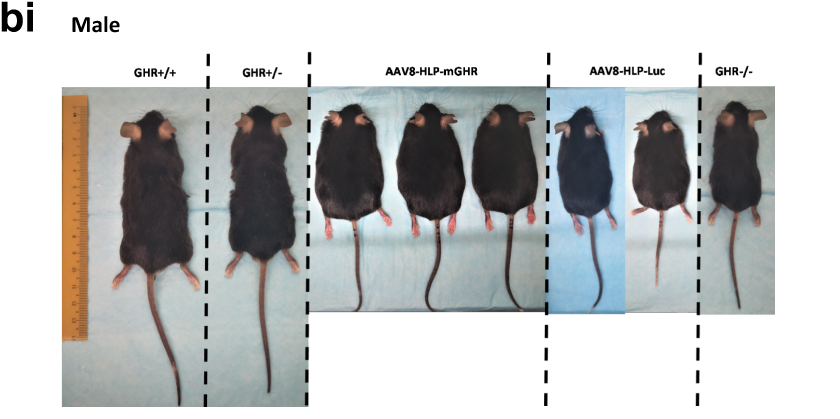
Mice with poorly functioning growth hormone receptors also become small, as humans do.
Below is a photograph of mice used in an actual study.
The difference in body size is apparent between the wild-type mouse on the left and the receptor-deficient mouse at the far right.
In animals, some mouse models with reduced growth-hormone action have shown longer lifespans.
In a 2016 study that deleted the growth hormone receptor gene at six weeks of age, maximum lifespan increased in female mice.
The same result was not seen in males. pubmed.ncbi.nlm.nih.gov
This means the relationship between growth signaling and lifespan can differ according to sex and the timing of an intervention.
However, the Ecuadorian human study did not establish lifespan extension.
Accidents, alcohol-related causes, and convulsive disorders accounted for a substantial share of deaths. pmc.ncbi.nlm.nih.gov
The observation that cancer or diabetes was rare is separate from a finding of increased overall survival.
Even if the risk of a particular disease falls, lifespan may not change if other causes of death remain.
Reducing one disease, living in good health, and living longer are outcomes that each need to be demonstrated.
Does having the “features of a young body” mean the body is aging slowly?
The idea of more muscle, less fat, and thicker skin is appealing.
Those are changes we can see.
But body composition or appearance becoming more like that of a young person does not, by itself, establish an improvement in long-term disease risk or lifespan.
This is the question Laron syndrome raises.
Are the growth signals that make us look younger necessarily the same signals that help us live long and healthy lives?
I think we need to distinguish the two when examining anti-aging research.
We need to ask not only what increased, but whether that change improved function, reduced disease, and how long the effect lasted.
A rise in a hormone level alone does not mean aging has slowed.
Nor does a decrease necessarily mean an improvement.
A body that grows when growth is needed and repairs when repair is needed
Should we therefore lower growth hormone and IGF-1 as much as possible?
That conclusion would miss the most interesting part of the research.
We need to maintain muscle, heal wounds, and produce new normal tissue.
Growth signals are necessary for these processes.
At the same time, we need to clear damaged proteins, remove abnormal cells, and maintain tissue quality.
Growth and maintenance or repair influence one another.
We cannot assume that permanently maximizing either side is optimal for healthspan.
What follows is my interpretation based on this research.
What matters in anti-aging may be not only the strength of growth signaling, but also the ability to regulate it according to the situation.
Growing sufficiently in the tissues and at the times that require growth, and allocating resources appropriately when maintenance and repair are needed.
This is not a prescription to lower a particular hormone or a claim that a particular lifestyle practice can freely switch between these two states.
Separate research is needed to determine which interventions actually increase human healthspan.
But when we supplement something in the name of anti-aging, we can ask more precise questions.
Instead of stopping at “There was more of it when I was young, so I should raise it again,” we should ask what it improves in the body we have now, and at what cost.
Laron syndrome is not a story that judges growth hormone to be a good or bad hormone.
It asks whether conditions that favor growth always favor lifelong health as well.
Key references
Guevara-Aguirre J, et al. Growth Hormone Receptor Deficiency Is Associated With a Major Reduction in Pro-aging Signaling, Cancer, and Diabetes in Humans. Science Translational Medicine. 2011;3(70):70ra13.
Guevara-Aguirre J, et al. GH Receptor Deficiency in Ecuadorian Adults Is Associated With Obesity and Enhanced Insulin Sensitivity. Journal of Clinical Endocrinology & Metabolism. 2015;100(7):2589–2596.
Junnila RK, et al. Disruption of the GH Receptor Gene in Adult Mice Increases Maximal Lifespan in Females. Endocrinology. 2016;157(12):4502–4513.
Making the body grow more and protecting it for longer are not the same thing.