Even if snoring decreases after taping the mouth, it is difficult to conclude that breathing during sleep has returned to normal. Whether the sound is quieter and whether enough air is moving in and out need to be checked separately.
When snoring wakes the person beside you, a simple solution such as mouth tape can be appealing.
Before choosing a tape, however, there is a distinction to make: are you trying to reduce noise, or a recurring breathing problem during sleep?
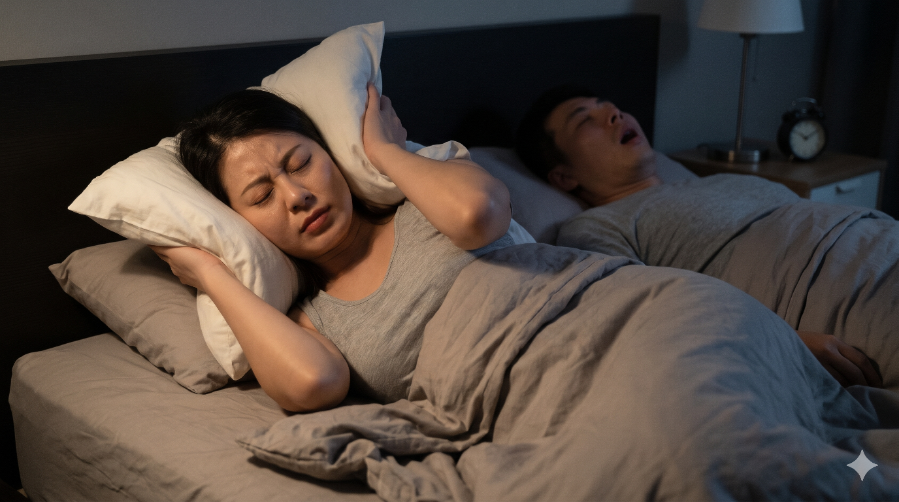
Quieter snoring and normal breathing during sleep are not the same thing. AI-assisted illustration.
How is the sound of snoring different from an obstructed breath?
The muscles inside the throat relax during sleep. When air passes through a narrowed airway and makes the surrounding tissues vibrate, snoring can occur. Obstructive sleep apnea involves the airway narrowing further or closing, repeatedly reducing or stopping airflow.
Oxygen levels may then drop, or sleep may be repeatedly interrupted. Even after lying in bed all night, you may feel sleepy during the day and find it difficult to concentrate.
Has research found that taping helps?
Some research has explored whether closing the mouth and encouraging nasal breathing might help. In 2022, researchers in Taiwan compared home sleep tests in 20 adults with mild sleep apnea who slept with their mouths open. They tested them without tape, then tested them again with tape a week later.
The median number of apnea and hypopnea events per hour fell from 8.3 to 4.7, and the snoring index also decreased. Unlike a simple testimonial, the study documented a change on a breathing test, which is meaningful. Original study
However, the study included only people who could tolerate mouth taping, and nasal obstruction was treated first when present.
Most participants were men, and there was no separate comparison group that did not use tape. As a small retrospective study, it is insufficient to establish long-term effects or safety for general use.
In particular, participants had already been diagnosed with mild sleep apnea before entering the study. That is a different starting point from trying it at home without being tested or knowing the severity of your condition. These findings cannot be applied to everyone who snores or used to justify replacing positive airway pressure treatment.
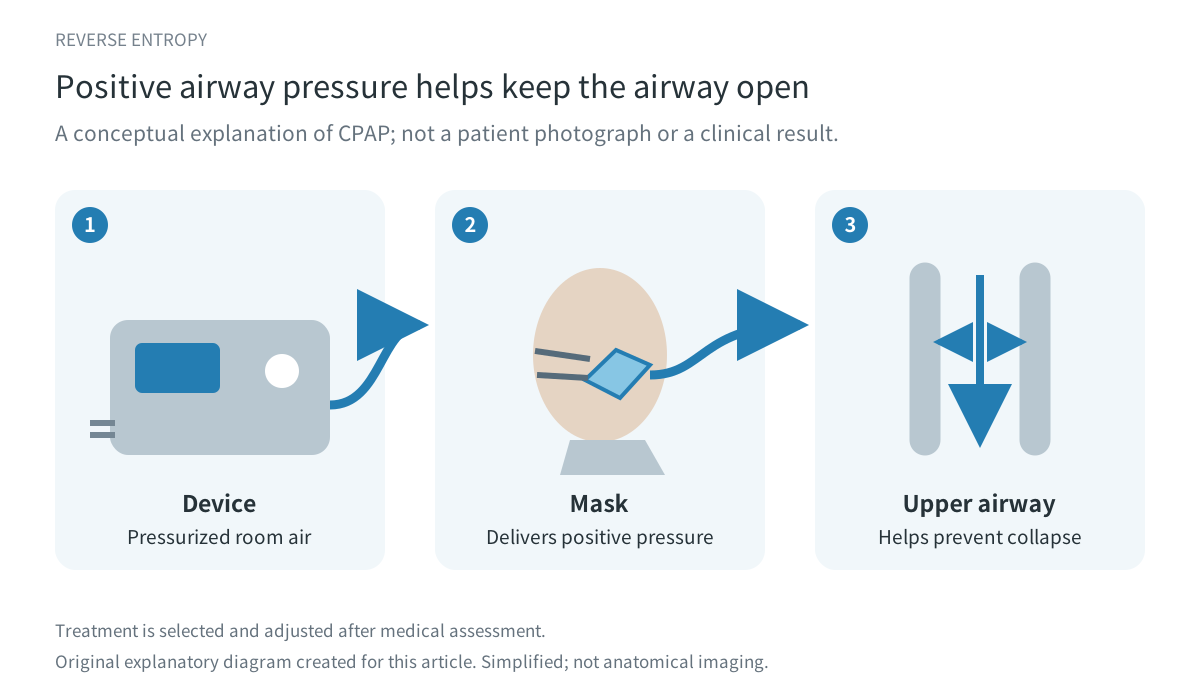
Time spent lying in bed all night does not tell us how well someone was breathing during sleep. This conceptual diagram illustrates positive airway pressure; it is not a photograph of a patient or a clinical result.
Diagram: independently created for this article to explain how positive airway pressure helps keep the upper airway open.
Taping could actually harm your health
If you have nasal congestion or suspected sleep apnea, it is safer not to experiment on your own with forcibly closing your mouth.
The American Academy of Sleep Medicine also warns that online trends such as mouth taping can be dangerous.
I have some mild snoring myself, and once tried mouth tape while measuring my overnight snoring time and oxygen saturation. I did not feel that I had a sleep problem; I simply wanted to see whether I could reduce the snoring.
The result was unexpected.
My snoring time decreased and oxygen saturation did not change much, but I felt much more tired in the morning. I had not been sleeping deeply.
I no longer use mouth tape. I occasionally use a nasal dilator instead. With that, I snore less and wake up feeling better.
Of course, mouth taping does appear to help in some cases,
but if you still want to try it, please keep the following precautions in mind.
Contraindications and breathing safety: most important
Check that the nasal passages are open first:
Before applying tape, check whether you can comfortably keep your mouth closed and breathe only through your nose for one to two minutes.
If your nose is blocked by rhinitis, sinusitis, a deviated nasal septum or a cold, blocking the mouth can lower oxygen saturation during sleep and create a risk of suffocation.
Caution with moderate or more severe sleep apnea:
In people with obstructive sleep apnea (OSA), whose upper airway closes completely rather than simply snoring from mouth breathing, closing the mouth may also block compensatory mouth breathing, the response of gasping through the mouth when breathing is obstructed, and increase apnea-related cardiovascular strain.
Do not use it after drinking alcohol or when vomiting is a risk:
Never use it after drinking alcohol, taking sleeping pills or sedatives, or on a day when you have gastroesophageal reflux or nausea.
In particular, if vomiting or acid reflux occurs during sleep while the mouth is blocked, vomit may enter the airway and cause aspiration pneumonia or airway obstruction.
Choosing and applying a product:
Products with a small vent, or vertical or X-shaped taping that leaves space at the sides, may avoid completely sealing the lips,
but leaving a gap does not guarantee safe breathing during sleep. If sleep apnea is suspected, seek medical assessment and advice rather than relying on the way the tape is applied.
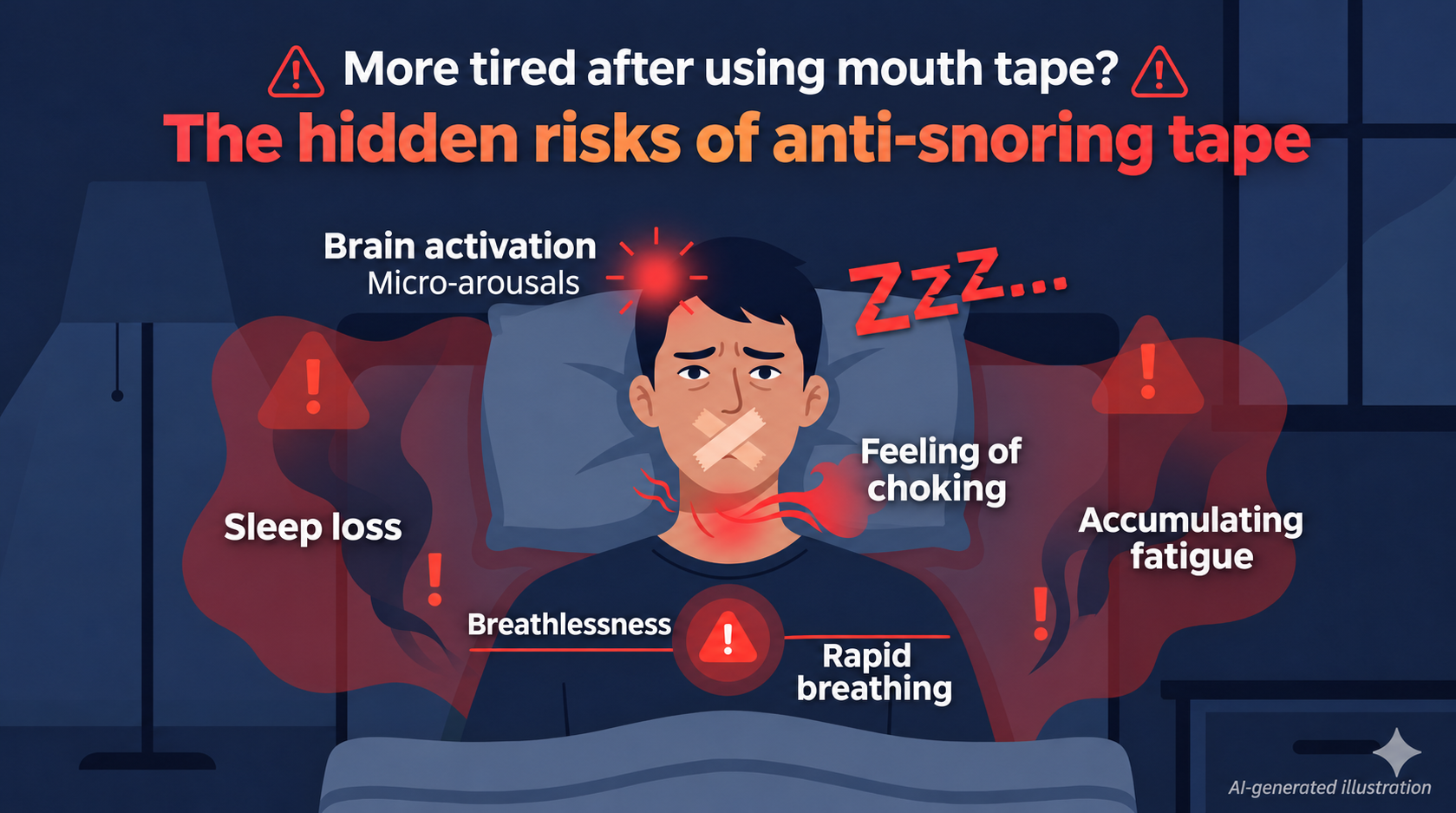
If you feel that there is a real problem with your sleep, however, my strongest recommendation is to visit a clinic and have polysomnography to check for sleep apnea.
If sleep apnea is confirmed, treatment such as positive airway pressure or a custom oral appliance is selected according to your circumstances and condition. Positive airway pressure uses air pressure to help keep the airway open. Its mechanism is fundamentally different from holding the lips together, and it has established therapeutic benefits.
References
Lee YC et al. A study of mouth taping in adults with mild obstructive sleep apnea who breathe through the mouth. Healthcare, 13 September 2022. Twenty participants; retrospective study without a control group.
Kapur VK et al. Clinical practice guideline for diagnostic testing for adult obstructive sleep apnea. Journal of Clinical Sleep Medicine, 2017. American Academy of Sleep Medicine.
American Academy of Sleep Medicine. Viral TikTok trends are not the answer for better sleep. 25 July 2023.
US National Heart, Lung, and Blood Institute. Sleep Apnea: symptoms, diagnosis and treatment information. Updated 9 January 2025; accessed 23 October 2026.
#Snoring #SleepApnea #MouthTaping #SleepTesting #SleepHealth #ReverseEntropy