After age 65, weight management should take abdominal fat and muscle condition into account, rather than focusing on body weight alone.
If you have put on a little weight, it is worth checking how your waist, muscle, and ability to move have changed before simply eating less. [2] [3]
A recent study of more than 1.4 million older adults found a lower mortality risk among people who moved from normal weight to overweight than among those who remained at normal weight. [1]
What, then, happened to people with obesity? And are there measurements that tell us more about health than BMI? Let us take a closer look.

1. Moving from normal weight to overweight was associated with 25% lower mortality
This study was published in npj Aging on November 5, 2026. Researchers analyzed repeated health examinations from 2017–2023 in 1,412,411 adults aged 65 or older. The main adjusted analysis included 1,338,732 people.
The reference group was people who remained at normal weight.
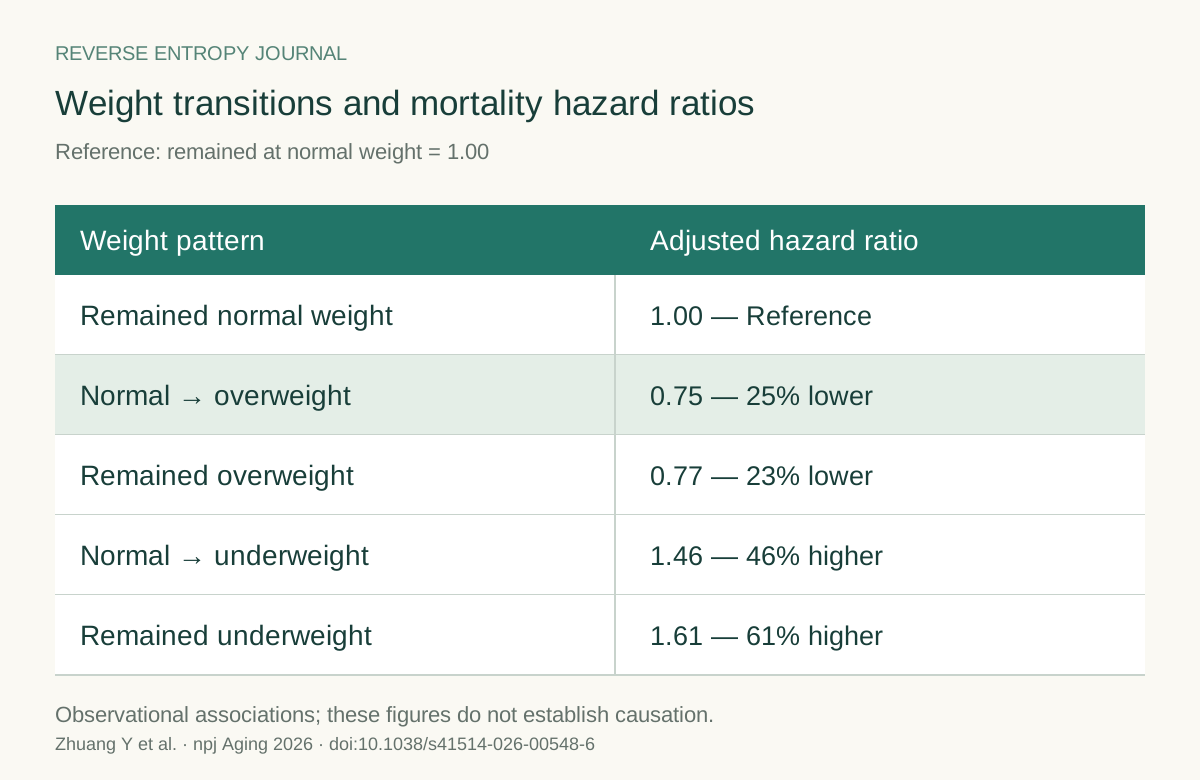
For those who moved from normal weight to overweight, the mortality hazard ratio was 0.75, with a 95% confidence interval of 0.73–0.77. This describes a relative difference in mortality during follow-up. [1]
Because this was an observational study, we also need to consider the possibility that healthier people were better able to maintain or increase their weight.
The unexpected result raised a question for me: “Can we assess health in later life using a normal BMI alone?” And what if someone gains much more weight?
2. What about people with obesity, beyond the overweight range?
Let us look at a separate US study that included obesity categories. Published in the Journal of the American Geriatrics Society in 2026, it analyzed 2011–2024 data from 6,905 adults aged 65 or older.
The following are all-cause mortality hazard ratios, using the normal-BMI group of each sex as its reference.
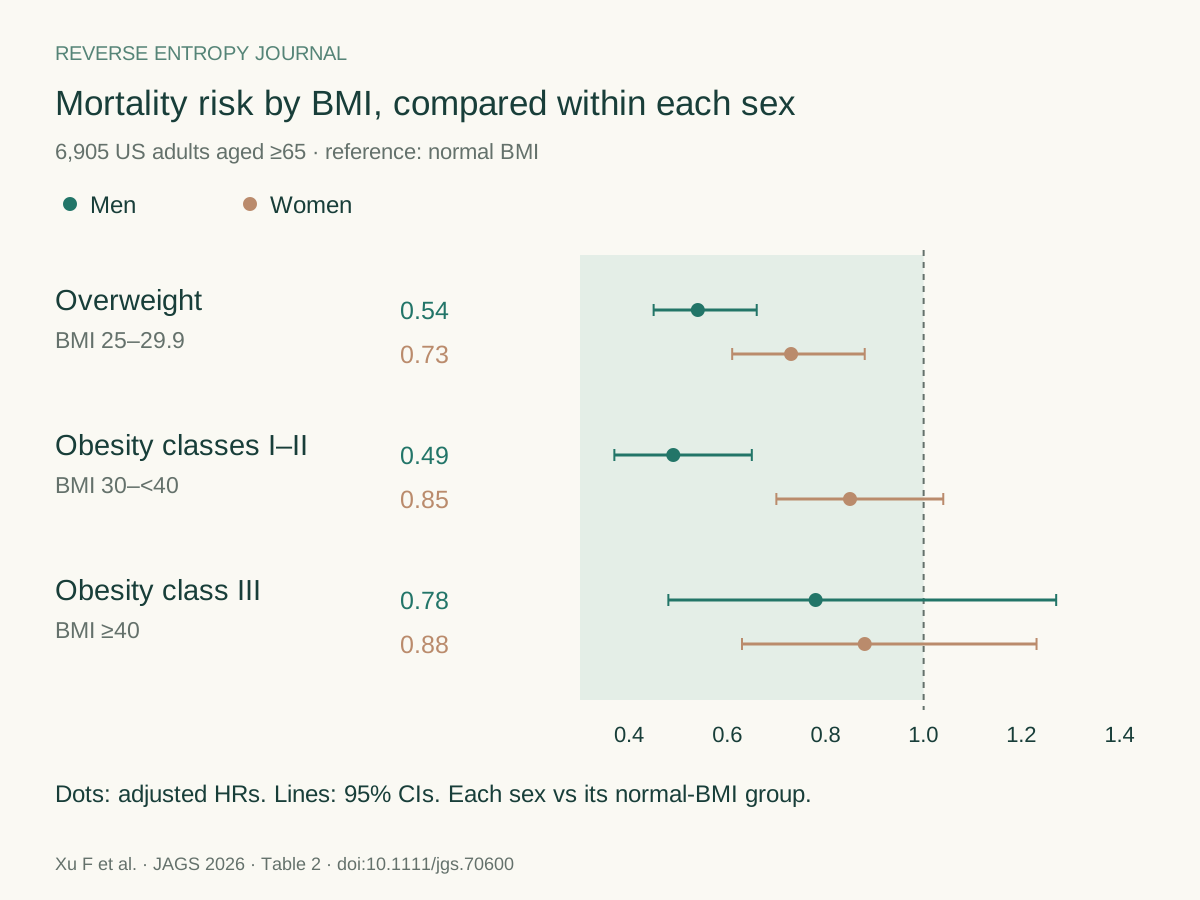
Overweight was associated with lower mortality in both sexes. Men with BMI from 30 to below 40 also had lower mortality. For women with obesity, and for both sexes with BMI of 40 or more, the differences from normal BMI were not statistically clear. [5]
Another result from the same study caught my attention. Compared with people who had both normal BMI and a smaller waist, people with normal BMI but a larger waist had a 33% higher mortality hazard among men and a 23% higher hazard among women. [5]
Weight category and the distribution of abdominal fat were telling different stories.
The categories in the figure come from the US study. In Korea, obesity is classified from BMI 25 upward, so “overweight” in an overseas study and “obesity” in Korean practice cover different ranges. [10]
3. WHR helps reveal the fat distribution BMI misses
BMI is calculated from height and weight. It does not tell us whether that weight comes from muscle or fat, or how much of the fat is concentrated in the abdomen.
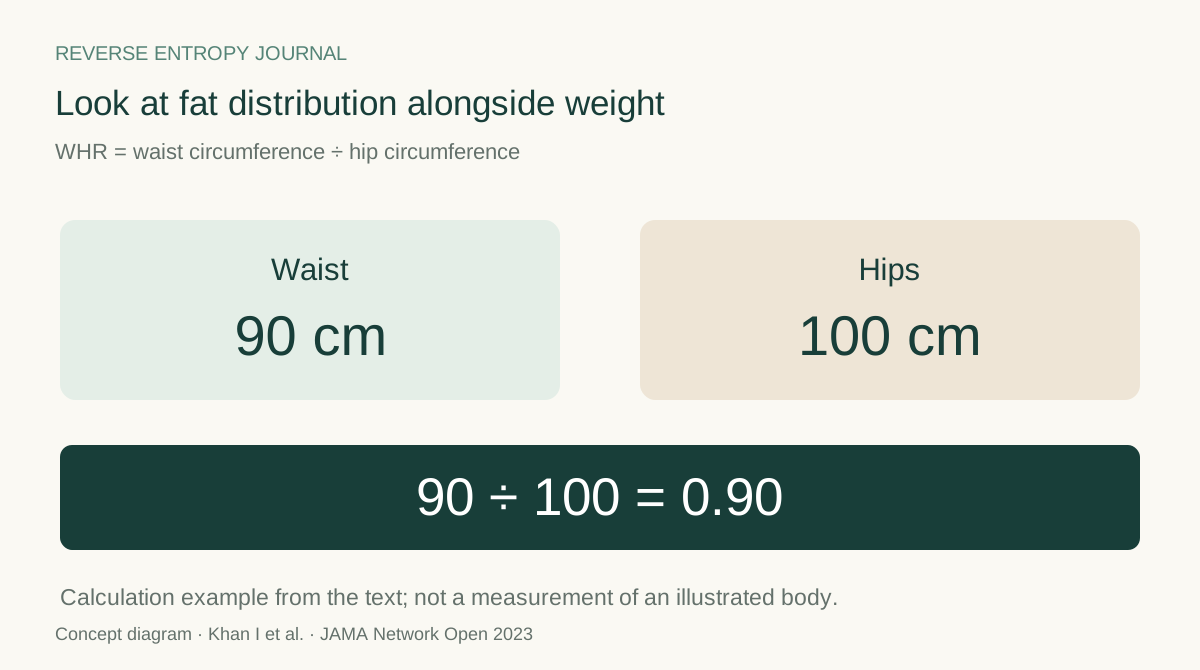
One additional measure is WHR, the waist-to-hip ratio.
WHR = waist circumference ÷ hip circumference.
For example, a 90 cm waist and 100 cm hips give a WHR of 0.90. It tells us how large the waist is relative to the hips, providing a way to assess the relative concentration of abdominal fat. [7]
A UK study following 14,833 people aged 75 or older for a median of 5.9 years illustrates this distinction. Among nonsmokers, higher BMI was not associated with increased mortality, but higher WHR was associated with increased mortality in both men and women. [6]
A UK Biobank study published in JAMA Network Open in 2023 found a similar pattern. In an observational analysis of 387,672 people with a mean age of 56.9, together with a separate genetic analysis, WHR had a stronger and more consistent relationship with mortality than BMI. [7]
Fat distribution revealed risks that BMI alone had missed. It is worth paying attention to an expanding waist as well as whether body weight is within a normal range.
4. At the same weight, a body with preserved muscle and strength is different
What makes up that weight also matters. Two people of the same height and weight can have different proportions of muscle and fat.
A 2014 study in the American Journal of Medicine analyzed 3,659 middle-aged and older US adults: men aged at least 55 and women aged at least 65. It used a muscle mass index, calculated by dividing muscle mass estimated with bioelectrical impedance by height squared.
People in the highest quarter of muscle mass index had about 20% lower mortality than those in the lowest quarter. The association remained after taking abdominal obesity assessed by WHR and other factors into account: adjusted hazard ratio 0.80, 95% confidence interval 0.66–0.97. [8]
Adding how much strength a person can actually produce gives a more rounded picture of their condition.
In the Health ABC study of 2,292 people aged 70–79, grip strength and leg strength were clearly related to mortality. The association remained even after accounting for muscle size. [9]
The European consensus on sarcopenia also treats low muscle strength as a key signal. Grip strength or the ability to rise from a chair is used to assess strength, muscle quantity or quality to confirm the diagnosis, and physical performance, such as walking, to assess severity. [3]
To understand health more accurately in later life, we therefore need to add WHR and waist circumference, muscle mass, grip strength, and walking ability to BMI.
5. Geriatric nutrition guidelines do not recommend weight loss for everyone
This perspective is reflected in clinical guidance.
The 2022 geriatric nutrition guideline from the European Society for Clinical Nutrition and Metabolism (ESPEN) recommends avoiding weight-reducing diets in overweight older adults to prevent muscle loss and functional decline. The emphasis is on stable weight, adequate nutrition, and physical activity.
If obesity is causing metabolic or mobility problems, the benefits and risks of weight loss should be assessed individually. When weight loss is needed, it should be combined with exercise while protecting muscle and nutritional status. [2]
The starting point is to identify what this particular body needs. Some people need to improve waist circumference and metabolic measurements; for others, eating enough and rebuilding strength take priority.
6. Similar 9% weight loss, different bodies afterward
A randomized trial published in the New England Journal of Medicine in 2017 followed 160 adults aged 65 or older with obesity for six months.
It compared weight-loss programs combined with aerobic exercise, resistance exercise, or both. Weight loss was similar in all three exercise groups, at about 9%.
Improvements in physical performance differed: approximately 14% with aerobic exercise, 14% with resistance exercise, and 21% with the combination.
Loss of lean mass, which includes muscle and other tissues, was also different: about 5% with aerobic exercise, 2% with resistance exercise, and 3% with the combination. [4]
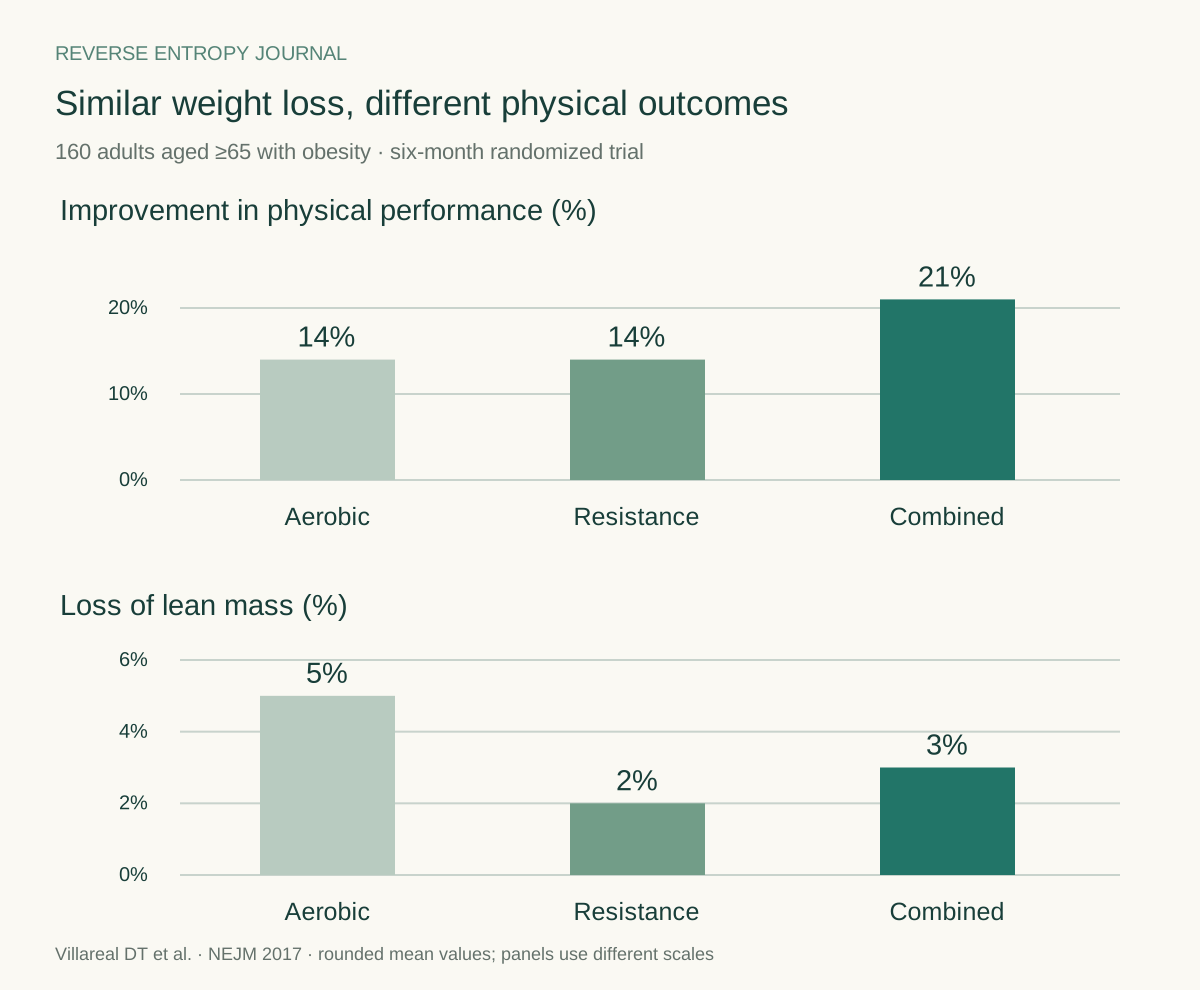
Even when the amount of weight lost was similar, the exercise approach affected the lean mass and physical ability left afterward.
For older adults who need to lose weight, changes in strength and physical function should be assessed alongside the change on the scale.
7. What to check alongside body weight
Weight alone should not be the basis of health management.
Waist circumference: how much fat is concentrated in the abdomen.
Muscle mass: how much of the muscle used for movement is being preserved.
Grip strength, getting up from a chair, and walking ability: the capacity to produce strength and function in everyday life.
Blood pressure, blood glucose, and lipids: metabolic health assessed alongside body weight.
Looking at body shape, composition, and function together reveals differences hidden by BMI alone. [3] [7] [10]
Eating habits need attention too. If someone regularly skips meals or rarely eats protein-rich foods, improving the diet may come first. Eating well becomes all the more important with age.
If weight keeps falling without deliberate dieting, especially with reduced appetite or energy, the cause needs to be assessed, including food intake and possible illness. [2]
The goal in later life is to eat well, walk well, and live independently
When I think about weight management for older adults, my main goal is to preserve a body that can keep living independently.
If we aim only for the weight we had when young or the “normal” range on a checkup report, we may miss what our body needs now.
If you have gained a little weight, look at your waist, muscle and strength, blood pressure, and blood glucose together. If your weight is normal but your abdomen is growing and your strength is fading, those changes deserve attention first.
BMI shows weight relative to height. Adding where fat is located, how much muscle remains, and how well we can actually move helps us understand how our bodies are aging.
Keeping a body that can eat and move well for many years: weight management in later life should serve that goal.
References and official sources
- Zhuang Y et al. Dynamic patterns of body size and mortality among older adults in China: Evidence from a multi-city cohort study. npj Aging. Published November 5, 2026.
- Volkert D et al. ESPEN practical guideline: Clinical nutrition and hydration in geriatrics. Clinical Nutrition. 2022;41:958–989. doi:10.1016/j.clnu.2022.01.024.
- Cruz-Jentoft AJ et al. Sarcopenia: revised European consensus on definition and diagnosis. Age and Ageing. 2019;48:16–31. doi:10.1093/ageing/afy169.
- Villareal DT et al. Aerobic or Resistance Exercise, or Both, in Dieting Obese Older Adults. NEJM. 2017;376:1943–1955. doi:10.1056/NEJMoa1616338.
- Xu F et al. Time-Varying Body Mass Index, Waist Circumference and All-Cause Mortality in US Adults Aged 65 or Older. JAGS. Published online August 19, 2026. doi:10.1111/jgs.70600.
- Price GM et al. Weight, shape, and mortality risk in older persons. AJCN. 2006;84:449–460.
- Khan I et al. Surrogate Adiposity Markers and Mortality. JAMA Network Open. 2023;6:e2334836. doi:10.1001/jamanetworkopen.2023.34836.
- Srikanthan P, Karlamangla AS. Muscle mass index as a predictor of longevity in older adults. Am J Med. 2014;127:547–553. doi:10.1016/j.amjmed.2014.02.007.
- Newman AB et al. Strength, but not muscle mass, is associated with mortality in the Health, Aging and Body Composition Study cohort. J Gerontol A. 2006;61:72–77. doi:10.1093/gerona/61.1.72.
- Korean Society for the Study of Obesity. Diagnosis of Obesity: 2022 Update of Clinical Practice Guidelines for Obesity by the Korean Society for the Study of Obesity. J Obes Metab Syndr. 2023.
#HealthyAging #WeightManagement #BMI #WaistToHipRatio #AbdominalFat #Sarcopenia #StrengthTraining #Healthspan #ReverseEntropy