Why the 2026 Nobel Prize in Physiology or Medicine Went to Optogenetics
This year’s Nobel Prize in Physiology or Medicine went to a technology that sounds a little like science fiction.
It attaches a light-operated switch to specific nerve cells, allowing their activity to be controlled.
The technology is optogenetics.
The three scientists receiving the prize are Karl Deisseroth, Peter Hegemann, and Georg Nagel. The science is a little complicated.
But for anyone interested, I will try to explain it as simply as possible.
In a nutshell,
think of it as fitting neurons with “light-operated switches.”
Neurons that have light-sensitive proteins can be stimulated with light. Conversely, other types of proteins can be used to suppress their activity.
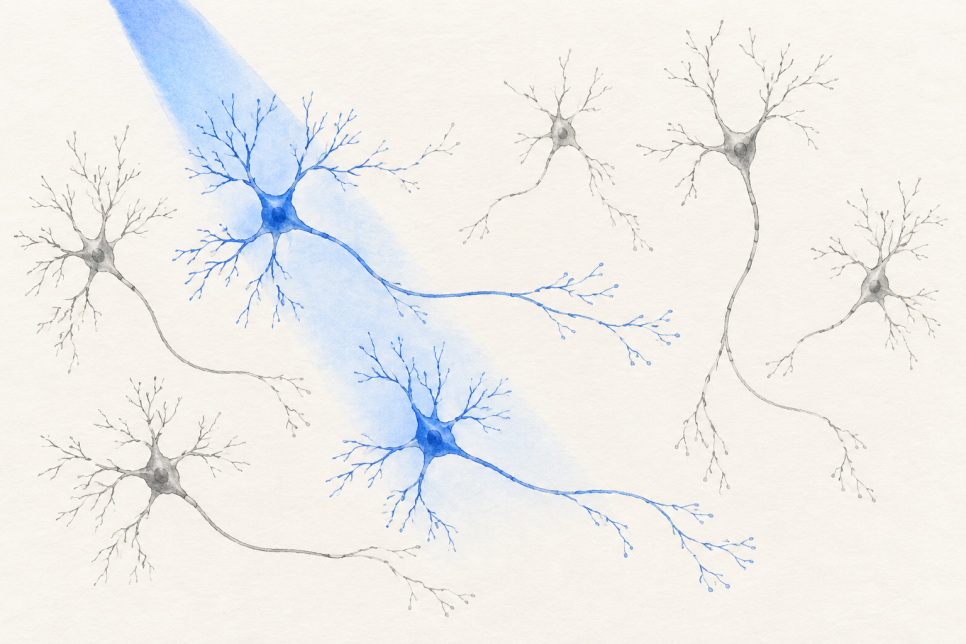
Source: AI-generated conceptual illustration.
It Began with Green Algae, Not the Brain
Optogenetics did not begin with humans or mice.
It began with a tiny single-celled green alga called Chlamydomonas reinhardtii.
This alga can move toward light.
To do so, it first needs to detect which direction the light is coming from.
One of the proteins involved is channelrhodopsin.
Channelrhodopsin is like a tiny door embedded in the cell membrane. It normally stays closed but opens when exposed to particular light.
When the door opens, ions such as Na⁺ move through it, changing the cell’s electrical state.
The work of Hegemann and Nagel played an important role in revealing the properties of these light-gated ion channels.
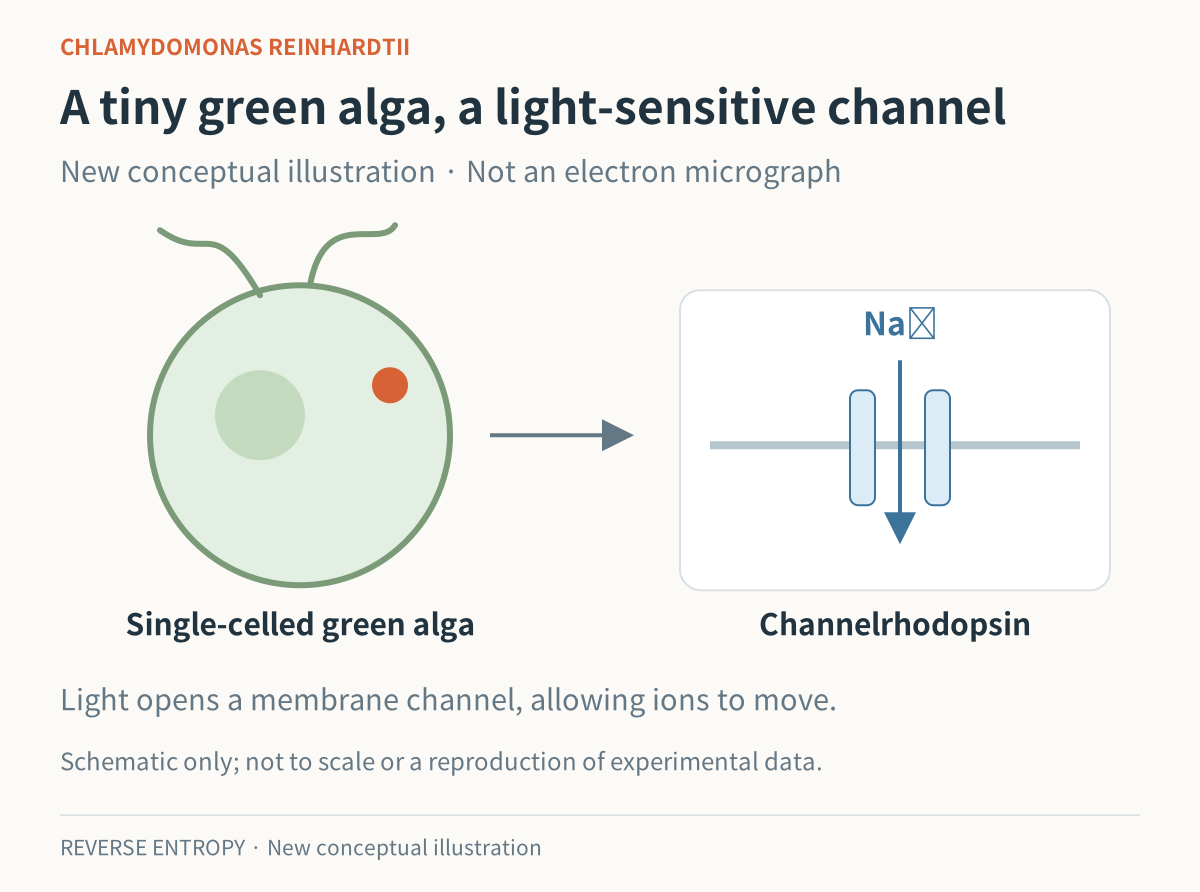
Source: New conceptual illustration by Reverse Entropy, based on the mechanism described in this article. The original source photograph has been replaced because commercial reuse permission was not established. Original research (external link)
Scientists Had an Ingenious Idea
Nerve cells also operate through electrical signals.
What would happen if this light-sensitive protein from green algae were introduced into nerve cells?
Genes are introduced so that neurons produce channelrhodopsin in their cell membranes.
Nerve cells that were previously difficult to control directly with light then become light-responsive cells.
When light is applied, channelrhodopsin opens, ions move, and the neuron is activated.
Put very simply:
light → the door opens → ions enter → the neuron fires.
“Firing” here does not mean the cell catches fire. It means that the nerve cell sends an electrical signal.
In 2005, researchers demonstrated that this approach could precisely stimulate nerve cells with light.
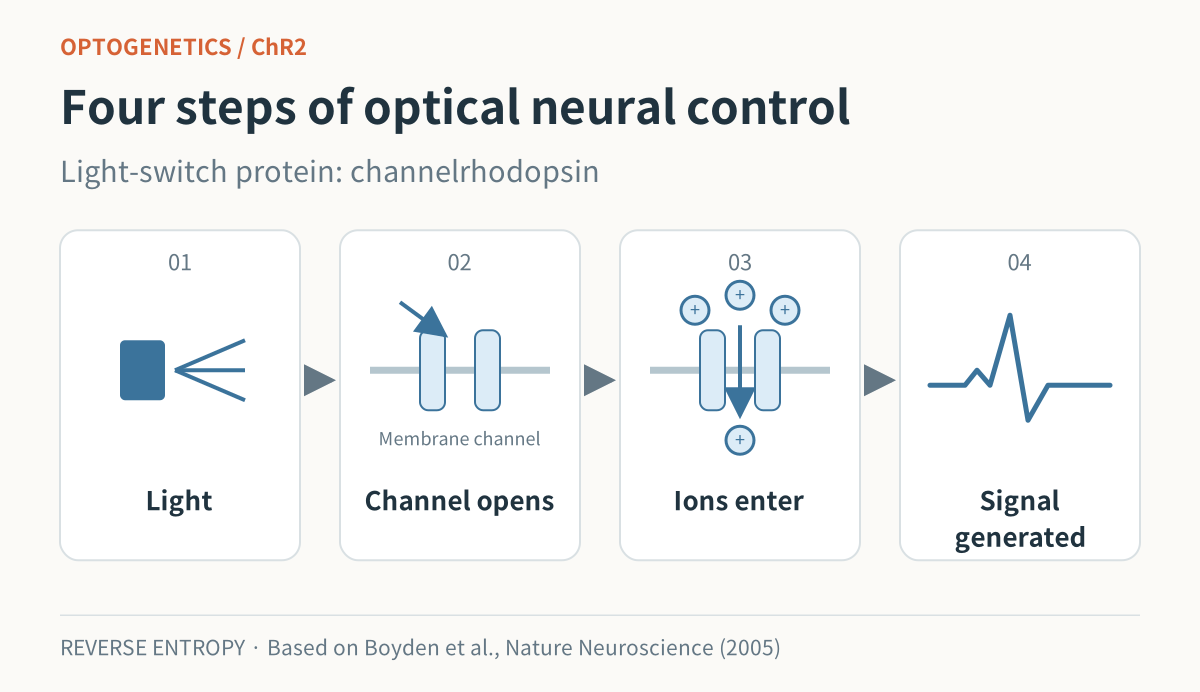
Source: Original explanatory diagram by Reverse Entropy, reconstructed from Boyden ES et al. Nature Neuroscience. 2005;8:1263–1268.
Why Is This Important Enough to Win a Nobel Prize?
We could observe the brain before this technology existed.
Functional MRI or PET can show which brain regions change their activity during a particular behavior.
Suppose a certain region becomes active when someone sees a frightening picture.
We can then say, “This region becomes active when the person feels fear.”
But there is a major problem.
Observation alone cannot easily tell us whether that region causes the fear or becomes active as a consequence of the fear.
This is the difference between correlation and causation.
Optogenetics provided a powerful way to investigate this problem.
Install light switches in specific neurons and turn those neurons on. A behavior changes.
Conversely, suppressing that circuit may reduce or eliminate the behavior.
This provides much stronger evidence that the neural circuit actually contributes to the behavior.
Of course, activating a single neuron does not explain every cause of a complex behavior.
Even so, the research method has shifted from watching to directly intervening and testing.
A Technology That Can Selectively Switch On One Wire in the Brain
Our brains contain approximately 86 billion neurons.
But not every neuron does the same job.
Some participate in movement, while others are involved in fear, reward, sleep, or wakefulness.
In the past, studying complex circuits often meant stimulating many nearby neurons at once.
The advantage of optogenetics is that it can selectively control the desired type of neuron.
It is more like pressing the light switch in one room than turning off the circuit breaker for an entire house.
This is because researchers control both which cells receive the gene and where the light is delivered.
Can It Be Used in People Right Away?
It is possible to introduce genes into selected neurons in a mouse brain and insert an optical fiber.
But applying the same approach to humans presents many problems.
First, genes must be delivered so that the desired nerve cells produce light-sensitive proteins. Light must also reach deep into the brain.
Shining a flashlight at someone’s head from outside will not switch on neurons deep inside the brain.
Researchers must also confirm that the system works safely over the long term.
There are therefore still substantial technical barriers to using optogenetics directly to treat brain disorders.
The Eye Is a Little Different
Vision restoration is one area in which optogenetics is moving toward human treatment.
In conditions such as retinitis pigmentosa, the light-sensing cells called photoreceptors die.
But some nerve cells downstream that transmit signals may remain alive.
What if these surviving cells were given new light-sensing proteins?
Cells whose original job was not to detect light directly would be made responsive to light.
In fact, in 2021, partial recovery of visual function was reported in one patient with retinitis pigmentosa who received optogenetic gene therapy together with special goggles.
While wearing the goggles, the patient could perform tasks such as locating, counting, and touching objects.
This does not mean that normal sight was restored.
But it showed that the idea of giving surviving nerve cells a new light-sensing function could also work in a human.
Several clinical development programs have continued since then.
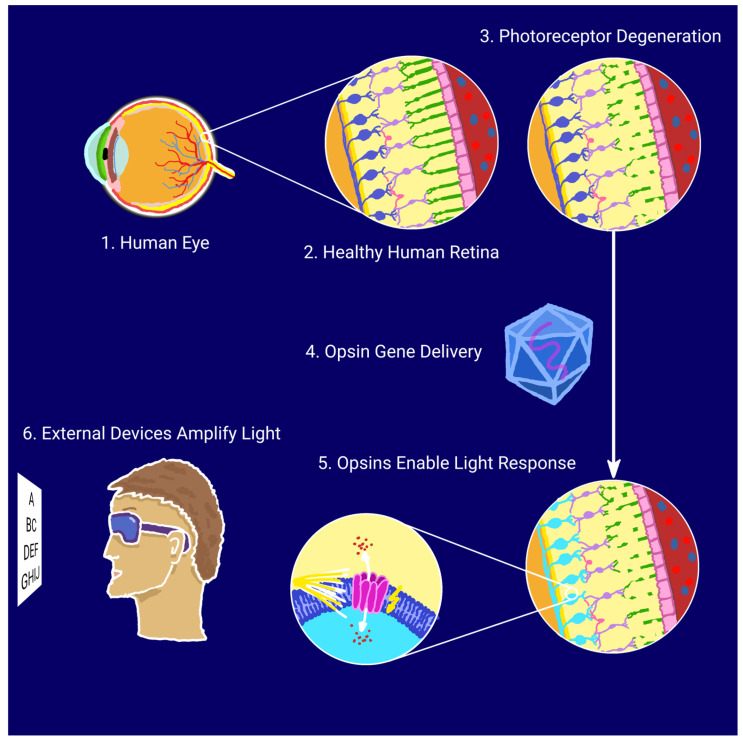
Source: Poboży K et al. Evolution of Light-Sensitive Proteins in Optogenetic Approaches for Vision Restoration: A Comprehensive Review. Biomedicines. 2025;13(2):429. Figure 1. Source / CC BY 4.0. Used without alteration.
It Can Also Be Applied to Hearing
A similar idea is being applied to hearing.
Current cochlear implants stimulate the auditory nerve electrically.
But electrical current spreads into surrounding areas, limiting how precisely different groups of nerves can be stimulated.
Light stimulation is expected to make it possible to distinguish and stimulate narrower regions.
Ultimately, Its Meaning Goes Beyond a Treatment
The greatest significance of this Nobel Prize is that the technology changed how we study the brain itself.
Before, researchers could say, “This behavior occurred when this neuron was active.”
Now, they can test, “I switched this neuron on myself, and this behavior occurred.”
There is an enormous difference between the two.
One is observation. The other is an experiment that directly intervenes in a potential cause.
And It All Began with Tiny Green Algae
This is what I find most fascinating about this research.
A technology used to understand the human brain did not arise from studying the brain in the first place.
It began with a protein discovered while studying how tiny green algae detect light.
Introducing that protein into neurons made it possible to control selected types of nerve cells with light.
In a little over 20 years, the technology became one of the most important tools in modern neuroscience, ultimately leading to the 2026 Nobel Prize in Physiology or Medicine.
It is an example of why basic science matters.
I practice medicine now, but I previously graduated with a degree in physics.
I had many exceptionally bright classmates, but it was difficult to pursue research properly in Korea, so most moved abroad and established themselves there.
Those who were a little less bright took jobs at large companies to make a living. :)
The small question “How do green algae follow light?” became a tool for testing the much bigger question “How are human memories and emotions formed?”
Basic science may seem to have no immediate payoff, yet it can later become research that greatly benefits humanity.
I hope investment in basic science increases, and that Korea, too, will produce a Nobel Prize-winning scientist.
References
#NobelPrize #NobelPrizeInPhysiologyOrMedicine #Optogenetics #BrainScience #Neuroscience #Channelrhodopsin #VisionRestoration #RetinitisPigmentosa #BasicScience #ReverseEntropy