I have one rule when choosing supplements or anti-aging medicines: “If the benefit is unclear, I would rather leave it out.”
Oral collagen falls into that uncertain territory. My answer upfront is that I do not advise someone concerned about skin aging to start by buying an expensive collagen product. The reliable clinical evidence is still too limited to justify spending money every month expecting better wrinkles and firmness. [1] [2]
Words such as “low molecular weight,” “ultra-low molecular weight,” “marine collagen,” and “absorption” make it sound as though a product will travel efficiently to the skin. There are plenty of studies, too. What I most want to know is whether the positive findings recur in independent, rigorous research. Let me walk through the evidence.

1. Pooling 23 trials gave a different answer from separating them
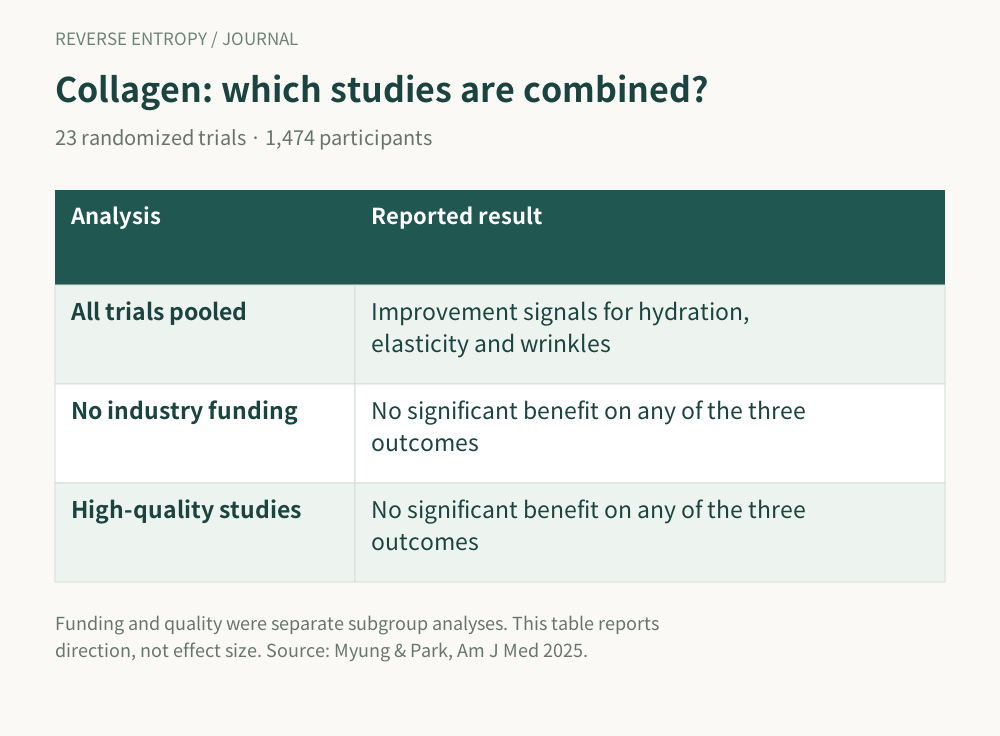
A study published in the American Journal of Medicine in 2025 combined 23 randomized trials involving 1,474 participants. When all the trials were pooled, there were signals of improvement in skin hydration, elasticity, and wrinkles.
But when the researchers analyzed only studies without company funding, none of those three outcomes showed a significant benefit. A separate analysis by study quality also found no significant benefit among the high-quality studies. [1]
In other words, the positive results were concentrated in the company-funded and lower-quality research. That is not a reassuring pattern.
2. What does an improvement in “skin elasticity” actually mean?
Skin research uses several measures of elasticity. Some assess how well skin returns after being pulled; others assess how readily it stretches. They can be measuring different properties.
A reanalysis published in September 2026 examined the underlying data handling and methods in collagen meta-analyses from 2021 and 2023. The authors pointed to incorrectly transcribed data, confusion between measures of variability, and the pooling of skin measurements that mean different things. Their concern was that these problems could exaggerate positive effects. [2]
There is another distinction that matters to consumers: is a small change detected by a machine large enough for someone looking in the mirror to notice? Moving from a hydration or elasticity reading to claims about deep wrinkles or facial sagging requires studies that directly measure those outcomes.
3. Does low-molecular-weight collagen change the answer?
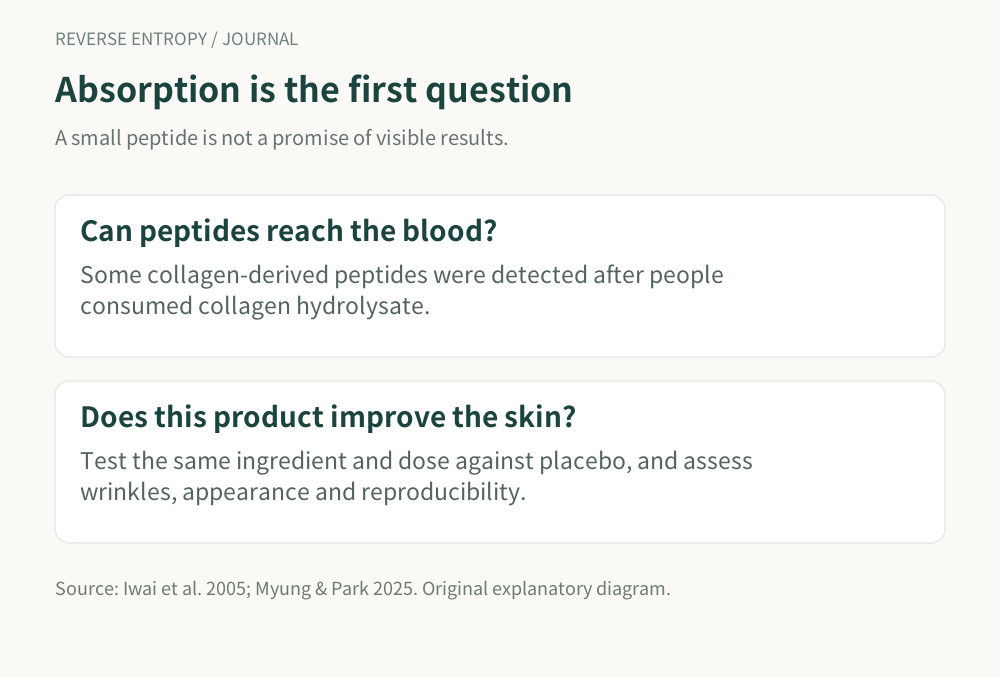
“Low molecular weight” means collagen has been broken into small fragments. Human feeding studies have detected some collagen-derived peptides in the blood after collagen hydrolysate was consumed. There is evidence that some of these small fragments are absorbed. [3]
The next question is: “How much did the skin of the people taking that particular product actually improve?”
There are positive trials. A randomized trial of 70 people published in 2025 reported improvements in wrinkles and elasticity after eight weeks of a particular low-molecular-weight collagen ingredient at 1,650 mg a day. However, this too was a short, manufacturer-funded trial of a specific ingredient. The ingredient, dose, and duration all matter. [4]
When choosing a product, I would ask:
- Was the same ingredient tested at the same daily dose?
- Was it compared with a placebo in people?
- Did only hydration readings change, or were the wrinkles and appearance I care about also measured?
- Was the result reproduced in another study?
The words “low molecular weight” do not answer those questions.
4. How I would prioritize a skincare budget
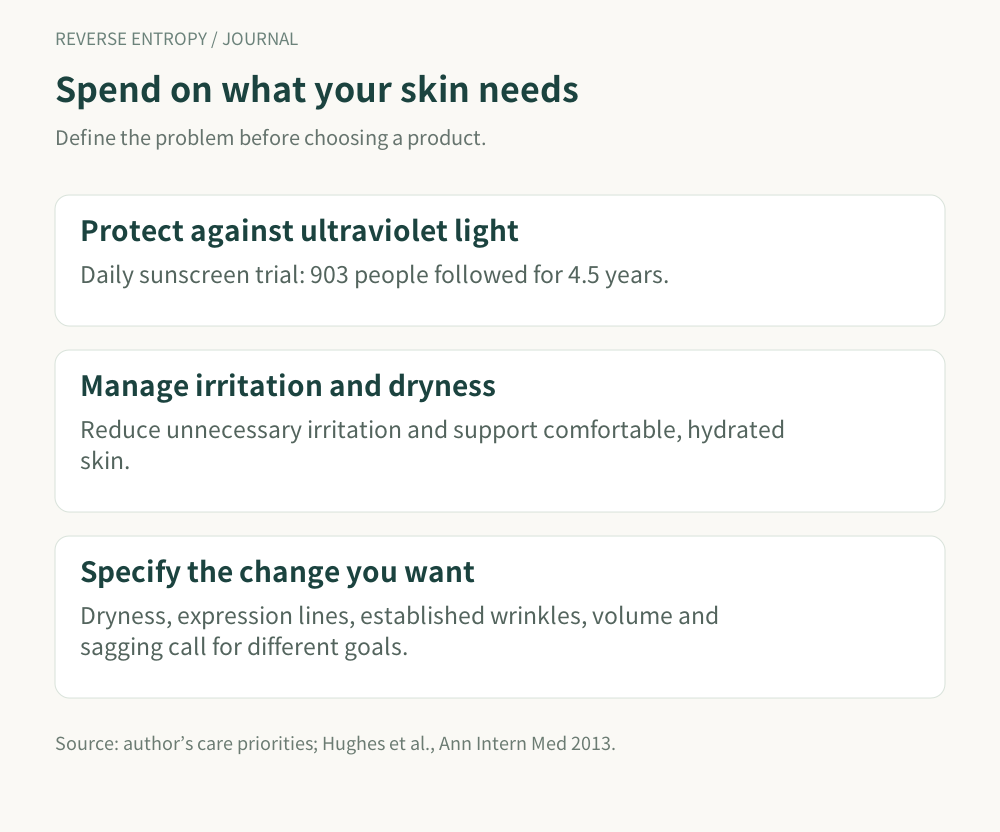
I would first check the basics: reducing unnecessary irritation, managing dryness, and protecting the skin from ultraviolet light. In my clinical priorities, radiofrequency treatment at an appropriate energy level and botulinum toxin for expression lines also come first.
Sunscreen has evidence from a long-term randomized human trial. In a study following 903 people for 4.5 years, skin aging progressed less in those assigned to use sunscreen routinely than in those who used it at their discretion. [5]
The next step is to define the concern. Dryness, lines that appear with facial expression, established deep wrinkles, and changes in volume or sagging are different problems with different goals. This helps direct time and money toward care that your skin actually needs.
Decide what you expect before you follow the advertising
Some oral-collagen trials have reported positive findings. The consumer’s task is to decide what level of expectation and cost is reasonable for that possibility.
I do not see oral collagen as an essential skin anti-aging supplement that everyone needs. You might choose a specific product hoping for a small improvement, but there is too little evidence to recommend repeatedly buying expensive products in expectation of clear wrinkle reduction or lifting.
From the standpoint of supplying collagen building materials, I think taking it for a few weeks after a radiofrequency procedure can be reasonable. But when allocating the money and time you spend on your skin, I would place it later in the order of priorities.
References
- Myung SK, Park Y. Effects of Collagen Supplements on Skin Aging: A Systematic Review and Meta-Analysis of Randomized Controlled Trials. Am J Med. First online May 3, 2025. DOI: 10.1016/j.amjmed.2025.04.034. [1]
- Grimes DR, Mahto A. Hydrolyzed Collagen for Skin Aging Meta-Analyses Are Unreliable. J Cosmet Dermatol. First published September 28, 2026. DOI: 10.1111/jocd.71208. [2]
- Iwai K, et al. Identification of food-derived collagen peptides in human blood after oral ingestion of gelatin hydrolysates. J Agric Food Chem. 2005. DOI: 10.1021/jf050206p. [3]
- Lee E, et al. Skin Anti-Aging and Moisturizing Effects of Low-Molecular-Weight Collagen Peptide Supplementation in Healthy Adults: A Randomized, Double-Blind, Placebo-Controlled Clinical Trial. J Microbiol Biotechnol. 2025. DOI: 10.4014/jmb.2507.07008. [4]
- Hughes MCB, et al. Sunscreen and prevention of skin aging: a randomized trial. Ann Intern Med. 2013. DOI: 10.7326/0003-4819-158-11-201306040-00002. [5]