I previously wrote about what happens when a younger person’s organ is transplanted into an older person. Read: Would a Young Transplanted Organ Make You Younger?
The result was a little unexpected: the younger transplanted organ deteriorated instead. But what if we transferred blood, rather than an organ? Could transfusing a young person’s blood make an older person young again?
It sounds rather far-fetched, but scientists really have studied how a young circulating environment affects aged tissues. A landmark experiment was published in 2005: joining the circulation of young and old mice improved regeneration-related functions in the old animals’ muscles and liver. Was there some special rejuvenating substance in young blood?
Fifteen years later, the field asked a different question: Do we really need young blood? Could changing the environment of old blood be enough?
A 2020 study tested that question directly. Remarkably, several tissues changed in old mice without giving them young blood.
1. It began with an experiment joining two mice’s circulation
In the 2005 study, the researchers surgically joined a young mouse and an old mouse so that they shared a circulation. This is called heterochronic parabiosis. You do not need to remember the name; think of it as an experiment allowing mice of different ages to share substances circulating in their blood. [1]
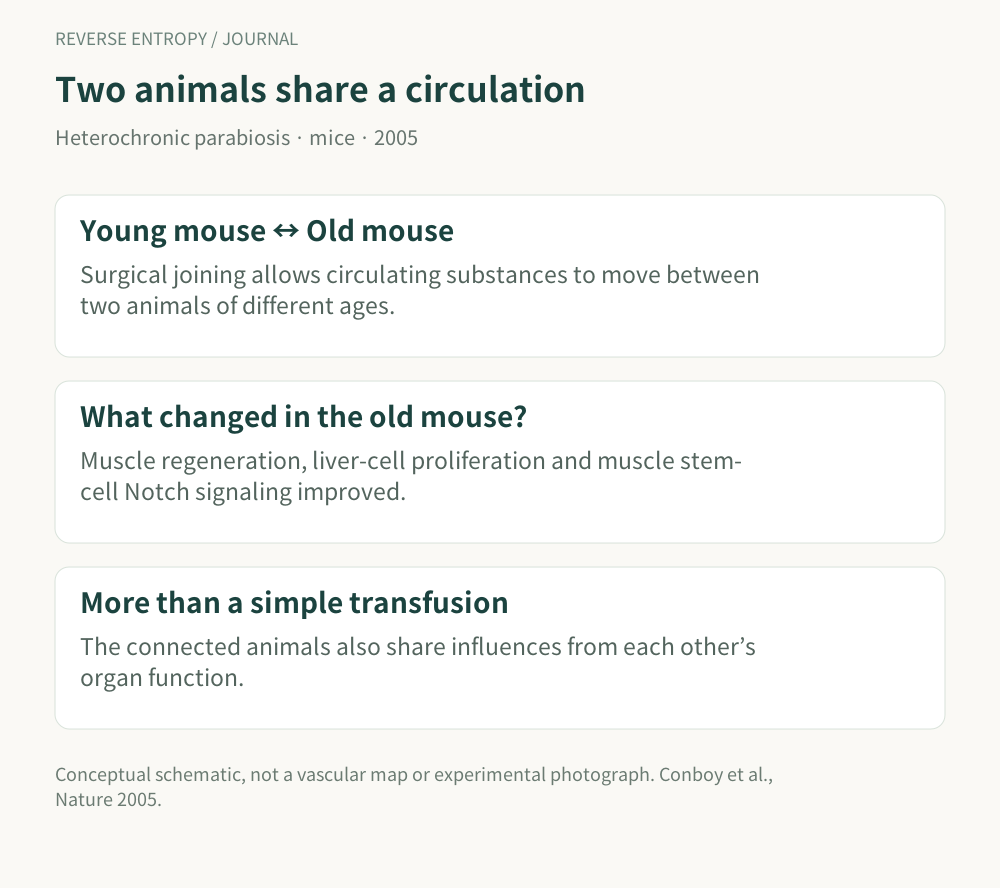
In the old mice, injured muscle regenerated better and liver-cell proliferation increased. The researchers also observed restoration of Notch signaling, which is important for muscle stem-cell activity.
This showed an important possibility: old stem cells may not be permanently unable to work. Changing their surroundings could reveal regenerative capacity that was still there.
2. Did adding something young help—or did diluting something old?
Joining a young mouse to an old one changes two things at once. Young blood components enter the old mouse, while components of the old mouse’s blood are mixed and change concentration.
Did a helpful substance arrive? Or did something that inhibited regeneration become less concentrated? Both could contribute. To learn whether young blood is necessary, however, you must ask whether change can happen without it.
3. So the researchers did not use young blood
In 2020, the Berkeley researchers exchanged approximately 50% of the plasma fraction in old mice. This does not mean they threw away half of all the blood.
Plasma is the liquid part of blood, apart from cellular components such as red and white blood cells. It contains countless proteins, hormones, nutrients, and signaling molecules. [2]
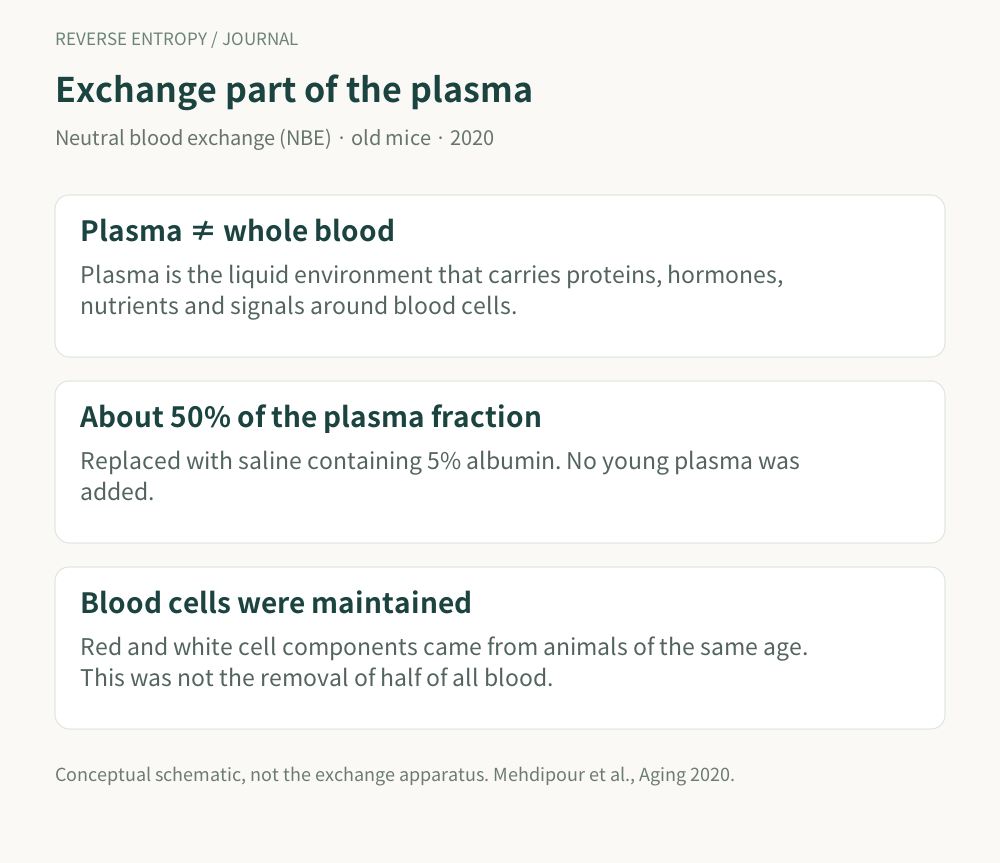
The researchers replaced the removed plasma with saline containing 5% albumin. Albumin is a protein that helps maintain fluid balance within blood vessels and transports many substances.
They did not bring in plasma from young animals. They diluted existing plasma components and replaced the albumin that would otherwise be reduced along with them. The method was called neutral blood exchange, or NBE.
More precisely, this experiment exchanged a platelet-rich plasma fraction. Cellular components such as red and white blood cells were maintained using components obtained from animals of the same age.
The main point is simple: they changed the liquid environment of old blood without adding young blood.
4. Injured muscle recovered better
Muscle stem cells become active after injury and help repair the tissue. This capacity declines with age. In the old mice receiving plasma exchange, regeneration after muscle injury improved, with changes in newly formed muscle fibers, fibrosis, and other measures.
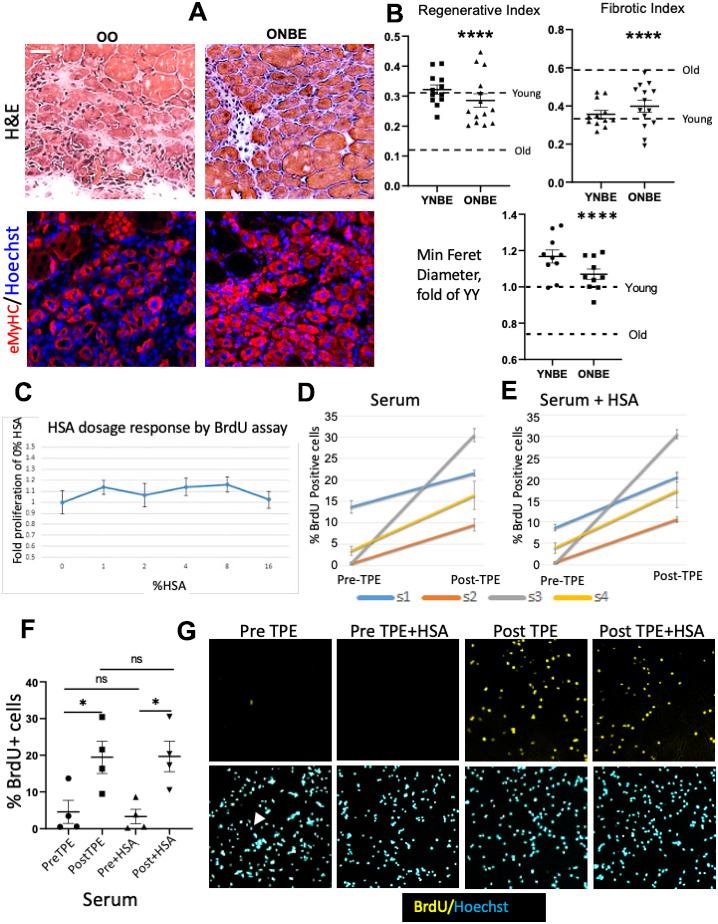
The striking point was that young blood was not required. The researchers interpreted some of the regenerative effects as potentially comparable to, or greater than, those seen in earlier young-blood-sharing studies. That comparison was across different experiments; it was not a human trial comparing which treatment works better.
The mouse experiment demonstrated that changing the blood environment could alter the regenerative capacity of aged tissue.
5. The liver and brain changed too
The effects were not limited to muscle. In the liver, tissue measures related to fat accumulation and fibrosis decreased. In the brain, measures related to neurogenesis increased in the hippocampus, a region important for memory and learning.
Muscle, liver, and brain have different jobs. It is intriguing that changes appeared in several tissues after the circulating environment was altered.
6. What was reduced that made the difference?
Blood carries signals that tell cells to grow, and signals that restrain their activity. That balance can change with age.
Protein analyses before and after plasma exchange found changes in the concentrations of many proteins. Interestingly, some increased. The experiment did not simply leave every component at half its previous level.
The researchers proposed that interactions and feedback between signaling molecules could readjust the body’s signaling environment after dilution.
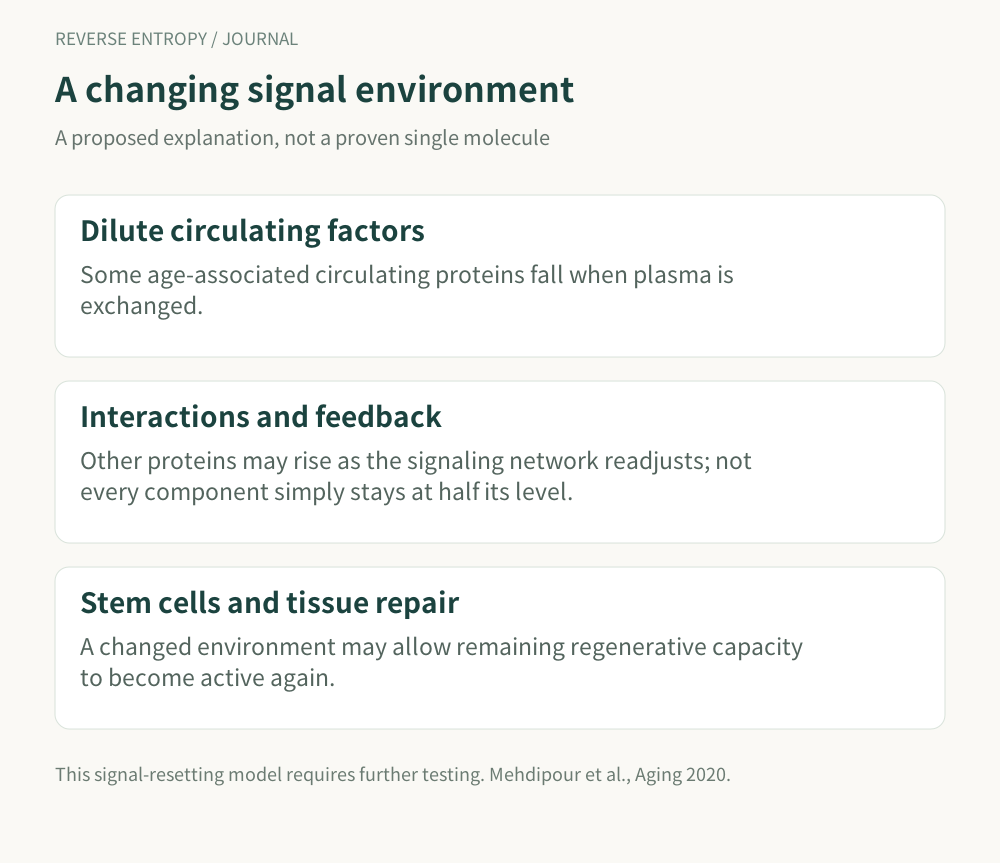
Put simply, reducing signals that suppress regeneration may change other signals as well.
7. The circulating environment can affect several organs together
We tend to think of aging organ by organ: muscle itself ages, the liver itself ages, and the brain itself ages. Aging does occur within each tissue and cell.
But blood circulates throughout the body, and its signals can influence several tissues. A decline in an organ’s ability to recover may therefore involve more than a problem inside that organ.
The environment circulating through the whole body may be suppressing the regenerative capacity of several tissues at once. This research supports that possibility.
8. Plasma exchange has also been studied in people
For a time, some Silicon Valley billionaires attracted attention for trying transfusions of young blood in pursuit of rejuvenation. The research above invites a different interpretation: perhaps a shortage of “young substances” is only part of the story, and age-associated inflammatory signals and proteins may also be obstructing cellular repair.
One way to picture the idea is an aquarium: adding a cup of clean water may do less than changing the water itself. This is an analogy for the hypothesis, rather than proof of a single cause of aging.
A human clinical trial involving the Buck Institute, published in Aging Cell in 2025, provides early evidence relevant to this question. Forty-two participants completed the study. At an intermediate assessment, monthly therapeutic plasma exchange was associated with an average reduction of about 1.3 years in biological age estimated from clocks; biweekly exchange combined with intravenous immunoglobulin showed about 2.6 years. These were biomarker estimates, and the differences from the sham group were no longer statistically significant at the later assessment. [3]
The procedure removes plasma and replaces it with fluids and albumin. The study also found changes in immune-cell composition and proteins associated with chronic inflammation, consistent with a shift in some age-related biological patterns.
Does that mean everyone should immediately have their plasma filtered? A closer look at the data is less straightforward. The earlier changes did not remain clearly different from sham treatment after additional sessions.
Exploratory analyses also suggested greater responses in people with less favorable starting health markers, including metabolic and inflammatory measures. For someone who already manages their health well, I would be concerned that the potential benefit may not outweigh the downsides. Useful immune components and some medications can also be removed during treatment. I therefore see this as an area for medical treatment and research, rather than routine maintenance for healthy people.
9. From “What should we add?” to “What should we adjust?”
When we think about anti-aging, we often think of adding something: more nutrients, replacement hormones, or substances that support regeneration. This research asks another question: not only what should be added, but what should be reduced or adjusted?
Diluting an aged blood environment changed functions associated with tissue regeneration. That does not mean removing every aging-related substance would be beneficial. Blood contains many essential proteins. The same molecule can be helpful or harmful depending on the setting.
The goal is to understand the balance of signals that changes with age, rather than indiscriminately removing them.
Before adding something young, could we change what stands in the way of repair?
The 2005 study showed that a young systemic environment could alter regeneration-related functions in old tissues. The 2020 study showed changes in a similar direction in some tissues without adding young blood.
This does not mean beneficial factors in young blood are unimportant. It means young blood was not necessary to obtain the particular results of that experiment.
For me, this widens the questions we ask about aging. Is a shortage of helpful substances the only problem? Or does the environment also suppress recovery abilities we already possess?
Do we fail to recover because we are old—or because we are living in an environment that makes recovery difficult?
Perhaps both are true. If some of that environment can be changed, older tissues may retain repair capacity that has not yet been brought back into use.
Alongside treatments that add something new, there may be treatments that help what we already have work again. I look forward to research testing whether this possibility improves real patients’ function and health.
References
- Conboy IM, Conboy MJ, Wagers AJ, et al. Rejuvenation of aged progenitor cells by exposure to a young systemic environment. Nature. 2005;433:760–764. February 17, 2005. [1]
- Mehdipour M, Skinner C, Wong N, et al. Rejuvenation of three germ layers tissues by exchanging old blood plasma with saline-albumin. Aging. 2020;12:8790–8819. May 30, 2020. [2] Full text · PMC
- Fuentealba M, et al. Multi-Omics Analysis Reveals Biomarkers That Contribute to Biological Age Rejuvenation in Response to Single-Blinded Randomized Placebo-Controlled Therapeutic Plasma Exchange. Aging Cell. 2025;24:e70103. [3] Full text