Recently, we often hear that taking acid-suppressing medication for a long time increases the risk of dementia.
A Korean study has now even reported that the risk of Parkinson’s disease may more than double.
On October 23, 2026, Korean researchers published a study in Scientific Reports analyzing the association between acid-suppressing medication use and Parkinson’s disease.
Among adults aged 40 and over, the hazard ratio for Parkinson’s disease was 2.24 in the group with at least 180 cumulative days of use.
If you regularly take stomach medication, this is understandably unsettling. It sounds as though a medicine taken to ease your stomach could cause problems for your brain health.
To give you my conclusion first: you do not need to stop a necessary medication because of the “twofold” figure in this study.
Let us look step by step at why I reached that conclusion.

1. The acid-suppressing medications discussed here are PPIs
There are many types of stomach medication. This article focuses on PPIs, or proton pump inhibitors.
These drugs reduce stomach acid secretion by inhibiting the pump involved in the final step of acid secretion in the stomach. They include omeprazole, esomeprazole, pantoprazole, lansoprazole, and rabeprazole.
They are used to treat gastroesophageal reflux disease and peptic ulcers and to protect the gastrointestinal tract in patients at high risk of bleeding. By reducing stomach acid, they help damaged mucosa heal. Their therapeutic effectiveness is well established.
Because they are widely used, research into the safety of long-term use continues. Studies on dementia and Parkinson’s disease are part of that research.
2. In whom was the “2.24-fold” figure observed?
The participants were adults aged 40 and over with upper gastrointestinal disorders, identified in National Health Insurance data. The researchers examined PPI use during the 7 years before the index date.
In the group with at least 180 cumulative days of use, one analysis found a hazard ratio of 2.24 for Parkinson’s disease. Here, 180 days means the total number of days of use across 7 years.
The paper also reports other results.
The hazard ratio comparing all PPI users with nonusers was 0.95, with no statistically significant increase in risk. When those with at least 180 cumulative days of use were compared using a different method, the hazard ratio was 1.25, which was also not statistically significant.
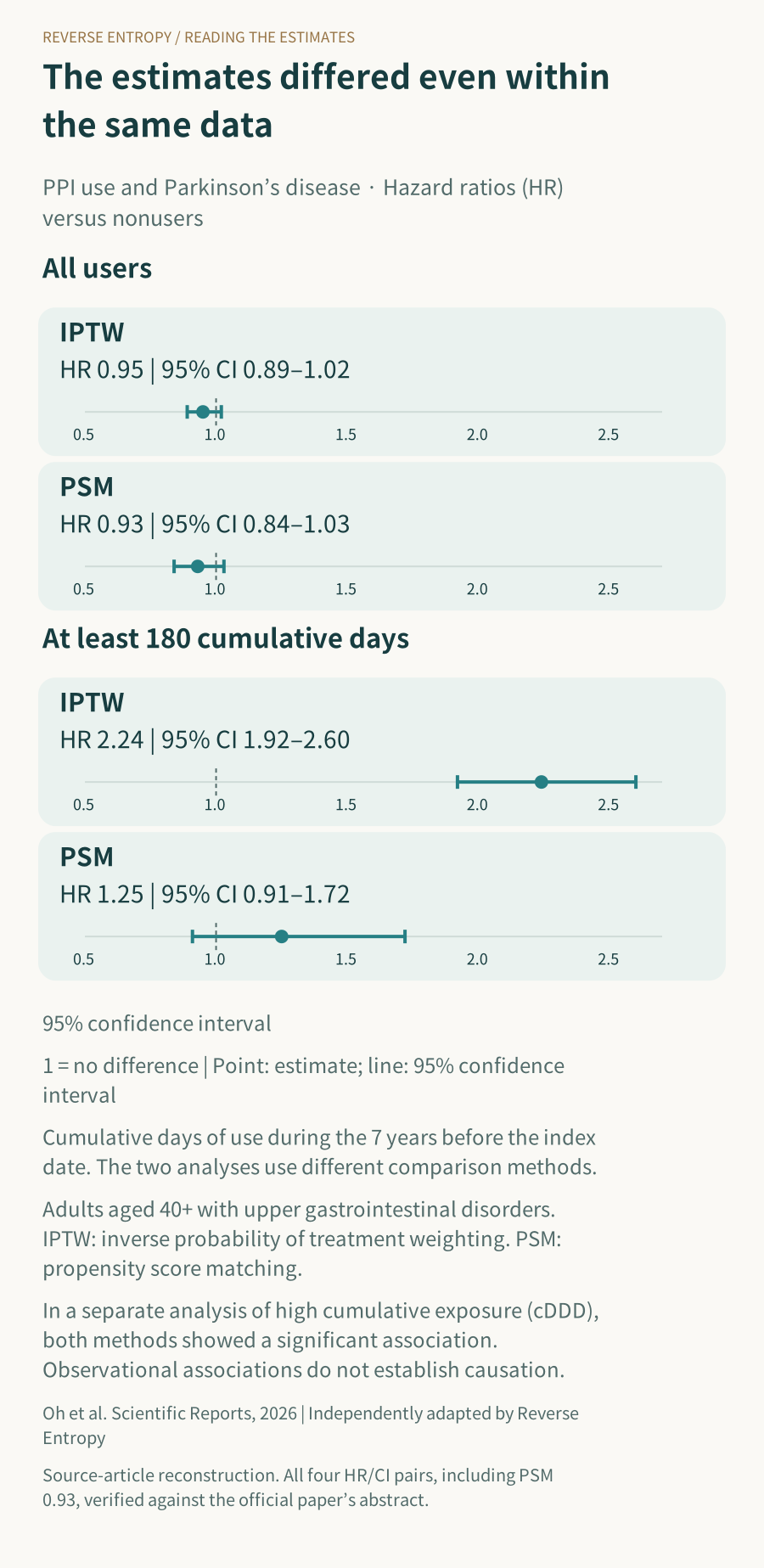
Source: Oh et al., Scientific Reports, 2026. Created by Reverse Entropy using figures from the publicly available abstract and supplementary tables. Original image source. Original graphic by Reverse Entropy.
The researchers used two methods to reduce differences in age, comorbidities, and other factors. One assigns statistical weights to individuals (IPTW); the other matches people with similar characteristics (PSM). The estimates differed as the people included in the comparisons and the calculation methods changed.
In a separate analysis of cumulative exposure, both methods showed significant associations at high exposure levels. The signal observed with long-term use therefore warrants further examination. However, these results cannot be read directly as “everyone who takes a PPI has twice the risk of Parkinson’s disease.”
The reason also relates to the study’s design.
3. Did the medication cause the disease, or did early changes from the disease lead to medication use?
This was not a clinical trial in which people were randomly assigned a PPI or a placebo. It was an observational study comparing previously recorded prescription and diagnosis data.
The important question here is: “Is the difference between the two groups due to the medication, or to the reason they took it?”
In Parkinson’s disease, gastrointestinal function can change before hand tremor or slowed movement appears. Indeed, studies have reported associations between gastrointestinal problems such as constipation or delayed gastric emptying and a subsequent diagnosis of Parkinson’s disease.
We can therefore consider another possible sequence. Gastrointestinal problems develop before Parkinson’s disease has been diagnosed, medical visits and prescriptions increase, and Parkinson’s disease is diagnosed later.
The records make it look as though medication was taken first and the disease arose afterward. In reality, however, the disease may have come first and created the need for medication. This is called reverse causation.
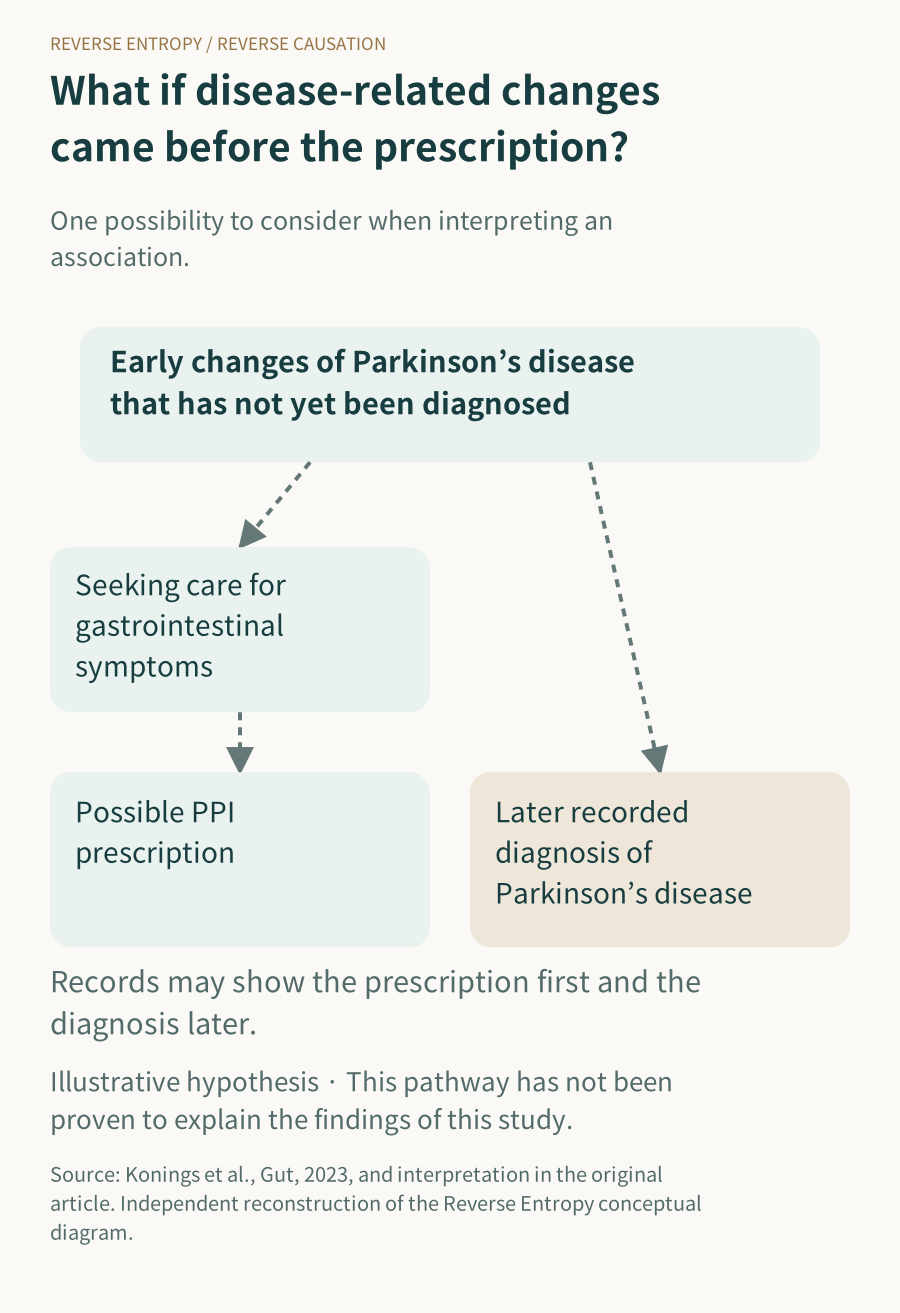
Source: Created by Reverse Entropy based on the study of gastrointestinal disorders preceding diagnosis by Konings et al., Gut, 2023, and the interpretation in this article. Original image source. Original graphic by Reverse Entropy.
4. Why have dementia studies produced different results?
The debate about dementia predates this Parkinson’s disease study.
A 2016 German study analyzed 73,679 adults aged 75 and over. It attracted considerable attention after reporting a hazard ratio of 1.44 for incident dementia among regular PPI users.
However, PPI users had other differing characteristics from the outset. Depression and ischemic heart disease were more common, and a higher proportion took multiple medications. Even if researchers statistically adjust for these differences, they cannot make all unrecorded health conditions and lifestyle habits identical.
Studies that carefully check medication use, directly assess cognitive function, and follow participants over time help reduce these problems.
A study published in 2023 analyzed 18,934 older adults who participated in ASPREE. Medication use was checked regularly, and dementia was assessed through cognitive testing and expert adjudication.
This analysis found no significant association between PPI use and incident dementia. Including extended follow-up data produced a similar result: a hazard ratio of 0.91 and a 95% confidence interval of 0.78–1.07.
The initial finding of increased risk was not consistently reproduced in studies conducted under different conditions. That is why I think it is important to look at multiple studies together.
5. One study combined data from more than 6.3 million people
A meta-analysis published in Brain Sciences on January 29, 2026, combined 18 observational studies involving a total of 6,325,898 people.
The pooled relative risk reported by the researchers was 1.14 in the overall analysis and 1.03 in the Alzheimer’s disease analysis. In both cases, the 95% confidence interval included 1, so no statistically significant increase in risk was established.
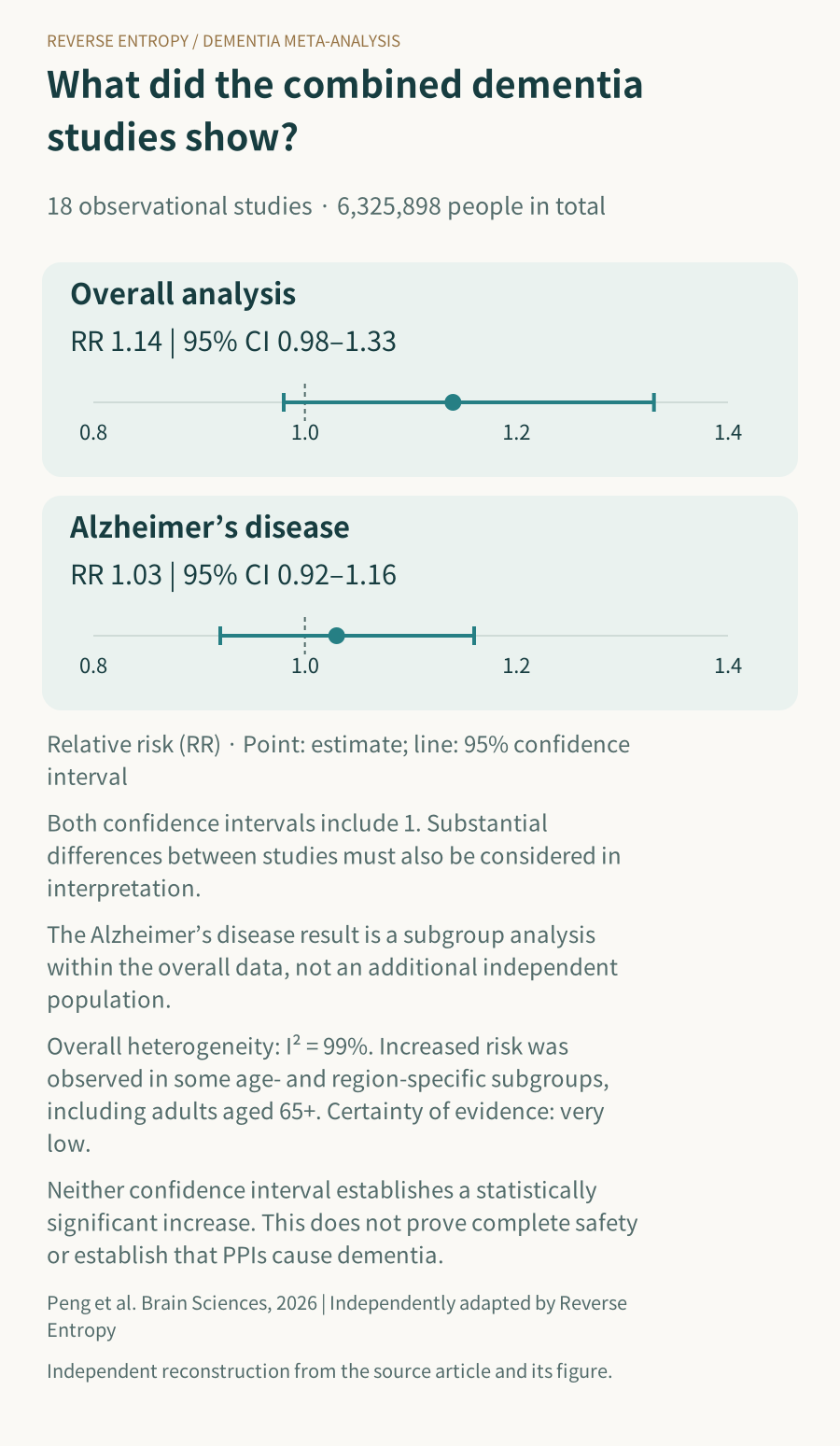
Source: Peng et al., Brain Sciences, 2026. Created by Reverse Entropy using the published estimates and confidence intervals. Original image source. Original graphic by Reverse Entropy.
When reading this analysis, we need to consider differences between studies as well as the number of participants. Heterogeneity between study results was very high, and increased risk was observed in subgroup analyses of people aged 65 and over or certain regions. The researchers also rated the certainty of the evidence as very low.
The conclusion I draw from this analysis is therefore that “there is still no consistent, certain evidence that PPIs cause dementia.” There is no need to stretch this into a claim that safety has been proven completely, nor to become alarmed solely by a large figure from one particular study.
The evidence for dementia and Parkinson’s disease needs to be considered separately. Nevertheless, the data so far, taken together, do not support stopping a necessary PPI solely out of fear of these diseases.
6. Even so, I think unnecessary PPI use should be reduced
I would like to add one more personal view here.
Even aside from dementia or Parkinson’s disease, I think it is best to avoid taking PPIs unless they are truly needed, and when they are needed, to define the dose and duration required for treatment.
Stomach acid performs functions our bodies need. It helps digest protein, contributes to defense against microorganisms entering with food, and affects the process by which we use vitamin B12 in food.
Strong acid suppression brings changes of its own. In some patients taking these drugs long term, vitamin B12 deficiency or hypomagnesemia needs to be considered, along with the risk of intestinal infections.
I am not presenting another list of adverse effects to make you afraid of medication. I mean that we should check whether a therapeutic reason for continuing it remains.
Even if a medicine was necessary when first prescribed, continuing the same dose may no longer be necessary once treatment is complete. It is worth periodically revisiting whether the reason for starting it and the reason for continuing it are still the same.
7. We need to distinguish people who can reduce treatment from those who still need it
In 2022, the American Gastroenterological Association (AGA) recommended regularly reviewing the reason for ongoing PPI use and considering discontinuation if there is no clear indication for long-term treatment.
It also emphasized that the decision to stop should be based on whether treatment is currently needed, rather than on vague concerns about adverse effects.
If you had only reflux symptoms, without erosive esophagitis or Barrett’s esophagus, and your symptoms became well controlled after treatment, stopping medication or using it only as needed can be considered. If maintenance treatment is necessary, the aim is to find the lowest effective dose that controls symptoms and maintains mucosal healing.
Conversely, long-term treatment may be necessary in people with severe erosive esophagitis, esophageal ulcers or strictures, Barrett’s esophagus, or a high risk of gastrointestinal bleeding. For these people, regular use plays an important protective role.
If there is room to reduce medication, lifestyle habits can also be reviewed. Losing weight if you are overweight, avoiding food for 2–3 hours before bedtime, and elevating the head of the bed if you have nighttime symptoms may help. If symptoms repeatedly occur after eating a particular food, you can also consider adjusting your intake of it.
The conclusion I would like to leave you with
“Twice the risk” is a striking figure. Its meaning changes, however, when we examine who the result applies to, what they were compared with, and whether other studies reproduce it.
Simply taking a PPI is not a reason to become very worried about dementia or Parkinson’s disease and stop necessary treatment.
Instead, consider asking this at your next appointment:
“Is there still a reason I need to keep taking this medication? Am I in a position to try reducing the dose or stopping it?”
References
1. Oh D, Cheon S, Lee KE, Chung JE. Cumulative proton pump inhibitor exposure and risk of Parkinson’s disease: a nationwide cohort study. Scientific Reports. 2026.10.23. Paper
2. Gomm W, et al. Association of Proton Pump Inhibitors With Risk of Dementia: A Pharmacoepidemiological Claims Data Analysis. JAMA Neurology. 2016;73:410–416. Paper
3. Mehta R, et al. Association of Proton Pump Inhibitor Use With Incident Dementia and Cognitive Decline in Older Adults: A Prospective Cohort Study. Gastroenterology. 2023;165:564–572.e1. Paper
4. Peng TR, et al. Inconsistency in the Association Between Proton Pump Inhibitor Use and Dementia Risk: An Updated Meta-Analysis. Brain Sciences. 2026;16(2):159. Paper
5. Targownik LE, et al. AGA Clinical Practice Update on De-Prescribing of Proton Pump Inhibitors: Expert Review. Gastroenterology. 2022. Recommendations
6. Katz PO, et al. ACG Clinical Guideline for the Diagnosis and Management of Gastroesophageal Reflux Disease. American Journal of Gastroenterology. 2022. Guideline
7. Konings B, et al. Gastrointestinal syndromes preceding a diagnosis of Parkinson’s disease: testing Braak’s hypothesis using a nationwide database for comparison with Alzheimer’s disease and cerebrovascular diseases. Gut. 2023. Paper
8. PROTONIX (pantoprazole) US prescribing information. DailyMed. Precautions concerning vitamin B12 deficiency, hypomagnesemia, and infections. Prescribing information
#AcidSuppressants #PPI #Dementia #AlzheimersDisease #ParkinsonsDisease #RefluxEsophagitis #StomachMedication #DrugSideEffects #MedicalResearch #HealthKnowledge #AntiAging #ReverseEntropy #CheongdamHuin