Hello! Today I want to share some very welcome news that the medical community has been waiting a long time to hear.
It is the arrival of a new treatment for herpes simplex virus (HSV) after roughly three decades.
For people who have struggled with cold sores and other herpes symptoms, the most familiar names are probably acyclovir and valacyclovir. But the acyclovir family dates all the way back to the 1970s.
For more than 30 years, we have largely relied on related drugs, with improvements such as better absorption.
Now a new generation of helicase–primase inhibitors, which interrupt viral replication in a different way, has reached the final stages of clinical development and is beginning to change the treatment landscape.
A leading drug in this group, pritelivir, received US FDA approval on October 9, 2026.
For people with recurring herpes, the most pressing questions are probably these:
“Can this one cure it? If I switch from my current medicine, will I have fewer recurrences?”
First, this is not a cure. It is a new oral treatment for patients whose infection has been difficult to manage with existing medicines.
The approved population is immunocompromised adults with HSV lesions of the skin or mucous membranes that have not responded to other treatments.
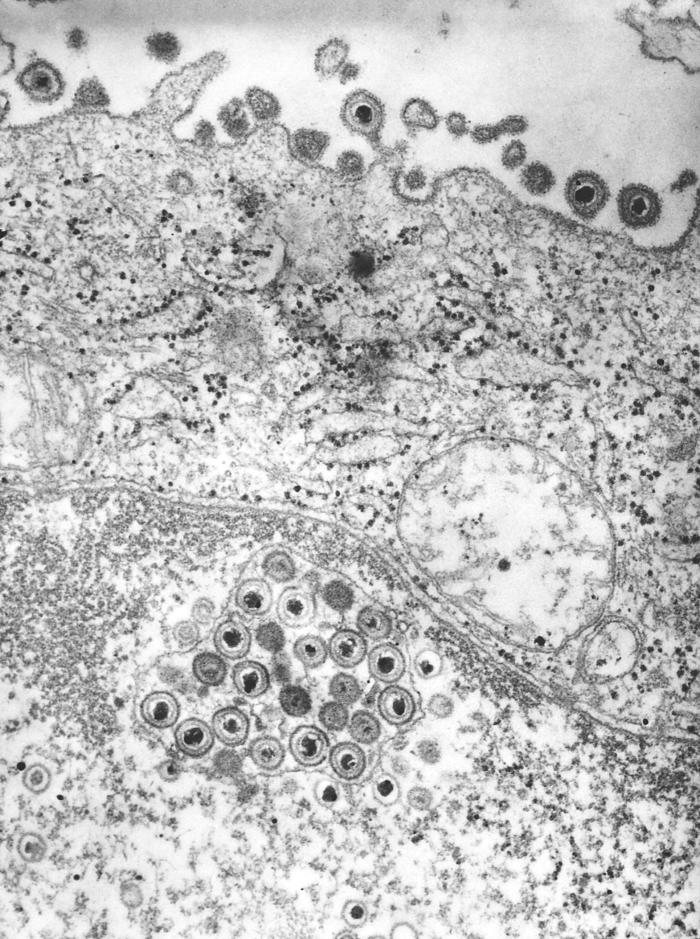
Source: CDC / Dr. Fred Murphy; Sylvia Whitfield, 1975. PHIL #10260.
One common misunderstanding comes up often with patients: if herpes returns after taking medication, does that mean the virus has become resistant?
Not necessarily. Recurrence and drug resistance are not the same thing.
After symptoms settle, HSV can remain dormant in nerve ganglia. Existing antivirals suppress actively replicating virus, but they do not eliminate the latent virus. So improving with treatment and then developing blisters again later does not, by itself, mean that the medicine no longer works.
The medicines commonly used today are acyclovir, valacyclovir, and famciclovir. People may take a short course when an outbreak occurs, or take daily suppressive treatment if recurrences are too frequent.
Although uncommon, resistance can develop during treatment, leaving these drugs ineffective.
For those patients, treatment options during an outbreak are limited. They may need hospital-based intravenous drugs with substantial side effects.
This new medicine could be a major help for them.
Three advantages of the new drug
1. A substantial reduction in viral shedding
HSV can be released even when there are no symptoms. In a short comparative trial, pritelivir reduced HSV-2 shedding to less than half the level seen with valacyclovir. This is encouraging, although a reduction in shedding is not the same as directly proving a reduction in transmission to partners.
2. Activity against viruses resistant to existing treatment
Pritelivir has shown meaningful antiviral activity in immunocompromised patients, including transplant recipients and people with HIV, whose HSV has been difficult to treat with acyclovir-based medicines.
3. Fewer days with lesions and improved healing
Short-term studies found fewer days with genital lesions, and the approval trial showed improved healing in treatment-refractory patients. These findings should be distinguished from proving a lasting reduction in recurrence after treatment ends.
Comparative shedding and lesion-day study: Wald et al., JAMA, 2016
It can work even when the virus is resistant to older drugs
To multiply, a virus must copy its DNA.
Existing drugs mainly interfere with DNA polymerase, the enzyme that builds new DNA strands. Pritelivir targets the helicase–primase complex, which helps unwind the two DNA strands and make the short RNA primers needed to begin copying.
Put simply, the two drug classes block different points in the same copying process. Inside a real cell, these processes are closely coordinated.
This is why pritelivir may still work when the virus is resistant to older drugs. Unlike existing nucleoside analogues, it also does not require activation by the virus's thymidine kinase.
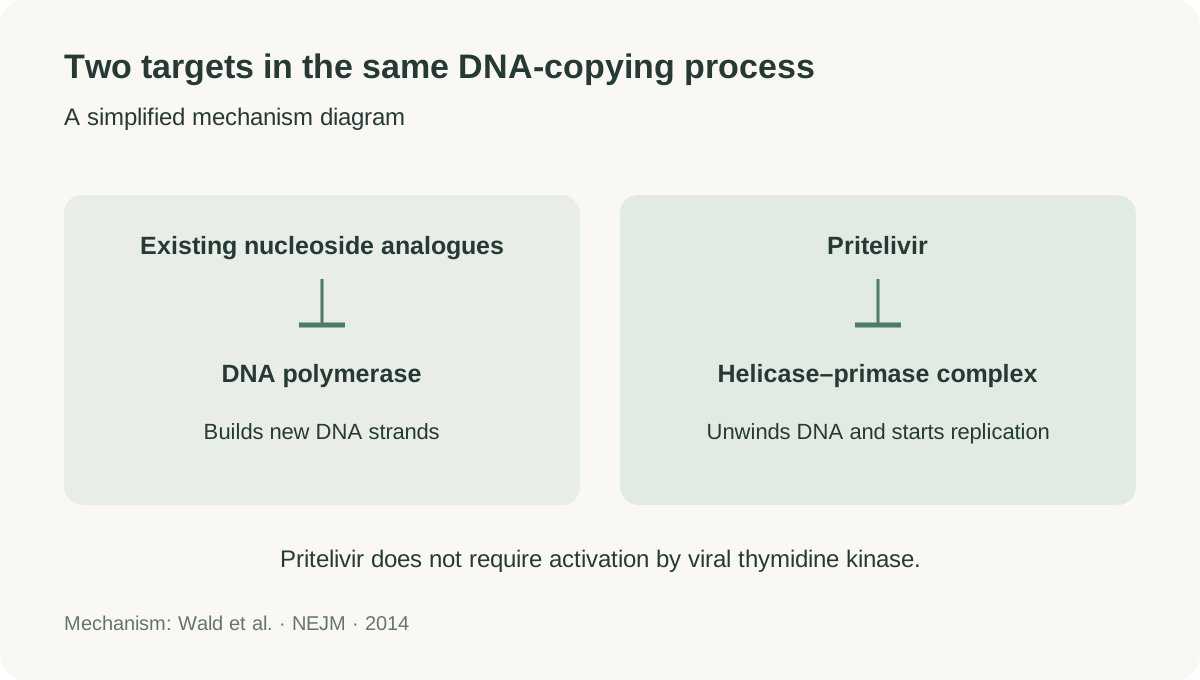
Source: Reverse Entropy. Localized explanatory diagram based on the mechanism described by Wald et al., NEJM, 2014.
Did the lesions actually heal better?
Part C of the phase 3 PRIOH-1 trial, which supported the approval, randomized 101 immunocompromised adults to pritelivir or an existing alternative treatment chosen by the investigator. This was not a placebo comparison. It was an open-label trial, meaning that participants and clinicians knew which treatment was being given.
By day 28, all lesions had healed in 63% of the pritelivir group and 34% of the comparison group, a difference of approximately 29 percentage points.
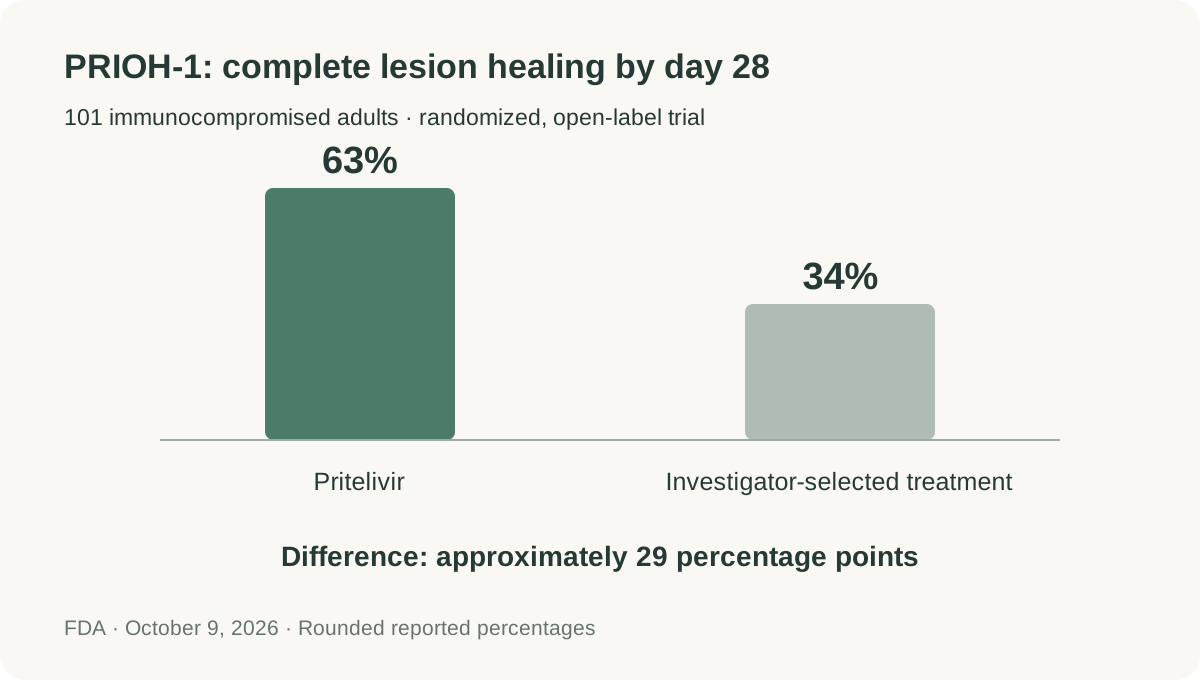
Source: FDA, October 9, 2026. Chart recreated by Reverse Entropy.
What about side effects?
Short-term comparative research did not find more side effects than with the existing oral medicine. Unlike drugs that have been used for many years, however, the new drug's long-term safety still needs continued observation.
Was it studied in people with normal immune function?
Yes, and it showed activity. A randomized placebo-controlled trial published in NEJM in 2014 enrolled 156 people with HSV-2 infection and a history of genital herpes.
Over 28 days, pritelivir reduced viral shedding and days with lesions in a dose-dependent manner.
In other words, effects were also seen in people with more typical genital herpes, even though the new approval is for the narrower population described above.
Has it been approved in South Korea?
At the time of the original Korean post, it had not yet been approved in South Korea. Following the FDA approval, I expect Korean approval may follow, although the timing is not confirmed.
Why I welcome this news
What people with recurring herpes most want is probably a treatment that prevents it from ever coming back. Unfortunately, this medicine is not a cure.
But the situation is different for patients whose lesions persist because existing drugs have not worked. Having one more option, especially an oral drug with a different mechanism, meaningfully broadens the treatment choices.
That is how I want to judge this new medicine. It has not changed treatment for every person with herpes all at once, but for some people whose infection has been difficult to treat, it is truly welcome progress.
I hope more drugs like this will follow, reducing the burden of recurrence and eventually leading toward a cure.
References
- FDA. FDA Approves Drug to Treat Lesions Caused by Herpes Simplex Virus. October 9, 2026. Approval announcement
- ClinicalTrials.gov. PRIOH-1, NCT03073967. Trial registration
- Wald A, et al. Helicase–Primase Inhibitor Pritelivir for HSV-2 Infection. NEJM. 2014;370:201–210. Original paper
- CDC. Herpes — STI Treatment Guidelines. Treatment guidelines
- Wald A, et al. Effect of Pritelivir Compared With Valacyclovir on Genital HSV-2 Shedding in Patients With Frequent Recurrences: A Randomized Clinical Trial. JAMA. 2016;316:2495–2503. Supporting comparison