Retatrutide is an investigational obesity treatment being developed by Eli Lilly.
It is a triple agonist that acts simultaneously on three hormone receptors involved in appetite, blood glucose, and energy use: GIP, GLP-1, and glucagon.
A retatrutide study published in the international medical journal NEJM on October 21, 2026, reported particularly interesting findings.
Patients who received retatrutide lost weight, and the number of apnea and hypopnea events measured during sleep testing also fell substantially. 1
I think this finding is just as important as the percentage of weight lost in this study.
It broadens what we may be able to expect from obesity medications.
AI disclosure information
1. The tongue can gain fat too
Obstructive sleep apnea is a condition in which the air passage inside the throat repeatedly narrows or becomes blocked during sleep.
Breathing can become unstable, blood oxygen levels can fall, and sleep can be interrupted.
How easily the airway narrows depends on several factors, including the tongue, the surrounding soft tissues, and the structure of the jaw.
Obesity is another important factor. When fat accumulates around the neck, it becomes harder to keep enough space open for air to pass through. 2
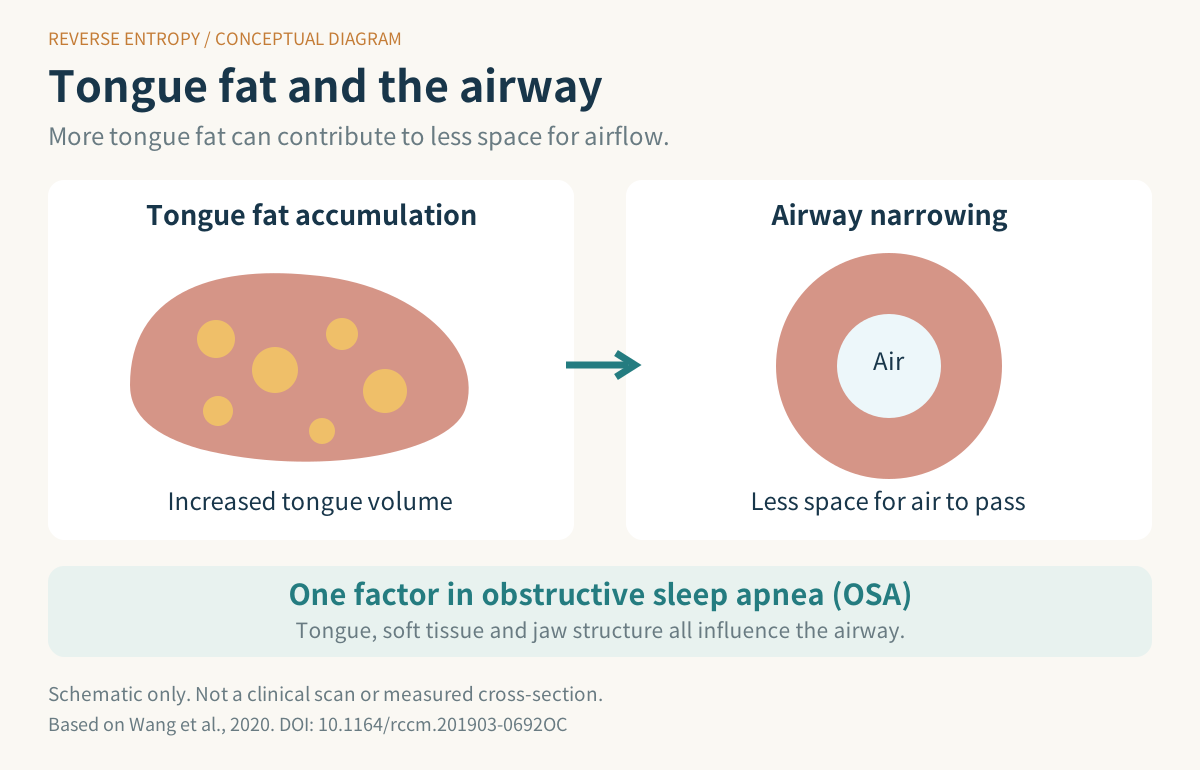
There is a less widely known fact here: fat can accumulate in the tongue too.
A human study published in 2020 compared MRI scans of patients with sleep apnea before and after weight loss.
The reduction in tongue fat emerged as an important factor explaining the improvement in sleep apnea. 3
In other words, the changes that accompany weight loss can also occur inside the throat.
This may make the airway less prone to narrowing during sleep.
2. How much did breathing disturbances decrease per hour of sleep?
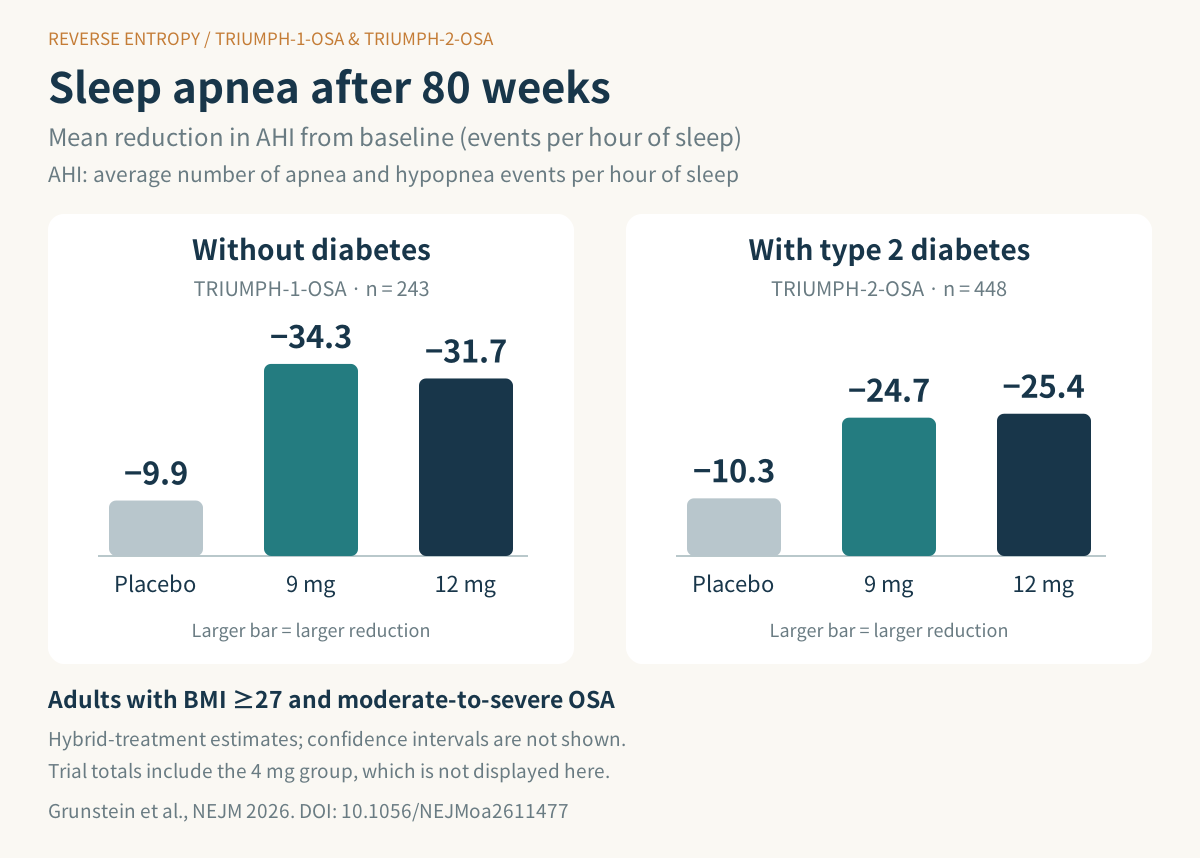
The new study separately evaluated 243 patients without diabetes and 448 patients with type 2 diabetes.
Participants had a BMI of at least 27 and moderate-to-severe obstructive sleep apnea. They received retatrutide or placebo for 80 weeks.
The main measure the researchers examined was the apnea–hypopnea index, or AHI.
This is the average number of times breathing stops or becomes shallow per hour of sleep.
Among participants without diabetes, AHI fell by 34.3 events per hour in the 9 mg group and by 31.7 events per hour in the 12 mg group.
The reduction in the placebo group was 9.9 events per hour.
In the trial involving patients with type 2 diabetes, AHI fell by 24.7 events per hour in the 9 mg group and by 25.4 in the 12 mg group.
The placebo group had a reduction of 10.3 events per hour. 1
3. What does retatrutide add beyond Wegovy and Mounjaro?
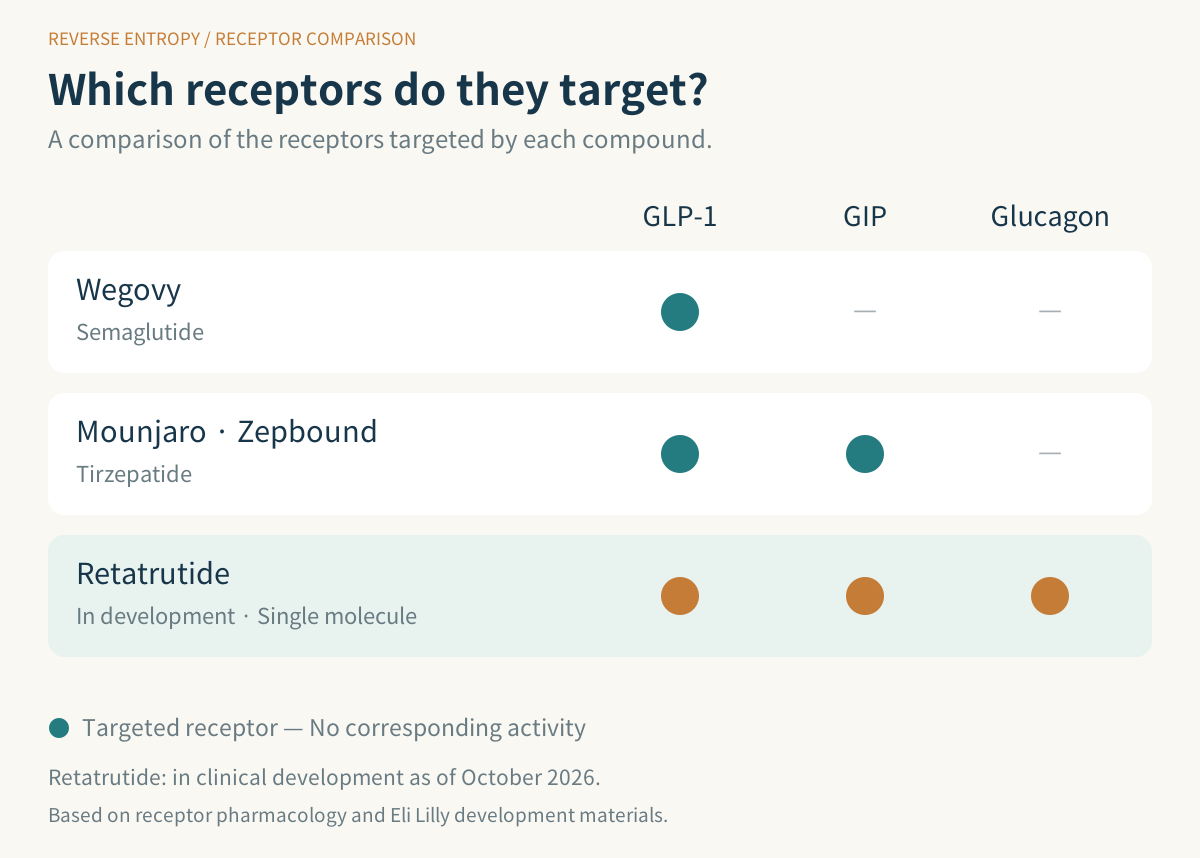
Retatrutide was designed so that a single molecule acts on three hormone receptors. 4
Semaglutide, the active ingredient in Wegovy, acts on the GLP-1 receptor.
Tirzepatide, the active ingredient in Mounjaro and Zepbound, acts on two receptors: GLP-1 and GIP.
Retatrutide adds glucagon receptor activity to these.
Source: Created by Reverse Entropy from the pharmacological mechanisms of the individual compounds and Eli Lilly's development materials. Image source Original graphic by Reverse Entropy.
GLP-1 helps reduce appetite and food intake. Glucagon is commonly known as a hormone that raises blood glucose, but it is also involved in the processes through which energy is used.
The aim is to combine reduced food intake with increased energy expenditure through the glucagon receptor. 5
Could glucagon activity raise blood glucose, then?
Fortunately, in the actual TRIUMPH-2 trial in people with type 2 diabetes, both body weight and blood glucose decreased.
4. Average weight loss was 25%
The effect on weight was also substantial.
The larger overall TRIUMPH-1 trial, which included the patients with sleep apnea and no diabetes described above, enrolled 2,339 people. In this overall trial, average weight loss at 80 weeks was 25.0% in the 12 mg group and 3.9% in the placebo group. 7
Obesity is connected with a range of health problems. As weight increases, the airway may narrow more easily, blood glucose may become harder to control, and movement may place a greater burden on the body.
That is why I am hopeful about obesity treatment as an approach to improving the common foundation of these problems. The question is how far treatment that reduces body weight can also improve breathing, metabolism, and the ability to be active.
This study put specific numbers to one of those possibilities: improvement in breathing disturbances during sleep.
5. Lasting benefits from weight loss also require attention to muscle and nutrition
As it becomes possible to lose more weight, the kind of body we maintain and build during that process matters more too.
From an anti-aging perspective, I think we need to consider strength, physical function, and nutritional status alongside fat loss.
The goal is to maintain a body that can move well in everyday life and do what it needs to do.
Resistance exercise, aerobic exercise, and an appropriate diet are all needed to translate weight loss into better physical function.
When appetite decreases, it is especially important to check whether a person is getting enough protein and other necessary nutrients. 11
We also need to consider how well treatment can be continued. Gastrointestinal symptoms such as nausea, diarrhea, vomiting, and constipation, as well as dysesthesia, were reported with retatrutide. In the overall TRIUMPH-1 trial, 11.3% of the 12 mg group and 4.9% of the placebo group discontinued treatment because of adverse events. 8
If retatrutide enters clinical use, it will be important to tailor treatment to each person while monitoring weight changes, physical function, and tolerability together.
I am looking forward to what comes after weight loss
As obesity medications advance, I think treatment goals may become both more specific and broader.
After someone loses weight, we can ask whether breathing is easier, blood glucose is well controlled, movement is more comfortable, and strength and everyday function are being maintained.
I also want to see how much these changes contribute to long-term cardiovascular health and the years people live in good health.
This retatrutide study takes that expectation one step further in the specific condition of sleep apnea.
Reducing body weight may become part of a process of restoring the body's function.
To me, that is the most important meaning of these findings.
References
1. Grunstein RR, et al. Retatrutide Once Weekly for Treatment of Obstructive Sleep Apnea. NEJM. October 21, 2026. DOI: 10.1056/NEJMoa2611477. Abstract · Full text
2. NHLBI. Sleep Apnea: Causes and Risk Factors. Resource
3. Wang SH, et al. Effect of Weight Loss on Upper Airway Anatomy and the Apnea–Hypopnea Index. The Importance of Tongue Fat. AJRCCM. 2020. DOI: 10.1164/rccm.201903-0692OC. Paper
4. Eli Lilly. What to Know About Retatrutide. Accessed October 27, 2026. Development status
5. Coskun T, et al. LY3437943, a novel triple glucagon, GIP, and GLP-1 receptor agonist for glycemic control and weight loss: From discovery to clinical proof of concept. Cell Metabolism. 2022. DOI: 10.1016/j.cmet.2022.07.013. Paper
6. Eli Lilly. TRIUMPH-2 and TRIUMPH-3 results and plans for a U.S. regulatory submission. July 23, 2026. Official announcement
7. Jastreboff AM, et al. Retatrutide, a Triple Hormone Receptor Agonist, for Treatment of Obesity. NEJM. September 29, 2026. DOI: 10.1056/NEJMoa2604169. Abstract · Full text
8. Eli Lilly. TRIUMPH-1 weight-loss results, analysis methods, and safety. May 21, 2026. Official announcement
9. FDA. FDA Approves First Medication for Obstructive Sleep Apnea. December 20, 2024. Approval announcement
10. Caples SM, et al. Use of polysomnography and home sleep apnea tests for the longitudinal management of obstructive sleep apnea in adults: an American Academy of Sleep Medicine clinical guidance statement. J Clin Sleep Med. 2021. Guidance
11. Joint advisory from four professional organizations on nutrition and physical function during GLP-1 treatment. 2025. Paper
Research support: The retatrutide clinical trials were supported by Eli Lilly and included researchers employed by the developer.