When we think of radiotherapy, it is easy to picture a machine directing radiation into the body from outside.
But what if we attach a radioactive substance to a drug and send it to where the cancer cells are?
The drug seeks out cancer inside the body and releases radiation at close range.
On October 12, 2026, Bristol Myers Squibb (BMS) announced that RYZ101, a drug being developed using this approach,
had met its primary endpoint in a phase 3 trial.
What particularly caught my attention was the patient population.
These were patients in a difficult situation: their cancer had progressed despite previous treatment with another radiopharmaceutical.
If both treatments belong to the same broad family of radiation-based therapy, what has changed?
Announcement: BMS, ACTION-1 interim analysis
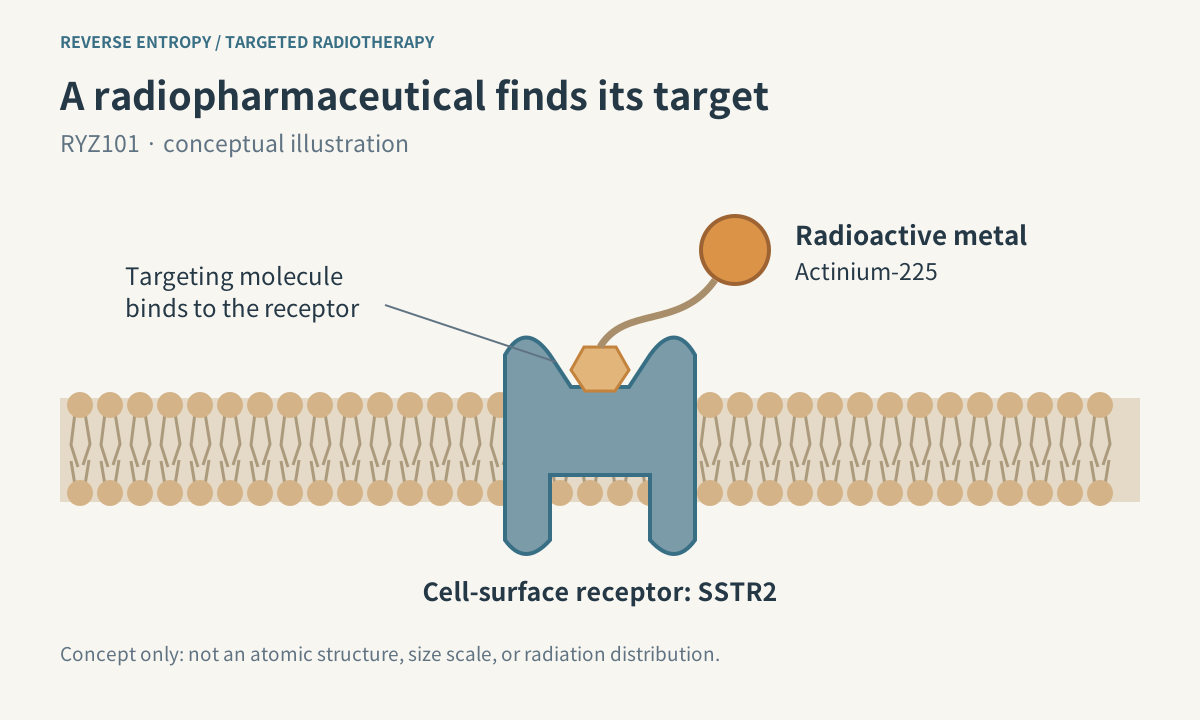
Source: Original concept created by Reverse Entropy, based on the RYZ101 preclinical study in Molecular Cancer Therapeutics, 2023. The original AI-generated concept with a separately edited title has been recreated here as a localized vector diagram.
The drug combines an “address” with a radioactive element
The address it targets is a somatostatin receptor, particularly the protein known as SSTR2.
This protein is abundant on the surface of some neuroendocrine tumor cells.
RYZ101 links a molecule that recognizes this target to a radioactive element called actinium-225 (²²⁵Ac).
The terminology sounds complicated, but the main idea is simple.
One drug combines a part that seeks out cancer cells with a part that emits radiation.
However, the radiation does not switch on only after the drug reaches a cancer cell.
The drug emits radiation while it is traveling too, so where it goes and how long it stays there matter.
RYZ101 composition and target binding: original preclinical study · How radiopharmaceuticals work: NIST
The particle it delivers differs from that of the existing drug
Treatments using lutetium-177 (¹⁷⁷Lu) have already been used for these tumors. Lutetium-177 emits beta particles.
The actinium-225 in RYZ101 emits alpha particles.
Both are forms of radiation, but they deposit energy in tissue differently.
The beta particles emitted by lutetium-177 are fast-moving electrons. They deposit energy along relatively long paths.
An alpha particle is a helium nucleus made up of two protons and two neutrons. It is much heavier than a beta particle and deposits energy densely along a short path.
In physics, this difference is described by linear energy transfer, or LET: how much energy a particle deposits over a given distance.
Put simply, alpha particles concentrate damage within a small area.
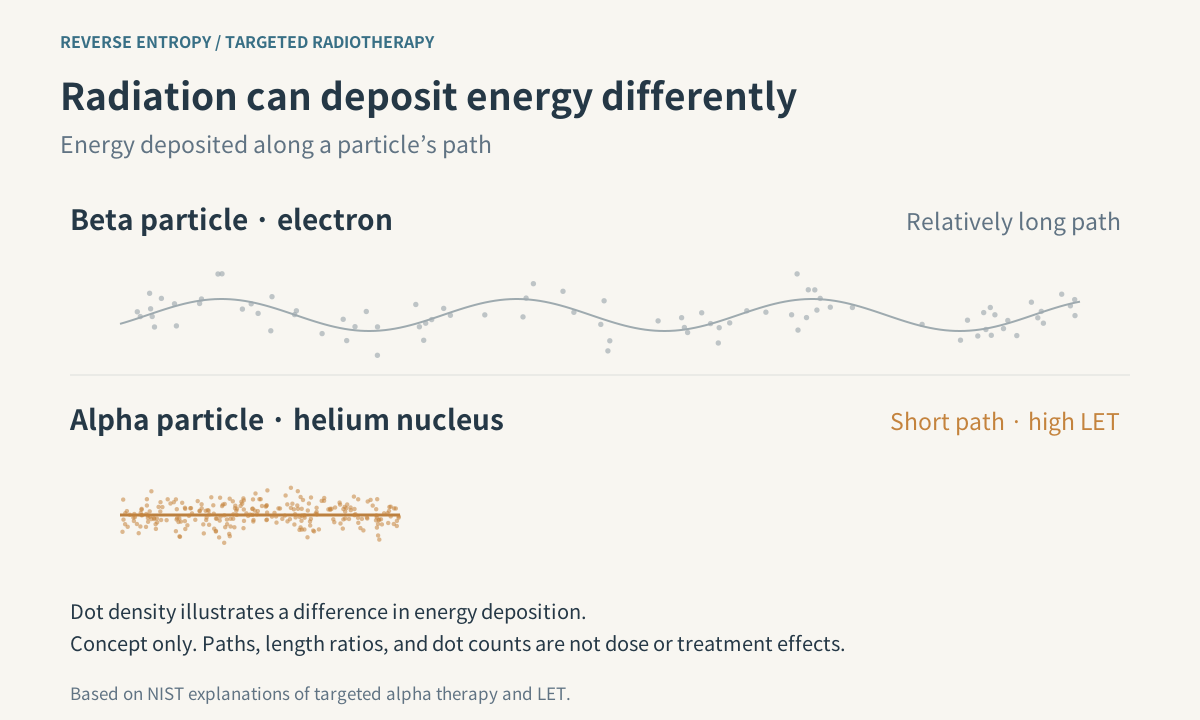
Source: Original vector concept by Reverse Entropy, based on NIST explanations of targeted alpha therapy and linear energy transfer. Recreated with localized labels.
This becomes important when the radiation encounters DNA.
DNA consists of two strands. When both strands break at nearby positions, this is called a DNA double-strand break.
Alpha particles can produce tightly clustered damage, including these breaks. The more complex and overlapping the damage, the harder it is for the cell to repair it correctly.
Beta particles can also cause double-strand breaks. The difference is not simply whether they can break DNA, but how dense and complex the damage is.
Particles and energy deposition: NIST · Cell study examining clustered DNA damage from alpha particles
That is why researchers hoped it might work after earlier treatment
Even if cancer cells have survived a previous treatment, changing the way damage is delivered may change their response.
Alpha-particle therapy tests that possibility: can the same target be used to deliver more densely clustered damage that is harder to repair?
That does not mean it overcomes every form of treatment resistance. It has limitations if the target is scarce or too little drug reaches the tumor. The longer range of beta particles, allowing them to affect neighboring tumor cells, can also be an advantage in some circumstances.
These results alone do not explain why each individual patient failed to respond to the previous treatment.
Do the differences predicted by physics translate into meaningful differences in treatment outcomes? ACTION-1 is the trial designed to answer that question.
Mechanism and development rationale: RayzeBio
The phase 3 finding was a delay in cancer progression
ACTION-1 enrolled patients with advanced, unresectable, well-differentiated, somatostatin receptor-positive neuroendocrine tumors arising in the gastrointestinal tract or pancreas.
This does not mean all common stomach or pancreatic cancers. Participants had experienced cancer progression after lutetium-177-based treatment.
The comparator was standard treatment selected by the treating physician, including somatostatin analogues, everolimus, or sunitinib.
The trial found an improvement in delaying cancer progression.
The detailed figures showing how many additional months were gained and the magnitude of the effect had not yet been released.
Overall survival continues to be followed.
So “phase 3 success” in the title means that the primary endpoint was met. It does not mean a cure or a longer lifespan has been demonstrated. This is still an investigational drug, and the announcement does not constitute marketing approval.
Trial registration: ACTION-1, NCT05477576 · BMS official announcement
I find the combination of “what to emit” and “where to deliver it” fascinating
Recognizing a target on a cancer cell belongs to medicine.
Understanding which particles a radioactive element emits, and how their energy is transferred to tissue, belongs to physics.
Turning the combination into a real drug requires both physics and medicine.
Having studied both subjects myself, I think that makes examples like this especially interesting to me.
To be honest, today's subject may not be quite as exciting if this is not your field. Haha.
Next, I want to look at how much this treatment delayed progression, how substantial the side effects were, and whether patients ultimately lived longer.
Those results will determine its place in actual clinical care.
Producing powerful energy and delivering that energy where it is needed are two different technologies.
This study showed that a treatment combining the two could help patients with cancer who need another option.
References
1. Bristol Myers Squibb. Topline results from the planned interim analysis of phase 3 ACTION-1. October 12, 2026. Official announcement
2. ACTION-1, NCT05477576. Population, treatment groups, and endpoints. ClinicalTrials.gov
3. RYZ101 composition, target binding, and preclinical research. Molecular Cancer Therapeutics. 2023. PubMed
4. NIST. Radioactivity measurement of actinium-225 medicines and targeted alpha therapy. 2025. Institutional explanation
5. Prostate cancer cell study examining clustered DNA damage from Ra-223. Translational Oncology. 2022. Original paper. This is basic research explaining the characteristics of alpha-particle damage, not clinical results for RYZ101.
6. IAEA. Production and Quality Control of Actinium-225 Radiopharmaceuticals. IAEA-TECDOC-2057. 2024. Technical report
#AnticancerTherapy #CancerTreatment #TargetedTherapy #Radiopharmaceuticals #RYZ101 #Actinium225 #AlphaParticleTherapy #NeuroendocrineTumors #CancerDrugDevelopment #Phase3 #ReverseEntropy