Could Wegovy reduce not only your weight, but the age of your heart?
In a recently released study, people taking semaglutide showed changes in a heart-age measure that were approximately 2–4 years lower than those in the placebo groups.
The researchers analyzed protein data from 10,052 participants in five clinical trials.
Looking only at those numbers, it sounds as though a drug that makes us younger has finally arrived. But “heart age” here is an estimate calculated from proteins in the blood. It does not mean that the entire heart literally returned to the way it was four years earlier.
Semaglutide already has evidence from several studies showing that it can prevent actual cardiovascular events and worsening kidney disease.
Even so, there is a reason this study interests me: this time, the researchers looked at those effects again through the lens of aging.
How can a blood test tell us the age of the heart?
Even among people of the same age, the condition of the heart and kidneys varies. And within one person, not every organ ages at the same rate.
The researchers looked for these differences in blood proteins, which carry information related to damage, inflammation, and changes in function.
A protein-based aging clock uses patterns across many proteins to estimate the condition of individual organs. Studies have also linked these measures to future organ disease and mortality risk.
This semaglutide analysis used protein models trained to predict mortality risk. Their scores were then expressed in units of “age.”
That is different from counting birthdays, but it offers a useful way to explore future disease risk and assess the body's current condition.
Among 10,000 participants, the most consistent change was in the heart
Released on September 22, 2026, this study reanalyzed protein data from five randomized clinical trials comparing semaglutide with placebo.
The trials included populations with obesity and cardiovascular disease, heart failure, diabetes, or chronic kidney disease. This was not a study in which 10,000 healthy people were given Wegovy for anti-aging purposes.
The heart-related aging measure decreased consistently across all five trials. Changes in other organs varied by trial and measurement time point. Some data extended to 156 weeks.
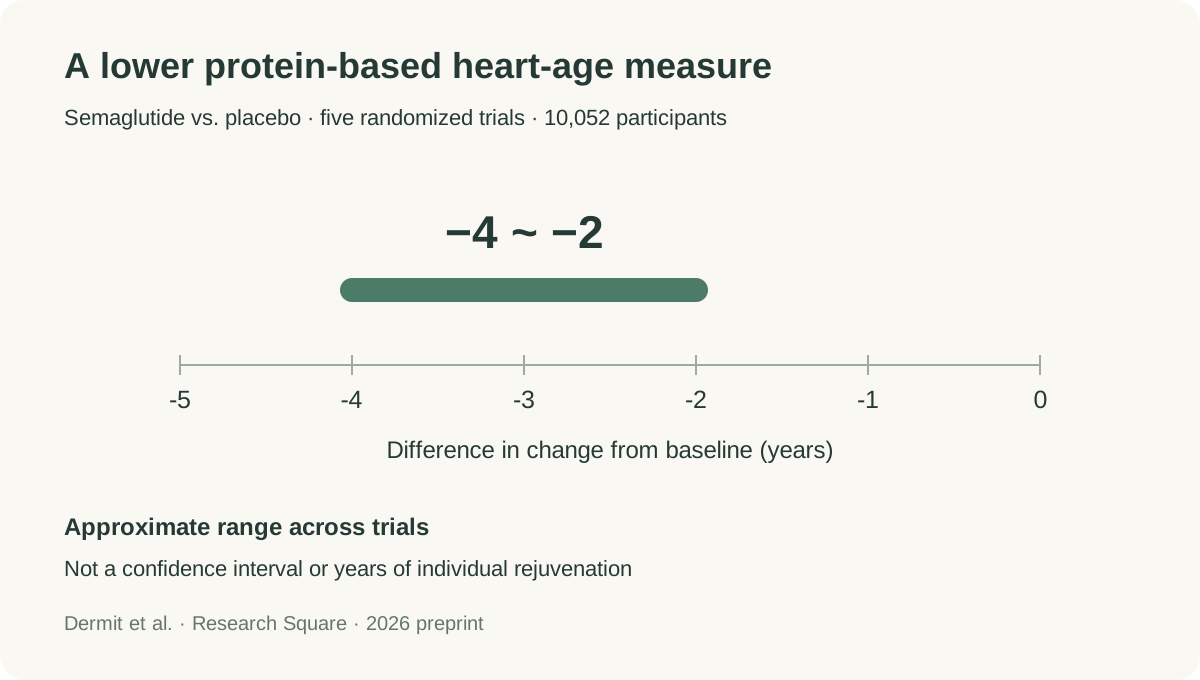
Source: Dermit M et al., Research Square, 2026. Original visualization of the summary range reported in the abstract.
Not everyone received the same Wegovy injection. The trials included different doses of injectable semaglutide as well as oral semaglutide.
The study: Dermit et al., Research Square, 2026
What matters more is whether actual disease becomes less common
In the anti-aging field, we often hear that a laboratory value has improved.
I want to know what comes next. The test result improved, but did the person actually experience less disease?
Fortunately, semaglutide has data that address that question.
Published in 2023, the SELECT trial compared 17,604 adults who had cardiovascular disease and overweight or obesity, but did not have diabetes.
Over approximately 40 months of follow-up, cardiovascular death, nonfatal myocardial infarction, or nonfatal stroke occurred in 8.0% of the placebo group and 6.5% of the semaglutide group. The absolute difference was 1.5 percentage points.
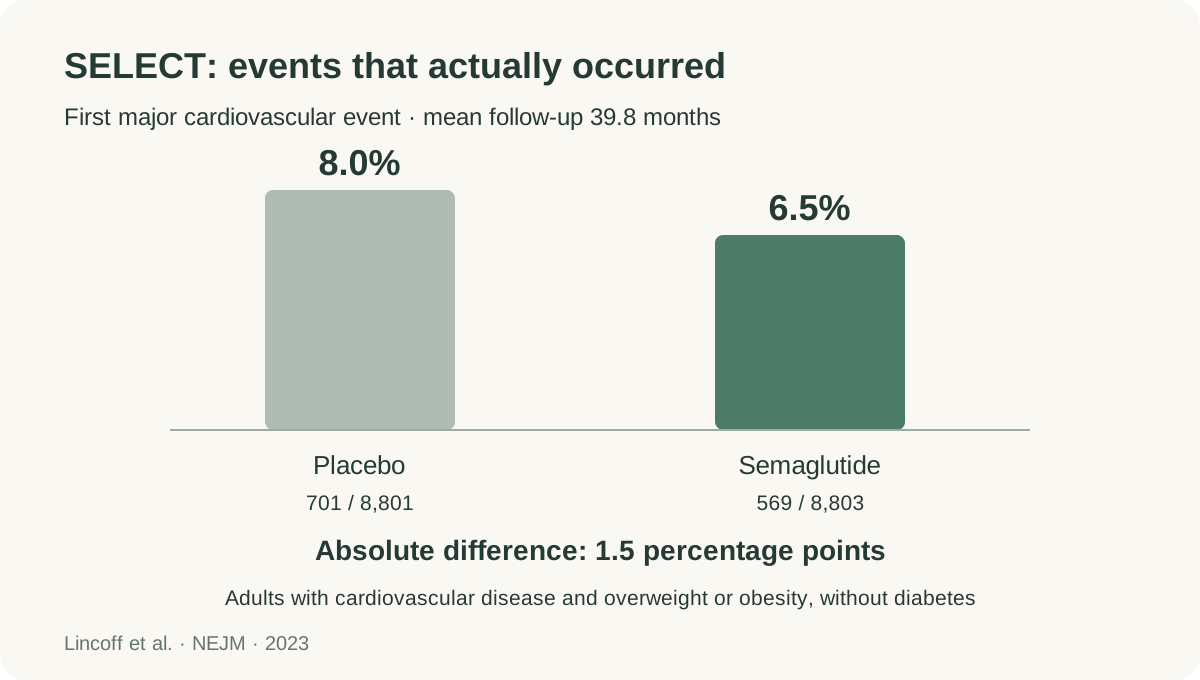
Source: Lincoff AM et al., NEJM, 2023. Chart recreated from the published aggregate data.
Both groups also received their existing cardiovascular care. The group that added semaglutide experienced fewer events.
This was not a risk predicted by an aging clock. It was a count of disease events that actually occurred.
SELECT paper: Lincoff et al., NEJM, 2023
There are kidney data, too. The FLOW trial enrolled 3,533 patients with type 2 diabetes and chronic kidney disease.
The risk of a composite outcome including kidney failure, a large decline in kidney function, or death from kidney or cardiovascular causes was 24% lower in relative terms in the semaglutide group.
FLOW paper: Perkovic et al., NEJM, 2024
This is also why the new study interests me. A drug with demonstrated organ-protective effects in specific patient groups is now being examined again as a tool for aging research.
Could the improvement simply be due to weight loss?
The researchers analyzed that question as well. Changes in body weight, glycated hemoglobin, which reflects average blood glucose, and the inflammatory marker CRP did not fully explain the changes in the organ-age measures.
That suggests that part of the change in these aging measures may extend beyond weight loss alone.
And even if an effect does come through weight loss, it still matters.
Protecting organs by improving weight and metabolic health does not make the treatment any less valuable.
If the body sustains less damage and keeps functioning longer, that is an important effect in itself.
Analysis: Dermit et al., Figure 3 and main text
People lost weight, yet one clock sometimes read “older”
The paper also includes an example that illustrates the limitations of aging clocks.
As body fat fell, levels of the hormone leptin decreased. The adipose-tissue aging clock interpreted that change as an increase in age.
Why?
The researchers suggested that in the observational population used to train the model, lower leptin may have been associated with weight loss caused by illness or frailty.
Losing weight because you are ill is different from losing excess fat through treatment. Yet an equation may not fully distinguish between the two.
So aging clocks are useful, but one number cannot tell the whole story of the body. When a measure improves, we also need to ask whether actual function improves. When it worsens, we need to understand what caused the model to read it that way.
The leptin example: Dermit et al., Figure 2 and discussion
Should healthy people use it for anti-aging, too?
This study alone does not justify that recommendation.
Personally, low-dose Wegovy is part of my own anti-aging regimen.
But reducing risk in people with disease and benefiting healthy people who use a drug preventively are questions that need to be tested separately. SELECT was not a trial of lifespan extension in healthy people, either.
Wegovy is not approved as a drug for anyone who wants to lower an aging-clock score. Side effects include nausea, vomiting, and diarrhea. Dehydration and gallbladder disease are also considerations.
From an anti-aging perspective, what I want to see is more than weight loss alone.
Can we reduce excess fat while preserving muscle strength and the ability to function in daily life?
If the aim is to stay healthy over the long term, that question cannot be left out.
The next question about Wegovy may not be “How many kilograms?”
I hope that in the future we will talk more about not just how much weight people lose, but which organs are protected, in whom, and for how long.
“Four years younger in heart age” is an attention-grabbing number.
But what I am hoping for goes beyond younger-looking numbers on a laboratory report.
Fewer heart problems. Kidneys that keep working longer. More years in which we can live independently as we grow older.
I want future research to show how far semaglutide can help us reach that goal.
References
- Dermit M, Colhoun HM, Goeminne LJE, et al. Semaglutide reduces proteomic organ-specific biological age across randomized clinical trials. Research Square. September 22, 2026. Preprint, not yet peer reviewed. DOI · Europe PMC
- Oh H-SH, et al. Organ aging signatures in the plasma proteome track health and disease. Nature. 2023;624:164–172. DOI
- Lincoff AM, et al. Semaglutide and Cardiovascular Outcomes in Obesity without Diabetes. NEJM. 2023;389:2221–2232. DOI
- Perkovic V, et al. Effects of Semaglutide on Chronic Kidney Disease in Patients with Type 2 Diabetes. NEJM. 2024;391:109–121. DOI
- Wilding JPH, et al. Impact of Semaglutide on Body Composition in Adults With Overweight or Obesity: Exploratory Analysis of the STEP 1 Study. Journal of the Endocrine Society. 2021;5(Suppl 1):A16–A17. Conference abstract. Original abstract
- Novo Nordisk. Wegovy US Prescribing Information. Revised June 2026. US labeling should be distinguished from local approvals. Official information