Shingles occurs when the varicella-zoster virus, which has remained hidden in the body, becomes active again.
It is characterized by severe pain and blisters, and often occurs in middle-aged and older adults with weakened immunity or during periods of severe stress.
Now, research suggests that shingles vaccination may also lower the risk of dementia.
Unusually, the researchers took advantage of vaccination eligibility that changed according to a person’s birthday.
A single day’s difference in birthday meant losing the opportunity to be vaccinated.
In Wales, UK, eligibility for a free live shingles vaccine in 2013 was determined by date of birth. The vaccine was Zostavax.
The key cutoff was September 2, 1933. People born immediately before and after that date were almost the same age, but their vaccination eligibility differed.
As of September 1, 2013:
Born September 1, 1933: aged 80 → excluded
Born September 2, 1933: aged 79 → offered vaccination
A single day meant that one group received the opportunity while the other did not, even in subsequent years of this free vaccination program.
Not everyone who became eligible received the vaccine, so actual uptake was about 47%.
Almost no one in the ineligible group received it.
People aged 80 or over were excluded at the time because the preventive effect of the live vaccine Zostavax declined considerably in older age groups.
(For reference, Shingrix, the recombinant vaccine we now use frequently, remains effective in older adults.)
Among people born within roughly one week on either side of the cutoff, vaccination uptake differed sharply: 0.01% versus 47.2%.
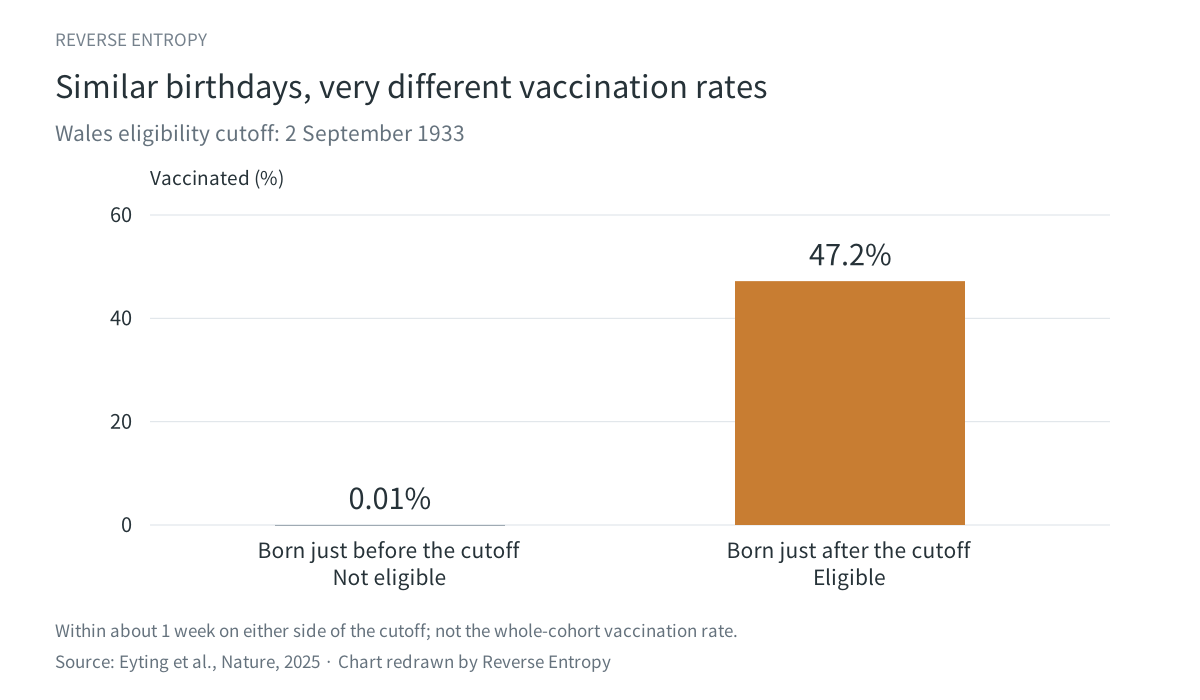
These are the vaccination rates observed within roughly one week on each side of the eligibility cutoff, September 2, 1933. This figure does not compare vaccination rates across all 282,541 people in the analysis.
Source: Eyting M et al., Nature, 2025. Graph redrawn by Reverse Entropy.
Ordinarily, comparing vaccinated and unvaccinated people creates a problem: people who already take good care of their health and visit doctors more often are more likely to be vaccinated.
This time, however, the opportunity to receive the vaccine differed because of a birthday cutoff. The researchers used this to look more closely at the effect of the vaccine itself. This approach is called a natural experiment.
Because the government was running a vaccination program for the population, the study could be conducted on a very large scale.
In fact,
dementia diagnoses in 280,000 people were followed for seven years
This study, published in Nature in 2025, analyzed medical records from more than 280,000 people.
Its main finding was estimated using differences among people near the eligibility cutoff who were about 80 years old at the time.
Receiving the live vaccine was estimated to reduce the probability of a new dementia diagnosis over seven years by 3.5 percentage points. Expressed as a relative reduction, that is about 20%.
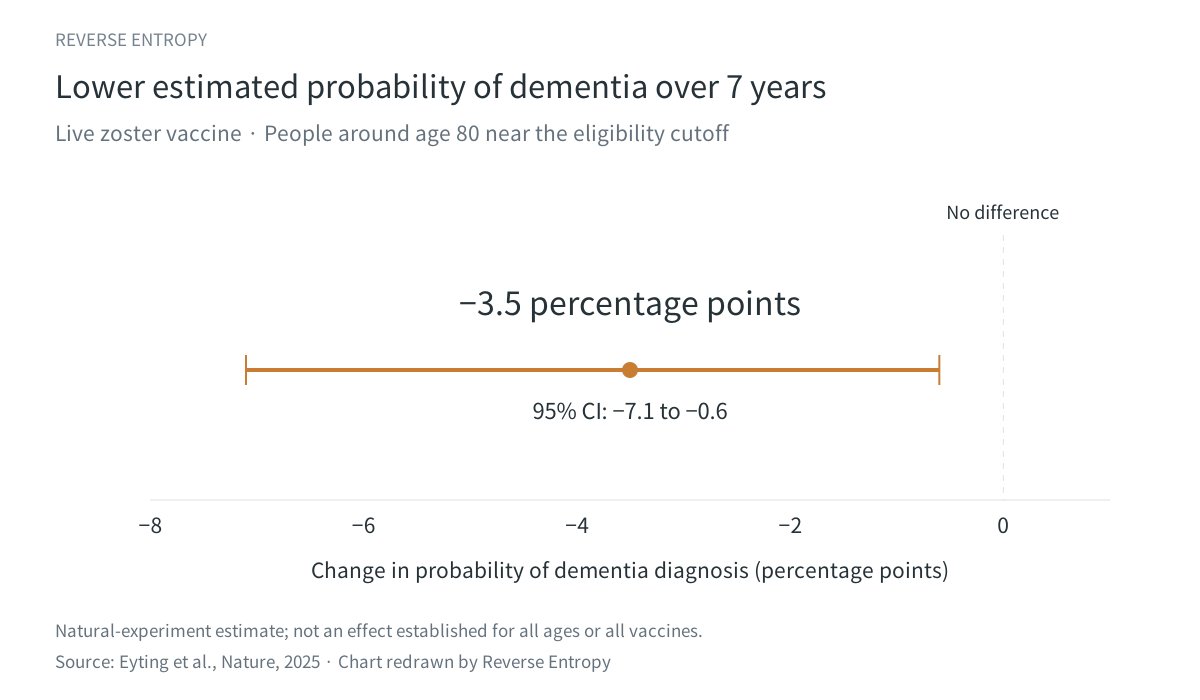
The natural experiment estimated that receiving the live vaccine changed the seven-year probability of a new dementia diagnosis by −3.5 percentage points. The line shows the 95% confidence interval (−7.1 to −0.6). This estimate concerns people aged about 80 near the eligibility boundary; it does not apply to every age group or vaccine.
Source: Eyting M et al., Nature, 2025. Graph redrawn by Reverse Entropy.
This finding deserves attention because the design reduced the influence of other factors.
Original study: Eyting et al., Nature, 2025
Does Shingrix have the same effect?
The vaccine used in the Welsh study was a live vaccine called Zostavax. These days, however, Shingrix is used much more frequently.
We cannot apply the study’s “20%” directly to the recombinant vaccine Shingrix.
But findings have also emerged for recombinant vaccines such as Shingrix.
A 2026 study compared 65,800 people who had received two doses with 263,200 unvaccinated people, and found fewer dementia diagnoses in the vaccinated group.
To account for the tendency of health-conscious people to get vaccinated, the researchers also compared them with people who had received a different vaccine, Tdap. Dementia diagnosis risk was lower in that comparison too.
In other words, a different vaccine and a different population produced findings in the same direction.
Related study: Rayens et al., Nature Communications, 2026
Could preventing a virus be connected to brain health?
Shingles is, in fact, a reactivation of the virus responsible for chickenpox in childhood.
After a childhood infection, the varicella virus can remain dormant in different parts of the nervous system throughout the body.
It can therefore hide in spinal or cranial nerve ganglia that carry sensory information to the brain.
The vaccine may have benefited brain health by reducing this reactivation and the associated inflammatory burden.
Reducing long-lasting infection and inflammation is ultimately one way to protect our health.
If you are considering vaccination, start with its original purpose
There is no need to put off shingles prevention until an effect on dementia prevention is definitively established.
The vaccine can prevent shingles,
and it can also reduce the overall risk
of postherpetic neuralgia, a complication of shingles. These preventive benefits are already established.
I recommend checking your age, immune status, and previous vaccination history and getting vaccinated promptly if you are eligible.
For people who are eligible, preventing shingles is itself a good reason to be vaccinated. A possible reduction in dementia risk would be an additional benefit.
I actually developed shingles affecting a cranial nerve during military service, when I was under stress. I have fully recovered, but it was a dangerous location where lasting complications could have occurred.
I had not thought about vaccination afterward, but reading this paper changed my mind. I plan to go and get vaccinated right away. Haha.
I do not think anti-aging is only about finding new drugs.
Reducing diseases that we can already prevent is also an important part of helping people live longer in good health.
References
1. Eyting M, et al. A natural experiment on the effect of herpes zoster vaccination on dementia. Nature. 2025;641:438–446. Full text
2. Rayens E, et al. Recombinant zoster vaccine is associated with a reduced risk of dementia. Nature Communications. 2026;17:2056. Full text
3. US CDC. Shingles vaccine effectiveness and vaccination guidance. Vaccination in Korea should be considered under Korean approved labeling. Resource
#ShinglesVaccine #Shingles #Shingrix #DementiaPrevention #BrainHealth #Vaccination #Healthspan #ReverseEntropy