The question I hear most often, both in and outside the consulting room, from people considering obesity medication is this:
“Once I reach my target weight and stop the injections, won’t I just gain it all back? If I have to take them for life, I’m afraid to start.”
The media often lead with alarming headlines about weight regain after stopping obesity drugs. But a closer look at the actual clinical-trial data tells a somewhat different story.
1. The less-discussed SURMOUNT-4 finding: one in six kept at least 80% of their weight loss after stopping
One of the best-known studies following people after they stopped Mounjaro (tirzepatide) is the SURMOUNT-4 trial, published in JAMA in 2024 by Aronne and colleagues.
Participants first received tirzepatide for 36 weeks and lost an average of about 20.9% of their body weight. Researchers then divided them into two groups: one continued treatment, while the other switched to placebo for another 52 weeks, or about a year. [1]
When this paper is cited, attention usually falls on the average: the placebo group regained roughly half of the weight they had lost. But there are other numbers worth examining.
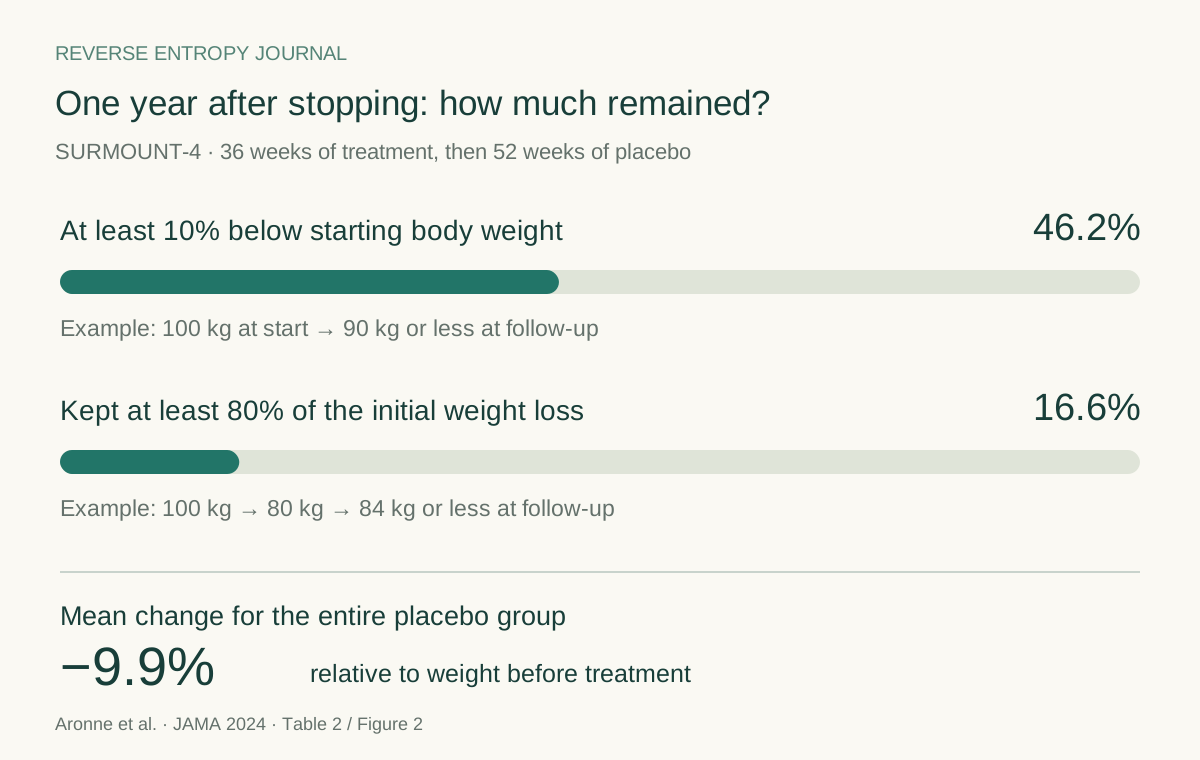
Maintaining a meaningful reduction: 46.2%. One year after stopping tirzepatide and switching to placebo, 46.2% still weighed at least 10% less than they had before treatment. A 10% reduction is also meaningful for metabolic health, including blood glucose and blood pressure.
Strong maintainers: 16.6%. More strikingly, 16.6% of the withdrawal group—about one in six—still retained at least 80% of the weight loss achieved during the first 36 weeks, a year after stopping.
The net reduction remained. Even across the entire withdrawal group, average weight at the end of that year was still 9.9% below the original starting weight. That is not a complete return to square one.
2. Real-world data from Epic Research: more than half maintained the loss or lost more
People also maintained weight loss outside the clinical-trial setting. Epic Research, a US electronic-health-record research organization, analyzed changes in weight after prescriptions for obesity medications ended.
Among 2,062 people with a weight measurement one year after their tirzepatide prescription ended, about 58% fell into the researchers’ “maintained loss or further weight loss” categories. Here, “maintained” included regaining less than one-quarter of the initial loss. About 17% regained all the weight they had lost or more. Measurements after restarting the medication were excluded. [2]
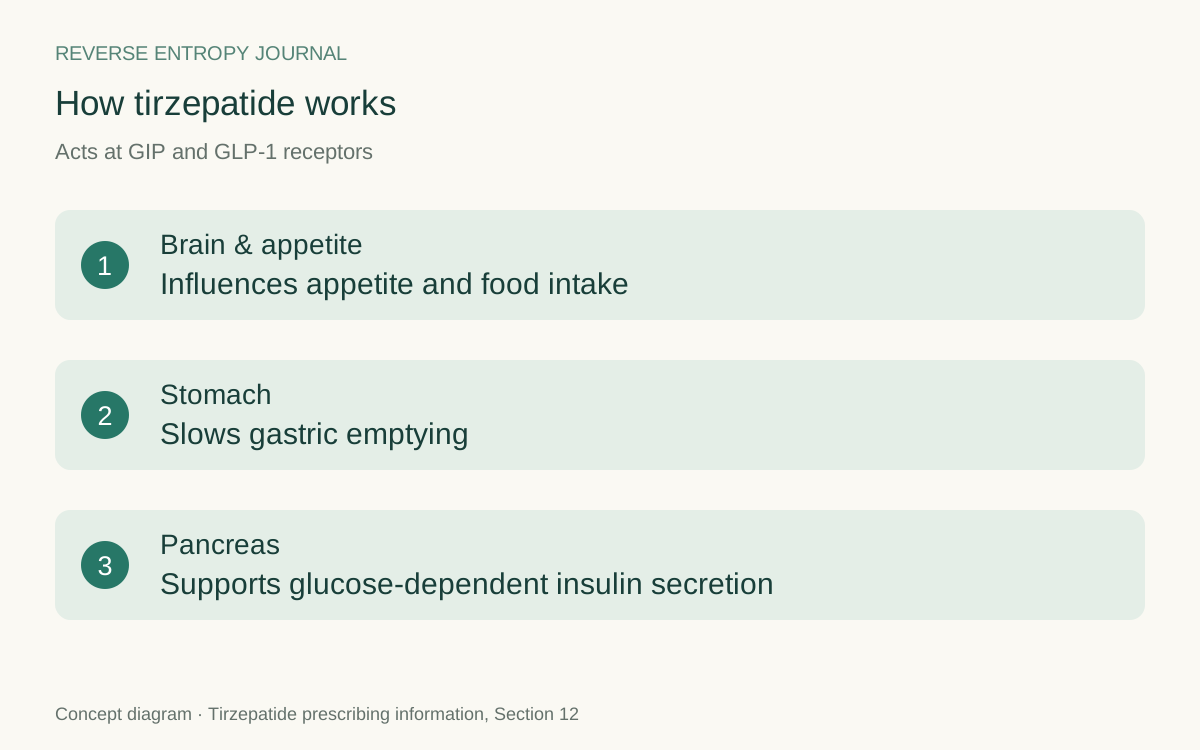
As the diagram shows, tirzepatide acts on GIP and GLP-1 receptors. It slows the emptying of food from the stomach, reduces appetite and food intake, and supports insulin secretion in response to blood glucose. [4]
The months spent with medication can be understood as time gained: with hunger quieter, there is an opportunity to reorganize eating habits and the surrounding environment, and to recover metabolic health.
3. My view of the set point: returning to a former range versus an inherently higher range
People often describe dieting as “changing the set point,” or resetting the body’s reference weight. The set-point concept describes the body’s tendency to defend a certain weight range. Inherited genetic tendencies also influence that range.
Why, then, do some people avoid weight regain after stopping medication while others regain it? I think the commonly repeated instruction that we must “change the set point” is nonsense.
This is my personal opinion. After more than ten years of discussing weight management with many patients, and reviewing recent research, I have come to think that our genetically inherited tendency toward a particular weight changes very little. Why do we then think the set point has changed?
First: a previously healthy weight range was disrupted by the environment
These are people who were slim or maintained a usual weight for many years, but gained beyond their familiar range as acquired changes accumulated—chronic stress, insufficient sleep, or an environment rich in ultra-processed foods.
For them, tirzepatide may serve something like a “restore switch,” interrupting a disrupted metabolic cycle. While medication makes appetite easier to manage, reorganizing habits and the surrounding environment may create room to maintain their previous healthy weight after stopping. I see this as one possible explanation for people who maintain weight well after withdrawal.

Second: the inherited tendency itself favors a higher weight
There are clearly people born with genetic characteristics that make weight gain easier. Their weight is not evidence of weak willpower, poor habits, or laziness. Strong appetite signaling and other inherited traits can mean they are working against much less favorable conditions.
After medication is stopped, their bodies may tend back toward that higher weight. There is no reason to blame themselves.
Just as we use glasses to correct vision or medication for essential hypertension, maintaining Mounjaro or Wegovy long term—and for some people throughout life—at an effective dose can be a sensible choice. Whether a lower dose is sufficient to keep weight and metabolic measurements stable can be assessed with the treating physician over time. It means using modern medicine to compensate for an inherited disadvantage and protect health.
4. Two strategies when stopping: tapering and preserving muscle
If you fit the first pattern, in which environmental disruption played a major role, the following two approaches may help you settle back into your previous healthy weight. They are also worth attending to for people in the second group who continue medication at a suitable dose.
Tapering: gradually lowering the dose
After reaching a target weight, the next step can be decided by watching how much appetite returns as the medication is reduced, and which direction weight moves.
In an observational semaglutide study presented at the European Congress on Obesity in 2024, participants received lifestyle coaching while tapering over a median of nine weeks. Among the 85 participants with data 26 weeks after stopping, average weight remained stable. [3]
The approved dosing interval for tirzepatide is once weekly. How far to reduce the dose and when to stop should be decided with the prescriber, taking appetite, weight trends, and—in people with diabetes—blood glucose into account.
Preserve skeletal muscle, an important user of glucose
If rapid weight loss includes a loss of muscle, resting energy expenditure and the ability to exert strength in everyday life may decline too.
Even when appetite is low during treatment, it is helpful to aim for about 1.2–1.5 g of protein per kilogram of reference body weight per day, alongside resistance exercise around three times a week. The reference weight used for the calculation and the appropriate intake should be chosen with the degree of obesity and kidney function in mind. [5]
Finishing the weight-loss phase with the “metabolic engine” of muscle preserved can help maintain everyday activity and a healthy weight.

Do not give up before understanding your own starting point
If the vague fear that “it will all come back as soon as I stop” is preventing you from starting, it may be time to look at the question differently.
If an unfavorable environment had taken you off course, injections may provide a chance to organize your habits and return to your former lighter weight without continued injections.
Even if you inherited a tendency to gain weight easily, you do not have to keep blaming your willpower. Medical tools offer a route to long-term health.
Either way, there may be a solution rather than failure. Instead of giving up out of fear, I encourage you to take the first step toward a healthier life in a way that fits your body.
References and official sources
- Aronne LJ et al. Continued Treatment With Tirzepatide for Maintenance of Weight Reduction in Adults With Obesity. JAMA. 2024.
- Bartelt K et al. Two Years After Stopping GLP-1s, Most Patients Sustain at Least Some Weight Loss. Epic Research. 2025. Table 4.
- Seier S et al. Tapering semaglutide to the most effective dose: real-world evidence from a digital weight management programme (TAILGATE). ECO 2024, Abstract 164.
- Tirzepatide (Zepbound). Official prescribing information, Section 12.
- Nutritional priorities to support GLP-1 therapy for obesity: a joint advisory. 2025.
#Mounjaro #Wegovy #WeightMaintenance #WeightRegain #SetPoint #Tapering #MusclePreservation #ReverseEntropy #HINClinic