What a clinical trial of 25,000 people tells us about the difference between correcting a deficiency and adding more
We are familiar with the idea that vitamin D matters for our bones. It is needed to absorb calcium in the intestine and properly mineralize bone. Does that mean that taking more makes our bones stronger? NIH information
To get straight to the point:
Too little vitamin D weakens bones, and too much can weaken them as well.
Below 20 ng/mL: vitamin D may be inadequate, but definitions differ. NIH distinguishes an increased risk of deficiency below 12 ng/mL from possible inadequacy at 12 to below 20 ng/mL. A low level does not by itself establish osteoporosis.
30–50 ng/mL: this is not an established optimal target for everyone. NIH considers 20 ng/mL or more sufficient for most people, and the 2024 Endocrine Society guideline does not establish a universal target for disease prevention.
Above 50–60 ng/mL: the Food and Nutrition Board cited by NIH recommends avoiding concentrations in this high range. Excess vitamin D can cause harm, so unnecessarily high blood levels or high doses should not be pursued.
That is because supplying what a deficient person needs is different from giving more to someone who already has enough.
A large clinical trial published in NEJM in 2022 invites us to consider the second situation.
Taking vitamin D raised blood levels, but did not reduce fractures.
An extra 2,000 IU every day for more than five years
The fracture analysis of the VITAL trial included 25,871 middle-aged and older adults in the United States: men aged 50 or older and women aged 55 or older.
The researchers randomly assigned participants to vitamin D3, 2,000 IU daily, or placebo, and followed fractures for a median of 5.3 years.
A fracture occurred in 769 of the 12,927 participants in the vitamin D group and 782 of the 12,944 participants in the placebo group.
There was no statistically significant difference in the overall risk of fracture.
No protective effect against hip fracture was demonstrated either. Original VITAL paper
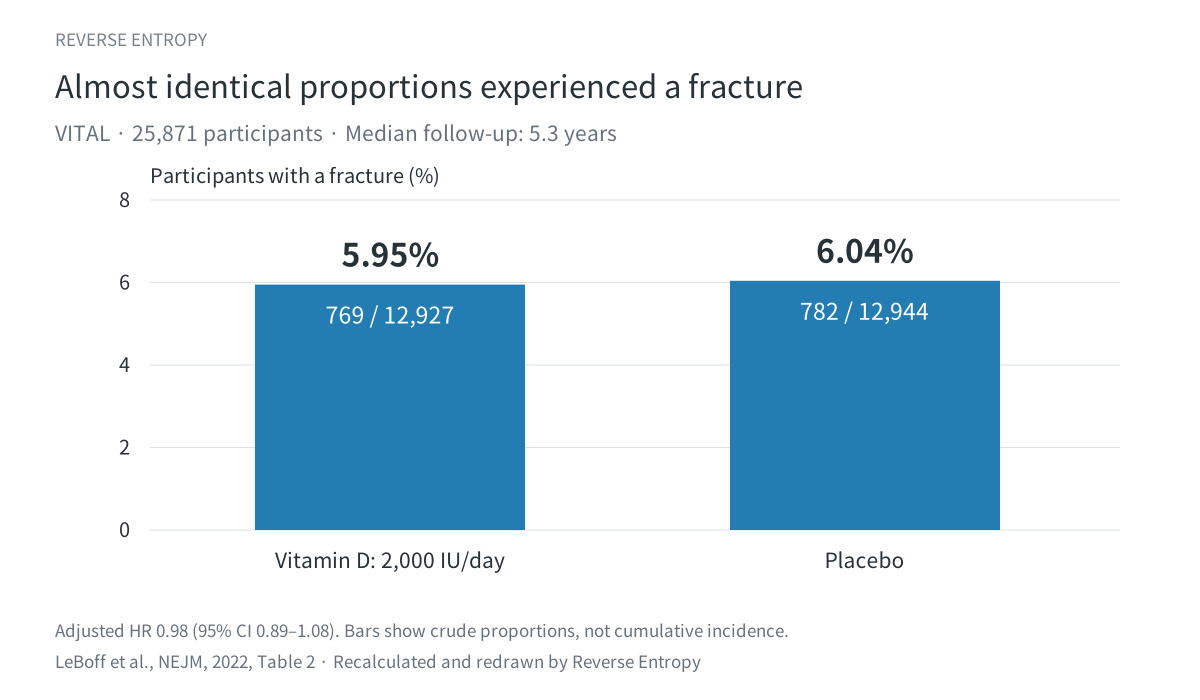
These are the crude proportions of participants who experienced a fracture during follow-up, not time-adjusted cumulative incidence. The adjusted hazard ratio was 0.98 (95% confidence interval, 0.89–1.08).
Source: LeBoff MS et al., NEJM, 2022, Table 2. Recalculated and visualized from reported participant counts by Reverse Entropy. Image data source. The original was a user-provided, independently created chart; the data and meaning are retained in this localized version.
What makes this study important to me is that it checked whether people actually broke a bone.
It went a step beyond explaining that a nutrient is necessary for bone and tested what benefit an additional supplement brings to people.
So they checked the blood levels
Could the lack of benefit simply mean that the vitamin D never properly reached the body?
The researchers checked blood tests to find out.
In the subgroup tested two years later, concentrations of 25(OH)D, a marker of vitamin D status, clearly diverged.
The mean rose from 29.2 to 41.2 ng/mL in the vitamin D group, while it barely changed in the placebo group, from 30.0 to 29.4 ng/mL. Original paper
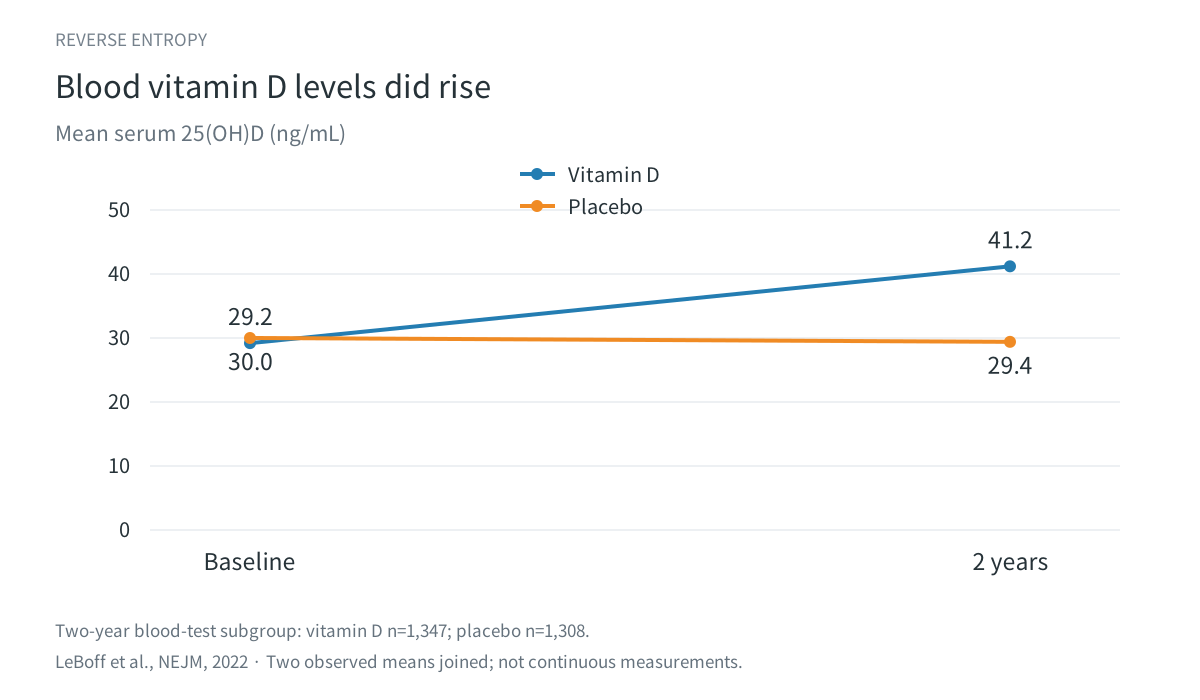
Mean values in the subgroup with blood tests at two years: 1,347 participants in the vitamin D group and 1,308 in the placebo group. The lines join two measured time points; they do not represent continuous measurements between them.
Source: LeBoff MS et al., NEJM, 2022, results section. Chart: Reverse Entropy. Image data source. The original was a user-provided, independently created chart; the data and meaning are retained in this localized version.
Taking the supplement did produce a response: the blood-test values went up.
That change, however, did not translate into fewer fractures.
This is something we should also look for when reading anti-aging research.
Beyond asking which test result changed, we should check whether the change actually led to a health benefit.
Were the participants severely deficient to begin with?
Among VITAL participants whose blood was tested at baseline, the mean 25(OH)D concentration was 30.7 ng/mL. About 2.4% of those tested had levels below 12 ng/mL.
In addition, 42.6% of all participants were using vitamin D supplements outside the trial. The study permitted this additional intake up to 800 IU per day. It is therefore difficult to apply these findings directly to the treatment of severe deficiency. Original paper
Of course, some studies have found supplementation helpful.
A 1992 NEJM study examined 3,270 women living in nursing homes or residences for older people, with an average age of 84.
These women had low calcium intake. When they were given vitamin D3, 800 IU per day, together with 1.2 g of calcium,
a reduction in hip and nonvertebral fractures was observed over 18 months. Chapuy study
What happened at higher doses?
A 2019 JAMA study divided 311 adults aged 55–70 into groups taking 400, 4,000 or 10,000 IU per day and compared them over three years.
Volumetric bone mineral density at the radius, a bone in the forearm, decreased by approximately 1.2%, 2.4% and 3.5%, respectively.
The higher-dose groups actually lost more bone density. Burt study
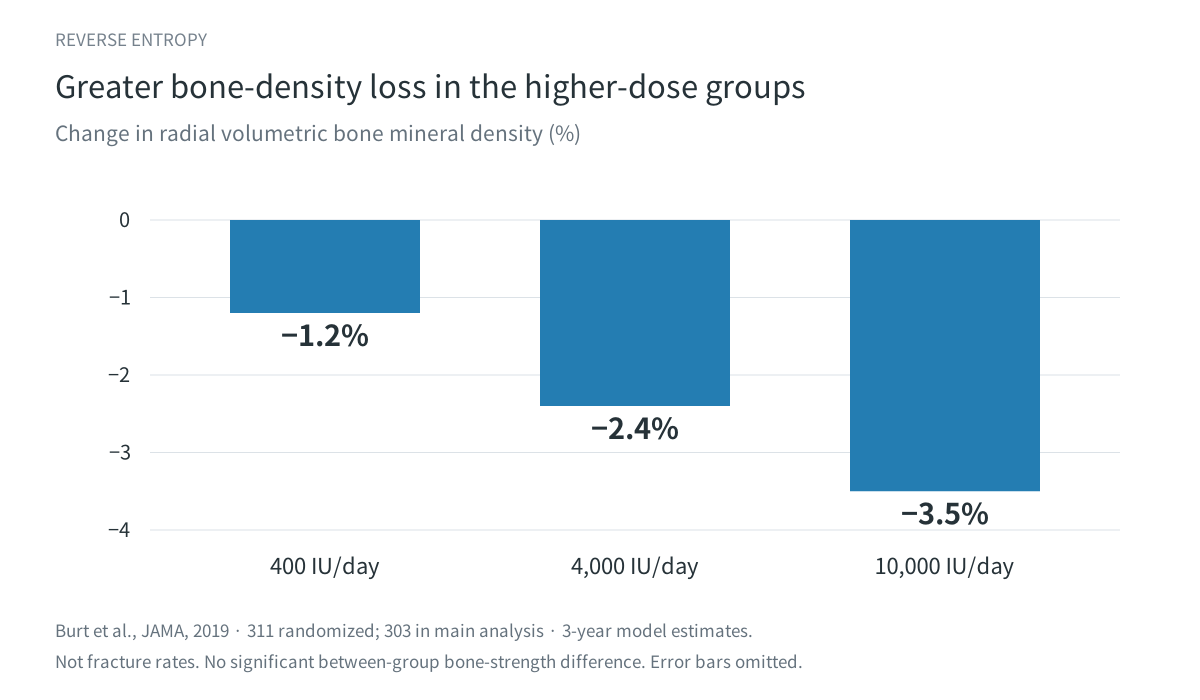
Model estimates of the three-year change in radial volumetric bone mineral density. There were 311 randomized participants and 303 in the primary analysis. These are not increases in fracture rates, and between-group differences in estimated bone strength were not significant. Error ranges are not shown.
Source: Burt LA et al., JAMA, 2019. Visualization of reported percentage changes: Reverse Entropy. Image data source. The original was a user-provided, independently created chart; the data and meaning are retained in this localized version.
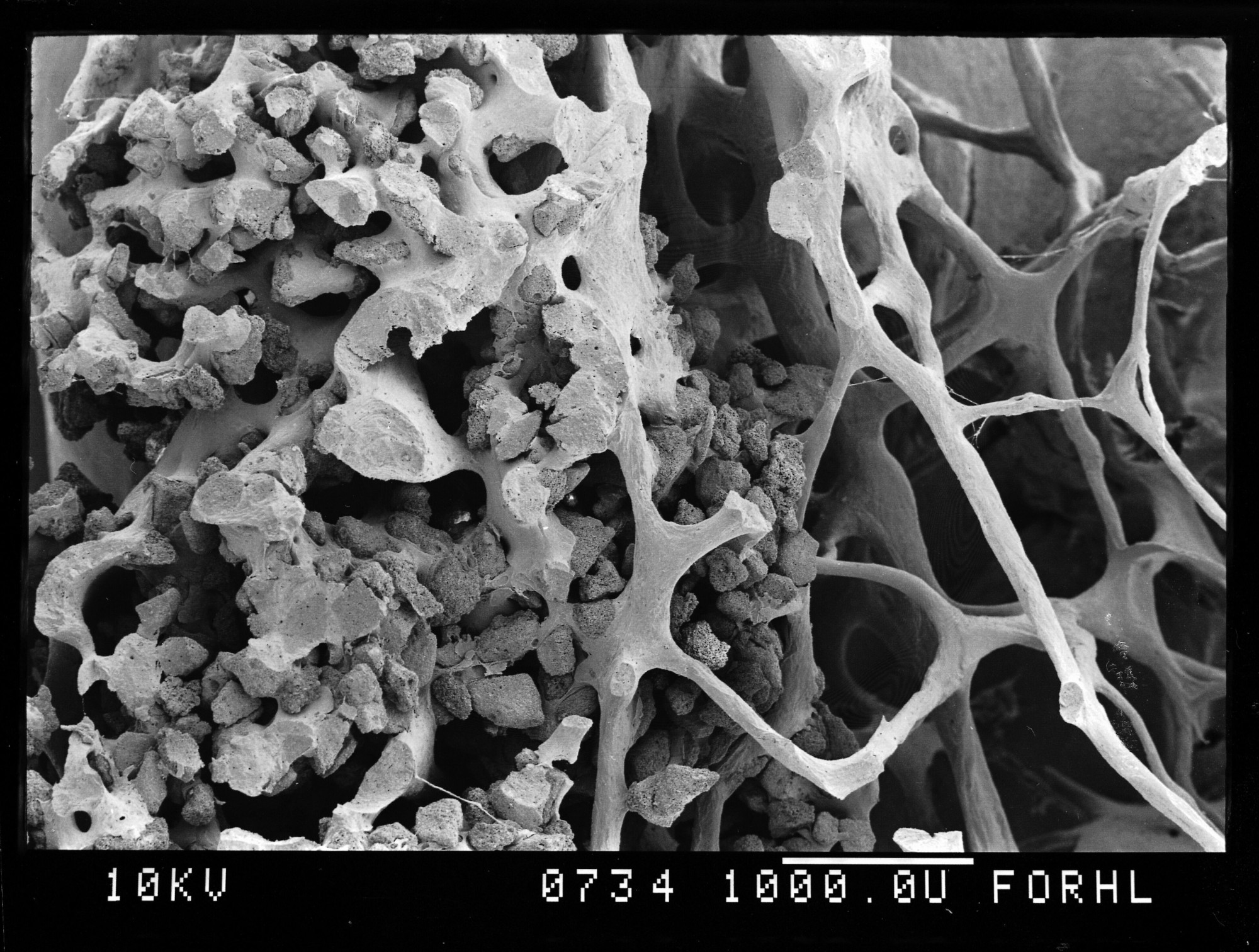
An actual scanning electron micrograph of osteoporotic bone, showing the three-dimensional structure inside the bone. It is neither a comparison with normal bone nor a before-and-after image of vitamin D use. The original scale bar has been retained.
Source: David Gregory & Debbie Marshall, SEM of osteoporotic bone, Wellcome Collection. Reproduced without alteration. Original image · CC BY 4.0 license
In my own care, a high number is not the goal
Personally, I use vitamin D injections based on my blood-test results and aim to stay near the lower boundary of the normal range. That is my choice not to pursue unnecessarily high levels.
For reference, here is my own blood-test result.
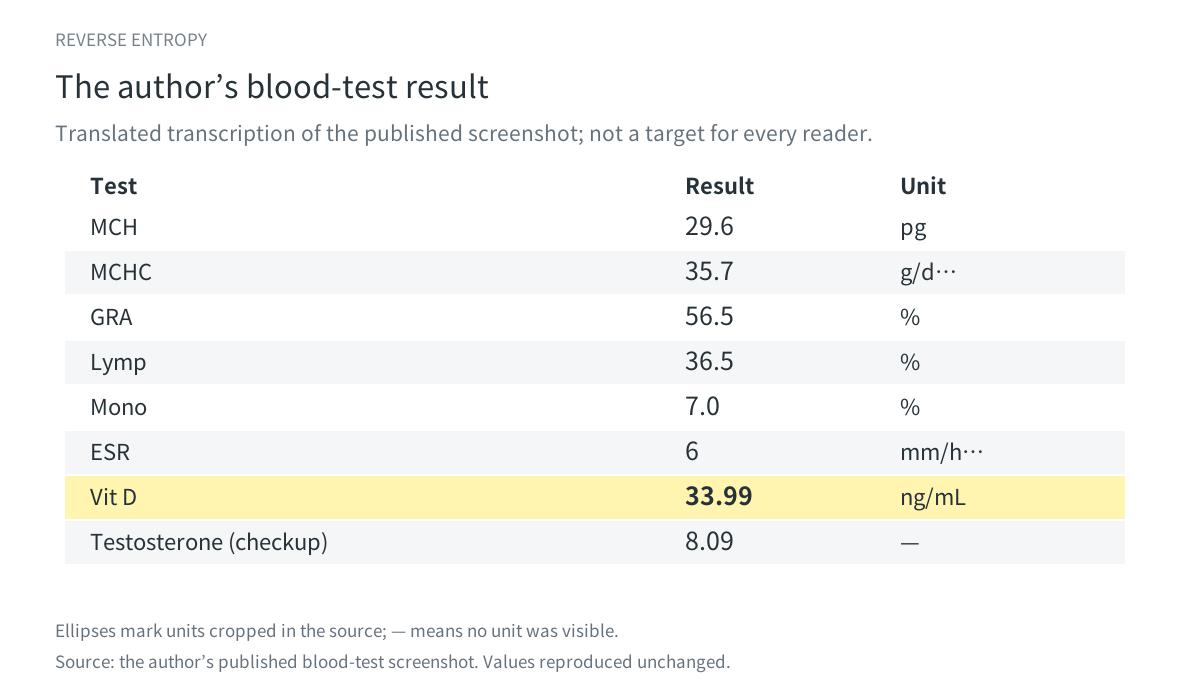
I am not presenting this as a target level or administration method for every reader.
The Endocrine Society’s 2024 guideline also does not recommend routine vitamin D testing in healthy adults without a separate indication, or repeated testing and dose adjustment to reach a target level. Clinical trials have not established the best blood concentration for disease prevention. Official guideline
At the same time, the guideline suggests supplementation for certain groups, including adults aged 75 or older. Identifying people who need supplementation is different from raising everyone’s levels.
What should we check for bone health?
If you have been prescribed vitamin D to treat deficiency or a specific condition, the VITAL findings alone are not a reason to stop treatment. If you take it for general health, it would be sensible to first check your reason for taking it and the total dose across products with overlapping ingredients.
For adults aged 50 or older who need supplementation or treatment, the Endocrine Society also favors daily lower doses over intermittent higher doses. The formulation and dosing interval should be considered separately in light of the individual’s condition and the purpose of treatment.
To be honest, a big reason I use injections is that taking a supplement every day is a bother. :)
When I consider bone health, I also look at muscle and movement, nutrition, fall risk and, when needed, osteoporosis treatment.
In other words, I want vitamin D to do its job without entrusting the entire plan to it.
Returning to the question at the start: vitamin D is essential for bone, but people who already have enough do not need to add more.
When I assess supplements and anti-aging treatments, the outcomes I want to see are staying active longer, getting injured less and living in good health. I want to read the numbers on a blood-test report in terms of how much they help those goals.
References
1. LeBoff MS, et al. Supplemental Vitamin D and Incident Fractures in Midlife and Older Adults. NEJM, 2022. Original paper
2. Chapuy MC, et al. Vitamin D3 and Calcium to Prevent Hip Fractures in Elderly Women. NEJM, 1992. Original paper
3. Burt LA, et al. Effect of High-Dose Vitamin D Supplementation on Volumetric Bone Density and Bone Strength: A Randomized Clinical Trial. JAMA, 2019. Original paper
4. Endocrine Society. Vitamin D for the Prevention of Disease. Clinical practice guideline, 2024. Official information
5. NIH Office of Dietary Supplements. Vitamin D — Health Professional Fact Sheet. Official information
#VitaminD #FracturePrevention #Osteoporosis #BoneHealth #Supplements #VitaminDTesting #AntiAging #Healthspan #ReverseEntropy